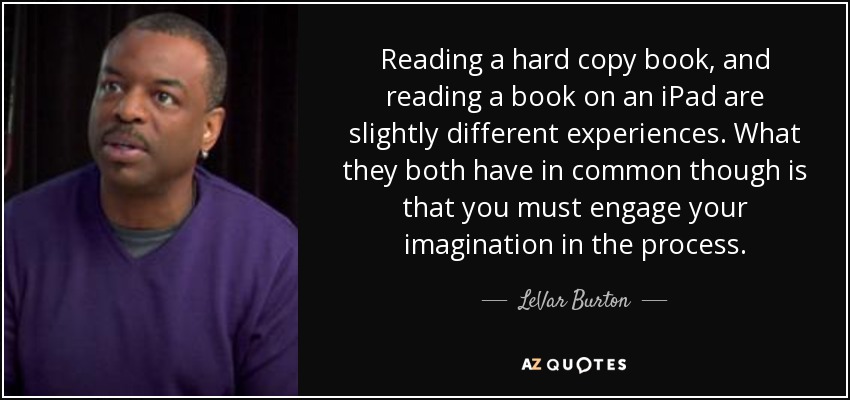
Reading a hard copy book, and reading a book on an iPad are slightly different experiences. What they both have in common though is that you must engage your imagination in the process.
The purpose of the headlines must be to convey a message to people who read headlines, then decide whether or not they will look at the copy.
The business of judging a headline AFTER you read the copy is wrong. It takes for granted that everybody reads the copy.
What good is all the painstaking work on copy if the headline isn't right? If the headline doesn't stop people, the copy might as well be written in Greek.
Instapaper does support paywall sites. I have a list of them, that when someone saves something it sends a copy of the page as they are viewing it only to them. If you subscribe to a paid site, you can save the content. I'm not really touching the money.
I'd rather do my own performance than copy someone else's.
I'm not big on reading business books. I get copies of all of them, because people want me to put a comment on the jacket. Every once in a while, I'll get interested and read one all the way through.
It was at a vividly bad time in Norman Mailer's life that I met him, and a sort of water-treading time in mine. He had stabbed his wife, and I was a copy boy at Time magazine.
Pedaling through the dark currents, I find an accurate copy. A blue print of the pleasure in me.
I managed to get my copy of Ulysses through safely this time. I rather wish I had never read it. It gives me an inferiority complex. When I read a book like that and then come back to my own work, I feel like a eunuch who has taken a course in voice production.
My father works for Xerox and fixes those gigantic copy machines that are about 10 feet wide.
I remember as a child I just would copy everyone else's handwriting, and now I have sort of a version of my sister's handwriting. And I feel like - sometimes I feel that way for my voice.
You know how some people will say to writers, "Why don't you just write a romance novel that sells a bunch of copies and then you'll have the money to do the kind of writing you want to do"? I always say that I don't have the skills or knowledge to do that. It would be just as hard for me to do that kind of writing as it would be to learn how to do any number of productive careers that I can't manage to make myself do.
A People Magazine article in 1982 referred to him as the late Abe Vigoda. The very-much-alive Vigoda placed an ad in Variety with him in a coffin holding a copy of People Magazine.
I grew up when comics were only sold in food markets and news stands, so the direct market is vital to me. The best way to make it stronger is if everybody buys my comics in multiple copies before they buy any others.
If you have a personality predisposed to liberalism, you might gravitate more to the artsy crowd or the anti-establishment crowd. And then those peers will affect you, and they will give you values, and you will copy them.
Basically, I've reached the point where I've lost any direct relationship to any of the editors I used to have. I suspect I'll have to pay to publish this myself, and I think a lot about about putting out fifty copies. I used to think about hogwash like my legacy and silly things like that. But I feel like if I never have another book out, I've done okay, I've had like twelve or thirteen little books, and I won't be upset about this on my death bed.
All the downloading of films and music make sense just being able to receive the energy, that way since everything is energy, but it's also cool to have hard copies too of pieces. So I'm sure it'll be both for a very long time until we transcend into etheric cities or something.
Look at Mann's reading habits, his explicit comments on Nietzsche, and his copy of Birth of Tragedy, and it starts to seem doubtful that this work of Nietzsche's played much role in the gestation of the novella.
At one point I took a copy of Berkeley's Principles from my father's library. That was the first philosophy book I read. I found it fascinating and wanted to read more philosophy.
In a bureaucracy, they shoot the bull, pass the buck, and make seven copies of everything.
But once an original book has been written - and no more than one or two appear in a century - men of letters imitate it, in other words, they copy it so that hundreds of thousands of books are published on exactly the same theme, with slightly different titles and modified phraseology. This should be able to be achieved by apes, who are essentially imitators, provided, of course, that they are able to make use of language.
We wanted to describe society from our left point of view. Per had written political books, but they'd only sold 300 copies. We realised that people read crime and through the stories we could show the reader that under the official image of welfare-state Sweden there was another layer of poverty, criminality and brutality.
Gone are the days when your indiscretions at university were recorded in a roneoed college newsletter of which there is only one copy left tucked in a filing cabinet at the back of a library. Today that same college newsletter is online, accessible by the whole world now and forever.
I really don't want to copy something to a great degree, but I love taking tiny ideas and putting them together.
Follow AzQuotes on Facebook, Twitter and Google+. Every day we present the best quotes! Improve yourself, find your inspiration, share with friends
or simply: