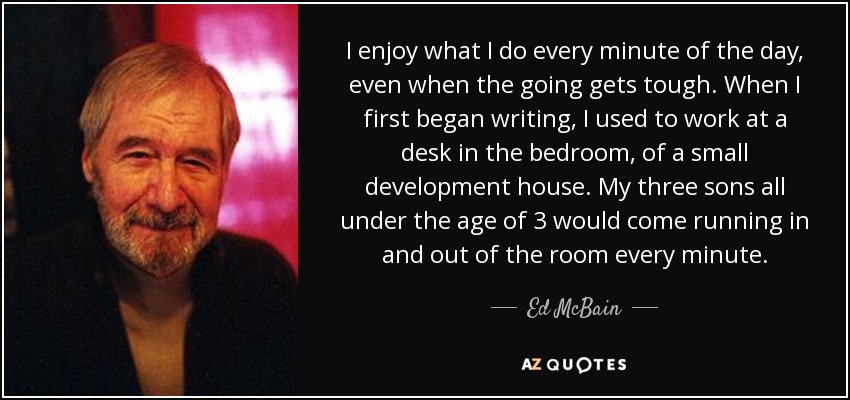
I enjoy what I do every minute of the day, even when the going gets tough. When I first began writing, I used to work at a desk in the bedroom, of a small development house. My three sons all under the age of 3 would come running in and out of the room every minute.
Many a forenoon have I stolen away, preferring to spend thus the most valued part of the day; for I was rich, if not in money, in sunny hours and summer days, and spent them lavishly; nor do I regret that I did not waste more of them in the workshop or the teacher's desk.
Age indomitably, in the European manner. Do not finish your labours young. Be a planet, not a meteor. Honor the working day. Sit at your desk.
Never put off until tomorrow what you can avoid altogether. A clean desk is a sign of a cluttered desk drawer. All you need in this life is ignorance and confidence, and then success is sure.
In fact, a very similar phrase was invented to account for the sudden transition of wood, metal, plastic and concrete into an explosive condition, which was "nonlinear, catastrophic structural exasperation," or to put it another way--as a junior cabinet minister did on television the following night in a phrase which was to haunt the rest of his career--the check-in desk had just got "fundamentally fed up with being where it was.
I went to art school... but I worked at the Museum of Modern Art. I worked in fundraising at the information membership desk. I ended up, over a period of time, doubling the amount of membership revenue that came in through people entering the museum, so people would ask me to come and work for them.
Insights don't usually arrive at my desk, but go into notebooks when I'm on the move. Or half-asleep.
'Show up at the desk' is one of the first rules of writing, but for 'Wolf Hall' I was about 30 years late.
If you get stuck, get away from your desk. Take a walk, take a bath, go to sleep, make a pie, draw, listen to music, meditate, exercise; whatever you do, don't just stick there scowling at the problem. But don't make telephone calls or go to a party; if you do, other people's words will pour in where your lost words should be.
I will never forget the bright September day, standing at my desk in the White House, when my young assistant said that a plane had hit the World Trade Center - and then a second one - and a third, the Pentagon.
I've always prided myself on my discipline as a writer. I do it like a job. I get up in the morning and go to my desk.
I can walk through a hotel lobby and watch people at the desk and see what they're doing. People don't look at me. They don't even know I'm there.
Starbucks was founded around the experience and the environment of their stores. Starbucks was about a space with comfortable chairs, lots of power outlets, tables and desks at which we could work and the option to spend as much time in their stores as we wanted without any pressure to buy. The coffee was incidental.
One of my great goals when I first started taking photographs or showing them publicly is that people might want one for over their desk. That's my goal.
In the third grade, a nun stuffed me in a garbage can under her desk because she said that's where I belonged. I also had the distinction of being the only altar boy knocked down by a priest during mass.
In the '50s and '60s, journalism wasn't a profession. It wasn't something you went to college for - it was really more of a trade. You had a lot of guys who came up working in newspapers at the copy desk, or delivery boys, and then they would somehow become reporters afterward and learn on the job.
Many aspects of the writing life have changed since I published my first book, in the 1960s. It is more corporate, more driven by profits and marketing, and generally less congenial - but my day is the same: get out of bed, procrastinate, sit down at my desk, try to write something.
As a producer, sitting on the other side of the desk, I have never once had an agent go out on a limb for his client and fight for him. I've never heard one say, 'No, just a minute! This is the actor you should use.' They will always say, 'You don't like him? I've got somebody else.' They're totally spineless.
My father was the editor of an agricultural magazine called 'The Southern Planter.' He didn't think of himself as a writer. He was a scientist, an agronomist, but I thought of him as a writer because I'd seen him working at his desk. I just assumed that I was going to do that, that I was going to be a writer.
Personal computers were created by some teenagers in garages because the, the wisdom of the computer industry was that people didn't want these little toys on their desk.
The vampire stared at me, his mouth slack as Ghastek assessed his options. I took a couple of forms from my desk, put them into the vamp's mouth, and pulled them up by their edges. "What are you doing?" Ghastek asked. "My hole puncher broke." "You have no respect for the undead.
He shook me, and despite it being one-handed, it made my teeth rattle. “If anything like that ever happens again. You. Leave. Me. Behind. Do you understand?” I would have argued, but I was feeling a little shocky for some reason. “I’m not good at abandoning people,” I finally said. A front-desk person scurried over, first-aid kit in hand, but Pritkin snarled at the poor guy and he quickly backed up a step. “Then get good at it!” He stomped off, limping, one shoulder hanging at an odd angle. “You’re welcome,” I murmured.
So much in writing depends on the superficiality of one's days. One may be preoccupied with shopping and income tax returns and chance conversations, but the stream of the unconscious continues to flow undisturbed, solving problems, planning ahead: one sits down sterile and dispirited at the desk, and suddenly the words come as though from the air: the situations that seemed blocked in a hopeless impasse move forward: the work has been done while one slept or shopped or talked with friends.
Of all human activities, writing is the one for which it is easiest to find excuses not to begin – the desk’s too big, the desk’s too small, there’s too much noise, there’s too much quiet, it’s too hot, too cold, too early, too late. I had learned over the years to ignore them all, and simply to start.
A friend came to visit James Joyce one day and found the great man sprawled across his writing desk in a posture of utter despair. James, what’s wrong?' the friend asked. 'Is it the work?' Joyce indicated assent without even raising his head to look at his friend. Of course it was the work; isn’t it always? How many words did you get today?' the friend pursued. Joyce (still in despair, still sprawled facedown on his desk): 'Seven.' Seven? But James… that’s good, at least for you.' Yes,' Joyce said, finally looking up. 'I suppose it is… but I don’t know what order they go in!
Follow AzQuotes on Facebook, Twitter and Google+. Every day we present the best quotes! Improve yourself, find your inspiration, share with friends
or simply: