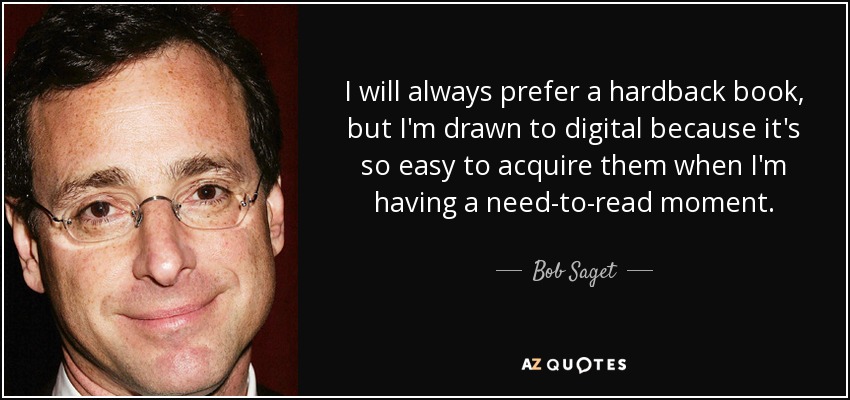
I will always prefer a hardback book, but I'm drawn to digital because it's so easy to acquire them when I'm having a need-to-read moment.
When people lose their jobs, they can either get another job or be entrepreneurs. In the music industry, a lot of people have attempted the latter by starting their own labels, but in the age of digital downloads, it's very difficult to succeed.
It's important that the disparities in the living conditions cannot be allowed in this digital period to be too marked. Each and every one must be given an opportunity to participate, which is why Germany's fate in many ways depends on the firmness of its alliance with NATO, with the European Union.
There's still value in a CD, even if it's just nostalgic. People are still willing to pay. But it can't compare to a digital-only release where you can control the exact time that it'll come out, you know what I mean? So whoever finds how to bridge that gap is gonna make a lot of money.
I think that human beings have gotten as far as we've gotten because of our adaptability, our ability to adapt, and our ability to dovetail our technologies - our brains to our tools. With the Industrial Revolution, we transcended the limits of our muscles. With the digital revolution, we transcend the limits of our minds.
I would say digital technology probably doesn't have much impact on us so far. We've seen photographs of people from when they are alive. We see home movies. We have videotapes now and e-mails. When it's going to get interesting is in massively multiplayer online games where you have avatars (online personas). You could actually create an avatar that's semi-autonomous. It could do things for you while you get off the game to run the rest of your life.
To be honest, everyone thinks that a digital camera is more reliable and every single time I work on any movie, it's just as many problems, the memory card doesn't work or blah blah blah, it overheats; it's the same volume as another camera. I think people are bit taken in by it.
Money is becoming increasingly plastic and digital. If there is a major disaster, let's say an asteroid strike, we'll go back to trading meats and furs. We won't need an abstraction, a dollar bill, but real tangible goods to survive.
The book has very specific qualities. Let's say in 2300 they discover the physical book, after having lived with the digital book for several hundred years. They'll be able to say, "Look at all the cool stuff you can have in a real book and how different it is." The differences are manifold.
The reason why Apple computers have worked so well over time is that, unlike Microsoft, they don't bend over backward to be compatible with every piece of hardware or software in the digital universe. To code or create for Apple, you follow Apple's rules. If you're even allowed to.
The acting style that has emerged from HD, because of the contrast and how sharp the picture is, it's more neutrally played. The main character is very minamalistic. That's what works in this digital age.
Most robotic vacuum cleaners don't see their environment, have little suction, and don't clean properly. They are gimmicks. We've been developing a unique 360 vision system that lets our robot see where it is, where it has been, and where it is yet to clean. Vision, combined with our high speed digital motor and cyclone technology, is the key to achieving a high performing robot vacuum - a genuine labor saving device.
Space has not changed but technology has, in many cases, improved dramatically. A good example is digital technology where today's cell phones are far more powerful than the computers on the Apollo Command Module and Lunar Module that we used to navigate to the moon and operate all the spacecraft control systems.
I put that in my management's hands and my company's hands. We sit down all together, the family, D-Block, my management and I go build with KOCH, the distributor. You open up your own sites, you get your MySpace, you get your websites and get your little digital team on the side... and that's how you handle that.
You just click and you get 18,000 screen shots on how to apply lipstick, for example, but there will be the same selection that has taken place in paper in digital, too.
I do know that people enjoy reading a comic book and saving it and collecting the comics. And sharing them and trading them with friends. That may be something you can't do as easily with digital comics.
We love the flexibility that print and digital formats give us, and diving deep on a print feature can be one step in a longer project that generates a lot of digital stories.
My goal is to create a sustainable long-term business that, we're committed to print, we're rooted in print, but we're expanding into digital and into modernizing the way we sell to customers through e-commerce and things like that. And it requires different skill sets; it requires different ways of doing business.
I question the premise that digital is necessarily the enemy of traditional media. In many ways, it presents us with enormous opportunities.
In a digital world, there are numerous technologies that we are attached to that create infinite interruption.
As human beings, we are the only organisms that create for the sheer stupid pleasure of doing so. Whether it's laying out a garden, composing a new tune on the piano, writing a bit of poetry, manipulating a digital photo, redecorating a room, or inventing a new chili recipe - we are happiest when we are creating.
I'm not into digital marketing, downloading, or streaming - I've always been a man of the theaters.
Advertising is the life blood of the digital economy.
Because we do not understand the brain very well we are constantly tempted to use the latest technology as a model for trying to understand it. In my childhood we were always assured that the brain was a telephone switchboard...Sherrington, the great British neuroscientist, thought the brain worked like a telegraph system. Freud often compared the brain to hydraulic and electromagnetic systems. Leibniz compared it to a mill...At present, obviously, the metaphor is the digital computer.
It's pretty incredible to look back 30 years to when Microsoft was starting and realize how work has been transformed. We're finally getting close to what I call the digital workstyle.
Follow AzQuotes on Facebook, Twitter and Google+. Every day we present the best quotes! Improve yourself, find your inspiration, share with friends
or simply: