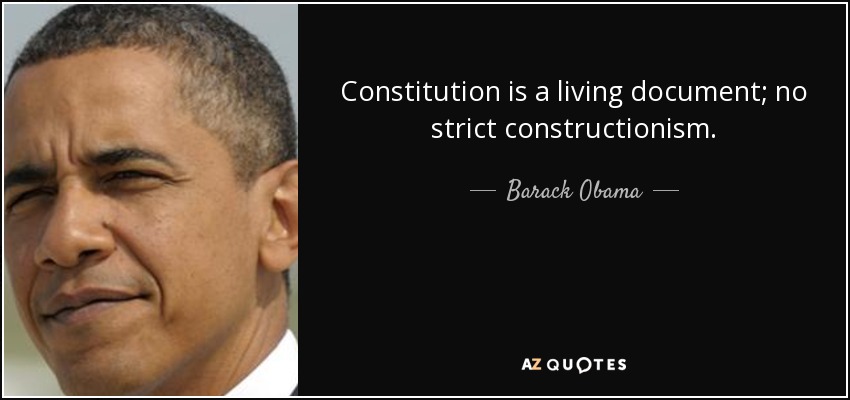
Constitution is a living document; no strict constructionism.
When your child has matured sufficiently to understand how the judicial system works, set a bedtime for him and then send him to bed an hour early. When he tearfully accuses you of breaking the rules, explain that you made the rules and you can interpret them in any way that seems appropriate to you, according to changing conditions. This will prepare him for the Supreme Court's concept of the US Constitution as a 'living document'.
Some may more quietly commemorate the suffering, struggle, and sacrifice that has triumphed over much of what was wrong with the original document, and observe the anniversary with hopes not realized and promises not fulfilled. I plan to celebrate the bicentennial of the Constitution as a living document, including the Bill of Rights and the other amendments protecting individual freedoms and human rights.
Saying the Constitution is a living document is the same as saying we don't have a Constitution.
That's the argument of flexibility and it goes something like this: The Constitution is over 200 years old and societies change. It has to change with society, like a living organism, or it will become brittle and break. But you would have to be an idiot to believe that. The Constitution is not a living organism; it is a legal document. It says something and doesn't say other things.
The Constitution of the United States has been mentioned...as the basis of wise decisions in fundamental principles as applied to all matters pertaining to law and order, because it was framed by men whom God raised up for this very purpose. But in addition to that inspired document, we must always keep in mind that the greatest weapons that can be forged against any false philosophy are the positive teachings of the gospel of Jesus Christ.
The two most important documents affecting the destiny of America are the Declaration of Independence and the Constitution of the United States. Both these immortal papers relate primarily to the freedom of the individual.
Until the 1930s, the Constitution served as a major constraint on federal economic interventionism. The government's powers were understood to be just as the framers intended: few and explicitly enumerated in our founding document and its amendments. Search the Constitution as long as you like, and you will find no specific authority conveyed for the government to spend money on global-warming research, urban mass transit, food stamps, unemployment insurance, Medicaid, or countless other items in the stimulus package and, even without it, in the regular federal budget.
In late 2011 there is an internal document called the Libya Tick Tock that was produced for Hillary Clinton, and it's the chronological description of how she was the central figure in the destruction of the Libyan state, which resulted in around 40,000 deaths within Libya; jihadists moved in, ISIS moved in, leading to the European refugee and migrant crisis.
We have published about 800,000 documents of various kinds that relate to Russia. Most of those are critical; and a great many books have come out of our publications about Russia, most of which are critical.
Our [Russia]documents have gone on to be used in quite a number of court cases: refugee cases of people fleeing some kind of claimed political persecution in Russia, which they use our documents to back up.
There were over 40,000 pages of FBI documents of which only about half are currently available to scholars and researchers. I think that this 40th anniversary of the assassination is a good opportunity for us to say that now is the time to declassify all FBI material on Malcolm X. There really is a need for us to challenge the US government for its refusal to open up its own archives 40 years after the death of Malcolm.
I took pictures of the objects and artifacts that Patti [Smith] would show to her friends because I wanted to document them.
A simple MS Word document, or a Powerpoint presentation, has its limits, particularly the unpredictability in how the page will actually display. With a PDF, you are locking down all those variables.
When I wrote about the Spanish Civil War many years later, I used documents that I picked up when I was a child, as a lot hadn't been published (a lot more resources are available now).
We [with Shindzo Abe] should understand that the results of that terrible tragedy of the 20th century, namely World War II, are enshrined in corresponding international documents, and finding a way to settle all disputes without destroying the entire foundation of international law that evolved as a result of World War II is a highly delicate task. Therefore, I would like to reiterate that we cannot second-guess the course, let alone the outcome of our negotiations.
There is progress in the sense that the Prime Minister [Shinzō Abe] has proposed, outlined, as it were, directions for movement toward a peace treaty and the resolution of issues related to territorial problems. Now, what did he propose? He proposed promoting an environment of trust and cooperation. I believe it is even hard to imagine that it can be any different, that we can agree to sign the documents that we are talking about without trusting each other or without cooperation. That is simply impossible even to imagine.
If I listen to a campaign promises, I would expect that on the first day [Donald Trump] would cancel all of the DACA documents out there that President [Barack] Obama unconstitutionally issued.
1975 is as much a historical document as 1803.
Ultimately it's a snowboarding film [Fourth Phase], of course, so the main thing that we wanted to celebrate was how awesome snowboarding is! Secondly, we wanted to celebrate the environment that we all shape our lives around. So the film documents myself and other like-minded individuals attempting to follow the hydrological cycles that shape the worlds we've committed our lives to.
I feel concerned by what happens in the world.... I don't want to merely document; I want to know why a certain thing disturbs or attracts me and how a situation can affect the person involved.
If a director takes the time to document - to step back to observe - I think it I more honest. Because it has to be the public that makes the conclusions and who, possibly, resolves the situation.
As editor of WikiLeaks, I am very proud of three things. Number one, we have never got it wrong in terms of what we say. A document is what it is. Number two, we have never revealed one of our sources ever. Number three, what are we proud of? We are proud that there is not a single instance of anyone coming into physical harm as a result of our publication.
What's important to me is that [photographs] have the appearance of being documents of what goes on. I like the illusion of veracity, that they look like life rather than movie stills. I don't want them to look fabricated.
Hillary Clinton ripped FBI Director Louis Freeh on Wednesday. She said she can't understand how FBI documents could vanish and then mysteriously reappear. She has to say that or she'd be thrown out of the Magician's Society.
Follow AzQuotes on Facebook, Twitter and Google+. Every day we present the best quotes! Improve yourself, find your inspiration, share with friends
or simply: