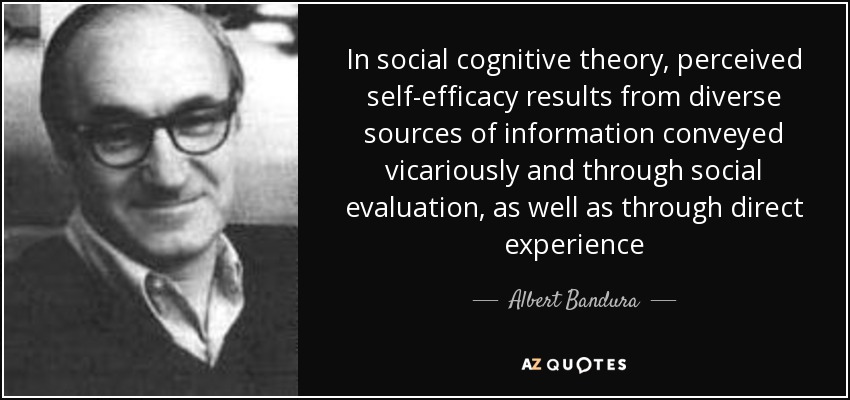
In social cognitive theory, perceived self-efficacy results from diverse sources of information conveyed vicariously and through social evaluation, as well as through direct experience
It is no more informative to speak of self-efficacy in global terms than to speak of nonspecific social behavior
In any given instance, behavior can be predicted best by considering both self-efficacy and outcome beliefs . . . different patterns of self-efficacy and outcome beliefs are likely to produce different psychological effects
The effects of outcome expectancies on performance motivation are partly governed by self-beliefs of efficacy
Expected outcomes contribute to motivation independently of self-efficacy beliefs when outcomes are not completely controlled by quality of performance. This occurs when extraneous factors also affect outcomes, or outcomes are socially tied to a minimum level of performance so that some variations in quality of performance above and below the standard do not produce differential outcomes
Perceived self-efficacy also shapes causal thinking. In seeking solutions to difficult problems, those who perceived themselves as highly efficacious are inclined to attribute their failures to insufficient effort, whereas those of comparable skills but lower perceived self-efficacy ascribe their failures to deficient ability
[Attributional] factors serve as conveyors of efficacy information that influence performance largely through their intervening effects on self-percepts of efficacy
People infer high self-efficacy from successes achieved through minimal effort on difficult tasks, but they infer low self-efficacy if they had to work hard under favorable conditions to master relatively easy tasks
Perceived self-efficacy influences the types of causal attributions people make for their performances
Self efficacious children tend to attribute their successes to ability, but ability attributions affect performance indirectly through perceived self-efficacy
Perceived self-efficacy and beliefs about the locus of outcome causality must be distinguished
In order to deal with reality successfully - to pursue and achieve the values which his life requires - man needs self-esteem; he needs to be confident of his efficacy and worth.
A laudation in Greek is of marvellous efficacy on the title-page of a book.
He who attempts to make others believe in means which he himself despises is a puffer; he who makes use of more means than he knows to be necessary is a quack; and he who ascribes to those means a greater efficacy than his own experience warrants is an impostor.
If we do not believe in ourselves- neither in our efficacy nor in our goodness- the universe is a frightening place.
Behavior must also be adequately assessed under appropriate circumstances. Ill-defined global measures of perceived self-efficacy or defective assessments of performance will yield discordances. Disparities will also arise when efficacy is judged for performances in actual situations but performance is measured in simulated situations that are easier to deal with than the actualities
I'm drawn to the magical efficacies of language as a political act.
To the best of my knowledge, every acute inpatient ward offers some inpatient group therapy experience. Indeed, the evidence supporting the efficacy of group therapy, and the prevailing sentiment of the mental health profession, are sufficiently strong that it would be difficult to defend the adequacy of the inpatient unit that attempted to operate without a small group program.
[Martin] Luther did not regard the water in baptism as common water, but as a water which had become, through the Word with its inherent divine power, a gracious water of life, a washing of regeneration. Through this divine efficacy of the Word the sacrament effects regeneration.
The efficacy of religion lies precisely in what is not rational, philosophic, nor eternal; its efficacy lies in the unforeseen, the miraculous, the extraordinary. Thus religion attracts more devotion according as it demands more faith - that is to say, as it becomes more incredible to the profane mind.
Proclaim a theology of divine righteousness which demands justice, respect, tolerance, compassion, inclusiveness, trust in the ultimate efficacy of divine zeal, and the rigorous pursuit of peace in the midst of competing interests and faith claims.
God, once imagined to be an omnipresent force throughout the whole world of nature and man. has been increasingly tending to seem omniabsent. Everywhere, intelligent and educated people rely more and more on purely secular and scientific techniques for the solution of their problems. As science advances, belief in divine miracles and the efficacy of prayer becomes fainter and fainter.
Surely our clergy need not be surprised at the daily increasing distrust in the public mind of the efficacy of prayer.
However inadequate our ideas of causal efficacy may be, we are less wide of the mark when we say that our ideas and feelings have it, than the Automatists are when they say they haven't it. As in the night all cats are gray, so in the darkness of metaphysical criticism all causes are obscure. But one has no right to pull the pall over the psychic half of the subject only . . . whilst in the same breath one dogmatizes about material causation as if Hume, Kant, and Lotze had never been born.
Regression analyses show that self-efficacy contributes to achievement behavior beyond the effects of cognitive skills
Follow AzQuotes on Facebook, Twitter and Google+. Every day we present the best quotes! Improve yourself, find your inspiration, share with friends
or simply: