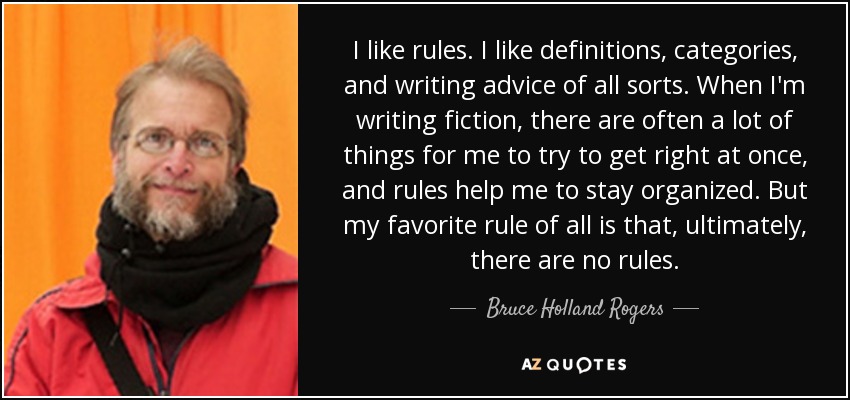
I like rules. I like definitions, categories, and writing advice of all sorts. When I'm writing fiction, there are often a lot of things for me to try to get right at once, and rules help me to stay organized. But my favorite rule of all is that, ultimately, there are no rules.
fiction is not only the historian of life but its apologist.
The trouble with lies was that once started, the fiction had to be continued, and it was hard always to be remembering details that you had made up upon the spur of the moment.
To my way of thinking and working, the greatest service a piece of fiction can do any reader is to force him to lay it down with a higher ideal of life than he had when he took it up.
Nobodys life is as romantic as it is in fiction.
If we truly seek diversity in fiction, we have to let the needs of others come before our need to define ourselves as social justice allies.
Farscape is not what you call hard science fiction.
If you look at the best-seller list for American fiction, they're all sequels to detective stories or stories about hunting serial killers. That's what's called American fiction these days.
I like science fiction and physics, things like that. Planets being sucked into black holes, and the various vortexes that create possibility, and what happens on the other side of the black hole. To me it's the microcosmic study of the macrocosmic universe in man, and that's why I'm attracted to it.
Every novel is a debtor to Homer.
You can never properly predict the future as it really turns out. So you are doing something a little different when you write science fiction. You are trying to take a different perspective on now.
I can remember when Pulp Fiction came out. I was, like, 10 years old. But I remember the impact that it had.
I'm not opposed to doing science fiction or comedy, but there has to be respect. I refuse to be the joke, the fat woman joke, in any movie. I've turned down roles.
I believe that reality TV should be called 'not reality' TV; it's fiction.
The most underrated of all contemporary American writers of fiction.
They have an amazing proliferation of TV channels now: The all-cartoon channel, the 24-hour-science fiction channel. Of course, to make room for these they got rid of the Literacy Channel and the What's Left of Civilization Channel.
We are tired of the pretense that we have special privileges and the reality that we have none; of the fiction that we are queens, and the fact that we are subjects.
I was obsessed with movies when I was younger. During the summer, I would go by myself to a theater down the street from my house. I saw every comedy or science fiction movie that came out. My kids love going to the movies, but 3D scares them.
I don't read much fiction because I already read a lot of scripts, so I want to learn about the world.
To be honest, Im not that much of a reader of Korean fiction, since so little is translated.
After all, that's why we read historical fiction-to be transported to another time, and to be astonished at ancient people's lives and traditions, just as they would probably be astonished at ours.
Teen fiction should be about teenagers - no matter how many arguments there are about what YA lit should be, this seems like the one thing we can all agree on.
A lot of comic conventions go way beyond comic books and include other parts of pop culture, like celebrities and science fiction and movies and books. So I go to them either as a celebrity, or as a fan, because I'm a big sci-fi geek.
Do I do as false prophets do and puff air into simulacra? Am I a Sorcerer--like Macbeth's witches--mixing truth and lies in incandescent shapes? Or am I a kind of very minor scribe of a prophetic Book--telling such truth as in me lies, with aid of such fiction as I acknowledge mine, as Prospero acknowledged Caliban.
Sometimes I - I try not to read too many fiction or novels.
Follow AzQuotes on Facebook, Twitter and Google+. Every day we present the best quotes! Improve yourself, find your inspiration, share with friends
or simply: