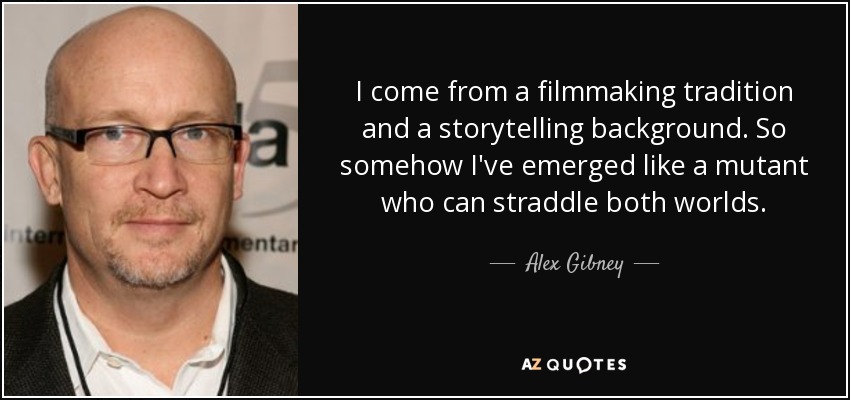
I come from a filmmaking tradition and a storytelling background. So somehow I've emerged like a mutant who can straddle both worlds.
Our film [Hide and seek ]was created as part of the Asian American Film Lab's 11th 72 Hour Film Shootout filmmaking competition, where filmmaking teams have just 72 hours to conceive, write, shoot, edit and submit a film based on a common theme. The winners were announced during the 38th Asian American International Film Festival in New York last July. The theme for 2015 was 'Two Faces' and was part of a larger more general theme of 'Beauty'.
I find filmmaking to be a super lonely, alienating experience.
Trying to find the story within the story was hard. Filmmaking is such a reductive process in a strange way and you keep whittling away to what is essential.
Everybody is completely different. I think there is no formula for filmmaking. Everybody finds their own way of doing things.
Whole class of filmmakers, they're all graduating to a new level of filmmaking, which I think is awesome.
Leni Riefenstahl was the one person Goebbels had no control over in the filmmaking community of Nazi Germany, and they despised each other. But because she was Hitler's favorite, she could do what she wanted. She was the only filmmaker that did not have to cow down to Joseph Goebbels.
It's been reinforced to me, and it's a little cliche, but I've learned that you can't make a movie that even works, much less that's good, without really good writing and really good acting. That lesson has led me to not be distracted, so much, by the other stuff going on in filmmaking and to focus on the essence of a story, and the words and the events and the way that those are interpreted by the actors. That philosophy has taken me to a place that I really like.
I think I have a real interest in filmmaking, and it's nice when I can go and do that sometimes. Then it's also great to not do it and not have the responsibility .
That's what I love about documentary filmmaking, we never know where the story is going, we don't know what is going to happen next, and we're inside a culture of people that you have to figure out in many ways. It's a relationship between what you thought might have been the story, and what happens in the 'field.'
I was mentioning with the digital camera, maybe this new fashion of filmmaking gives a closer look of what life may be like. But it's still nothing but a copy.
I wasn't searching for a common denominator - I started wondering about the challenge of working in other cultures. What I reached was the sudden acknowledgment of the universal aspect of filmmaking.
There's a very interesting article or symposium to be written on just the real difference between comedy filmmaking and non-comedy. Because, you know, when you work in comedy, you depend on audience screenings to tell you about your movie.
I intend more of a kinship with silent films than more modern film. I like the old cinema. My films are more of a hybrid - a different style of filmmaking to what I call talking head movies. Some people don't get it. Especially the more academic types.
The excitement about independent filmmaking is that they're a little more open to taking chances. The studios are a little more careful, as far as who they choose for their film and what they're known for and staying in the genre because they know what works.
I think, as a filmmaker, my style of filmmaking is very well-suited to 3-D anyway, so it's not like I'm having to change a huge amount of the way I shoot to work in 3-D. I think you could probably dimensionalize some of my movies and they would make very good 3-D films.
It's just the overall lack of privacy. I've always been a very shy person and so it invades that a lot. It goes with the territory so I'm very grateful to be able to do what I do. I love it and I love acting. I love being on set. I love the whole practice of filmmaking but the lack of privacy is hard. Fans are amazing because for the most part it's just love that they are sending to you. It's beautiful.
When I started making films I just decided "I'm the filmmaking equivalent of a garage band and I'll just make my garage band movies." But even the same musicians from garage bands would go to my movies and you could tell what they liked from the way that they dressed and they would be the first ones to walk out.
Filmmaking is something I have to do. It's not something I particularly want to do.
In polite society, there is such a thing as sensitivity to some issues, as time has gone on. There was a time when we weren't politically correct, at all, and we all wince at moments when we look to the past and see that. I don't really know what the answer is, as far as that is concerned. However, me, as an artist, I don't really think about it, at all. It actually is not my job to think about that, especially in terms of me, as a writer, but also as a filmmaker. I'm not worried about the filmmaking part because, if I'm writing it, that's what I'm going to do.
The "If you build it, they will come" approach to filmmaking has always been helpful to me.
I sort of plunged into filmmaking. I decided I'd jump off the deep end, so I started thinking about what kind of a movie I should try to make.
They [academy writing programs] have no concept that the world has changed, that publishing has changed, that filmmaking has changed, and if you're not constantly looking at your education model and adjusting for the change, you'll find yourself teaching antiquity. Like all of these programs that won't accept students who are writing genre fiction - what an institutional ego!
To be in a movie directed by Wolfgang Petersen, and a movie that had a large budget... I got a taste of what really good filmmaking could be.
Documentary filmmaking has all the challenges and hardships of narrative filmmaking without any of the infrastructure or support. That's both a blessing and a curse.
Follow AzQuotes on Facebook, Twitter and Google+. Every day we present the best quotes! Improve yourself, find your inspiration, share with friends
or simply: