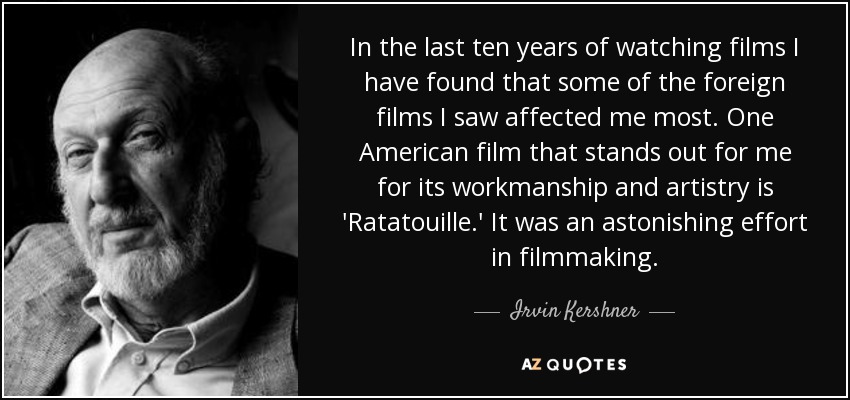
In the last ten years of watching films I have found that some of the foreign films I saw affected me most. One American film that stands out for me for its workmanship and artistry is 'Ratatouille.' It was an astonishing effort in filmmaking.
I discovered shooting and filmmaking around the time all of the software became affordable to anyone with a PC.
I think if you look at Sam Raimi and Jim Cameron, those guys know things about filmmaking that almost nobody knows anymore. They are students of film from when they handmade films themselves, you know cut films with their own hands and razor blades and tape.
When I first moved from photography to filmmaking, I was worried about how big I had to become. I was one person, or maybe me and an assistant, and I had these small cameras, and maybe a flash.
Jaws' was the definitive filmmaking turning point for me. It came out in the summer of '75 and I saw it an obsessive 55 times. They even ran a very embarrassing article about me in the local paper, about the weird kid who's seen 'Jaws' 55 times.
I learned very quickly that the hard thing in life is to make good films. Technically, filmmaking is the camera and the actor telling the story and that's what I'm more interested in doing.
People may be surprised at how hard and difficult filmmaking can be, having the creativity and the technical aspects together is very hard to do.
I suppose once in a while, a filmmaker makes a movie that's more than just a sum of its parts, more than good acting or good filmmaking. It's something else that has nothing to do with what you've done. This is in 1999, made by people in 1999 for people in 1999 about people in 1999.
A long-playing full shot is what always separates the men from the boys. Anybody can make movies with a pair of scissors and a two-inch lens.
I usually get involved in the interviews about the animators and the filmmaking in general, because I had a chance. I got to know, not only Marc Davis, but Frank Thomas, Artie Johnson, Ward Kimball, all these great animators, and just ask them all these questions about how they did certain things, what their trials and errors were, the ups and downs.
You never know what you have until you put it in front of an audience. That's the truth. That's the truth of filmmaking and that's why you make movies, for an audience to, hopefully, enjoy it.
Having been an actor, I always want to leave room for the actors to find their comfort zone, so I don't like to be too rigid in how I plan my shots. It's different if you have weeks to rehearse and you can rehearse on your sets or in your locations and you can plan that out with your actors, but in modern independent filmmaking, you don't really have that time. You have to have a certain level of improvisation.
There is a whole separate filmmaking team that's doing it, but that's part of what's great about the Brain Trust and about the inspiring leadership of John Lasseter. He leaves it up to that creative group of individuals to help each other elevate each thing that they're working on to only try to make it better and to share what you've learned on the first one.
You can't turn up at college in stilettos and say you're gonna be a filmmaker. In the college, they were teaching me avant-garde filmmaking, where I had to make films that were, like, an hour long about nothing. I just refused to do it.
Mostly it's like, I get inspired by something and I want to learn that part of filmmaking, I want to delve into that kind of depth. And leading, also, a lot of people. A lot of people, for two years of their life they follow me, and they believe what I believe in. So that's some responsibility and I'd like to make it worth the effort.
I like racing. I love the speed and I'm a very kinetic person in terms of filmmaking. I love the movement of film more than anything else.
I intend more of a kinship with silent films than more modern film. I like the old cinema. My films are more of a hybrid - a different style of filmmaking to what I call talking head movies. Some people don't get it. Especially the more academic types.
There's a very interesting article or symposium to be written on just the real difference between comedy filmmaking and non-comedy. Because, you know, when you work in comedy, you depend on audience screenings to tell you about your movie.
I think, as a filmmaker, my style of filmmaking is very well-suited to 3-D anyway, so it's not like I'm having to change a huge amount of the way I shoot to work in 3-D. I think you could probably dimensionalize some of my movies and they would make very good 3-D films.
It's just the overall lack of privacy. I've always been a very shy person and so it invades that a lot. It goes with the territory so I'm very grateful to be able to do what I do. I love it and I love acting. I love being on set. I love the whole practice of filmmaking but the lack of privacy is hard. Fans are amazing because for the most part it's just love that they are sending to you. It's beautiful.
When I started making films I just decided "I'm the filmmaking equivalent of a garage band and I'll just make my garage band movies." But even the same musicians from garage bands would go to my movies and you could tell what they liked from the way that they dressed and they would be the first ones to walk out.
Filmmaking is something I have to do. It's not something I particularly want to do.
In polite society, there is such a thing as sensitivity to some issues, as time has gone on. There was a time when we weren't politically correct, at all, and we all wince at moments when we look to the past and see that. I don't really know what the answer is, as far as that is concerned. However, me, as an artist, I don't really think about it, at all. It actually is not my job to think about that, especially in terms of me, as a writer, but also as a filmmaker. I'm not worried about the filmmaking part because, if I'm writing it, that's what I'm going to do.
They [academy writing programs] have no concept that the world has changed, that publishing has changed, that filmmaking has changed, and if you're not constantly looking at your education model and adjusting for the change, you'll find yourself teaching antiquity. Like all of these programs that won't accept students who are writing genre fiction - what an institutional ego!
I'm always happy when I learn more about communication in the wide free scope of that word. So next is a move, getting the film made and working on more music everyday which is equally large in my being as filmmaking.
Follow AzQuotes on Facebook, Twitter and Google+. Every day we present the best quotes! Improve yourself, find your inspiration, share with friends
or simply: