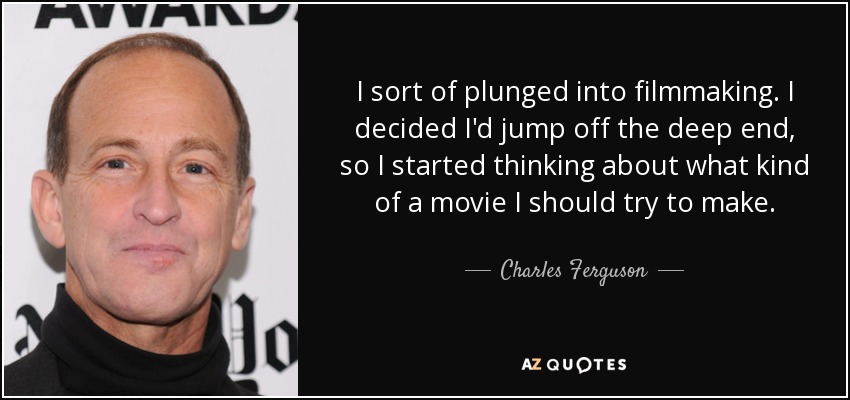
I sort of plunged into filmmaking. I decided I'd jump off the deep end, so I started thinking about what kind of a movie I should try to make.
I thought I should try something relatively inexpensive, relatively contained, relatively small. I started working on a feature, a film I'd still like to make: a very talky film of people and ideas about our contemporary state with regard to relationships, marriage, sex, and romance. I started trying to educate myself about filmmaking.
All directors make films in individual ways. But the classical kind of view of filmmaking is that you have a script and it's very linear.
And the best films feel like a fist punching you in the solar plexus and all elements of the filmmaking process - the acting, the design, the cinematography, the music, is all working to one end.
I really like Jason Blum a lot. We're friends, and while we make wildly disparate films, we share a philosophy about low-budget filmmaking, about taking chances on young filmmaking, taking risks and obliterating our salary so we can make something cheaply and if it wins everyone wins big.
I work almost completely year-round, since I was 18 or 19. It's nine months a year, and then you're out of town, (there are) crazy hours and all of the things that go with filmmaking, which is a pretty all-consuming business, although I'm very blessed to be a part of it.
I think people like Lena Dunham really opened up the door to what was possible, and they've inspired young women to go into filmmaking and writing and directing and acting in a way that maybe they didn't before, because now there is a path and there are jobs.
To be animating at the same time, it's the ultimate freedom in filmmaking because you can literally put anything on the screen that you can imagine.
I come from a filmmaking tradition and a storytelling background. So somehow I've emerged like a mutant who can straddle both worlds.
I was aware of the possible biases you could get as a commercial director, like being too concerned about the technical aspects of the form rather than anything of substance. If you keep working in commercials, you can get trapped in a very superficial way of thinking. I always used commercials as an exercise for filmmaking, like going to the gym.
Our film [Hide and seek ]was created as part of the Asian American Film Lab's 11th 72 Hour Film Shootout filmmaking competition, where filmmaking teams have just 72 hours to conceive, write, shoot, edit and submit a film based on a common theme. The winners were announced during the 38th Asian American International Film Festival in New York last July. The theme for 2015 was 'Two Faces' and was part of a larger more general theme of 'Beauty'.
I find filmmaking to be a super lonely, alienating experience.
Trying to find the story within the story was hard. Filmmaking is such a reductive process in a strange way and you keep whittling away to what is essential.
My favorite part of the whole filmmaking process is working with a fantastic cinematographer, a fantastic actor or actors, and then just creating emotions and stories. I get so excited by that. That's the part I'm utterly addicted to.
I get rejections from the New Yorker. When I had to give a little talk to the people graduating from the MBA program at Columbia who were going into writing and filmmaking and everything, I said, "When I tried to think of what to say, the only subject I thought was appropriate for people doing what you're going to do is rejection." That's what it's all about.
It's difficult to find new solicitations, new expressions. But this is talking about filmmaking. Cinema.
That's the magic of filmmaking, to draw the audience into an exotic world and keep them there and keep the suspense.
Making music has been connected to one of my greatest heartaches, because my own music has never quite connected with audiences. But it was this heartache that pushed me to explore other artistic avenues, like writing and filmmaking, and I ultimately feel most at home in a multidisciplinary environment.
A large part of my filmmaking self has to do with my love of being in the cinema audience, and my relationships to what I want to see on the screen, what I have seen on the screen and what I don't want to see on the screen again.
I'm peripheral in Colab's history because others were involved in media, filmmaking, and music, and I was always a studio artist.
I think every filmmaker in Europe would be lying if they didn't say one day they just wanted to make a movie here in Hollywood or at least try it. It's very different from European filmmaking, because here it's like a real industry. It's very much about money and making money, which I think is fine, because it's very expensive to make movies.
Sometimes it wasn't even when we were knocking on doors, it would be, the phone would ring and somebody would say, "God told me to do this," and it would be exactly the perfect timing to help us with the next step of the filmmaking.
You hear it said time and time again by successful directors: You have to make a movie for yourself. Don't make it for anyone else. My style of filmmaking happens to be give the audience what they know they don't want, but they want. Ultimately I have to write and direct in a way that let's just say, you don't want to regret making a choice.
I think coming off of "Blame", I've been talking a lot about directing. It's something that I really love and connect with. I truly consider it what I was born to do. That kind of loops in with filmmaking on the whole, because when you create something, you're also wearing a lot more hats than just director. At the same time, I also think acting is something that's very powerful in my life.
I really love any and all manifestations of art, really respect any kind of artistic impulse, whether it's paintings and sculptures or really good filmmaking or music. I really see the relationships between these different mediums as very fluid. I think you see that nowadays, in this postmodern context, there's much more use of different mediums in contemporary art. For me, if you're a creative person, you can choose to make a painting, you can choose to make a film.
Follow AzQuotes on Facebook, Twitter and Google+. Every day we present the best quotes! Improve yourself, find your inspiration, share with friends
or simply: