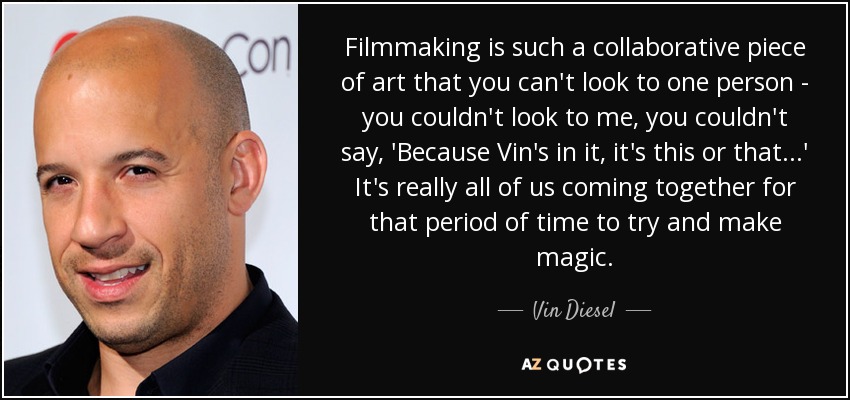
Filmmaking is such a collaborative piece of art that you can't look to one person - you couldn't look to me, you couldn't say, 'Because Vin's in it, it's this or that...' It's really all of us coming together for that period of time to try and make magic.
Filmmaking, like sex, isn't a polite enterprise. It involves a lot of mess and the bottom line is, if somebody ain't screaming, you're not doing your job.
I came to filmmaking as an actor looking for great characters and great opportunities, both of which are kind of hard to come by. It turns out I really love the process. And, it's exciting to be able to take my career by the reigns and make things happen for myself. Hopefully, in doing so, more opportunities will become available to me.
There is a whole separate filmmaking team that's doing it, but that's part of what's great about the Brain Trust and about the inspiring leadership of John Lasseter. He leaves it up to that creative group of individuals to help each other elevate each thing that they're working on to only try to make it better and to share what you've learned on the first one.
You can't turn up at college in stilettos and say you're gonna be a filmmaker. In the college, they were teaching me avant-garde filmmaking, where I had to make films that were, like, an hour long about nothing. I just refused to do it.
I never know what my next move will be in Hollywood. It's such an unpredictable town. People get jaded and lost and I've been able to stay a float. I think the next logical step in my career would be to start my own filmmaking empire like (Harvey Weinstein) and (Bob Weinstein) did so many years ago. I think if only the unions weren't so strict in Boston, I'd set up shop there and make films of a certain quality you don't see represented these days. I'm full of ideas and dreams.
Mostly it's like, I get inspired by something and I want to learn that part of filmmaking, I want to delve into that kind of depth. And leading, also, a lot of people. A lot of people, for two years of their life they follow me, and they believe what I believe in. So that's some responsibility and I'd like to make it worth the effort.
I really admire visual storytelling that shows you what's happening, instead of tells you what's happening. I think it really forces the filmmaking to be very clear.
Even in traditional filmmaking, you're always trying to find novel ways of telling stories, and this is different.
Some people live, eat and breathe art, and they love acting and filmmaking. I've got other loves. I love animals. I love teaching. I love kids. That's always something in the back of my mind.
I'm a believer that people need to understand that filmmaking is not a perfect process for anybody. It is a process in which you find the film and the film finds you. And that is every film.
I like challenges. If you're involved, as one is, in filmmaking, you want to challenge yourself. You don't want to repeat what you're done before.
My first teacher was Steven Spielberg. I worked on Amazing Stories. That was my first job, as a writer and as a story editor. Watching him and his command of the tools of filmmaking, and his admiration for writing and the story itself, was the greatest lesson I ever had.
Among today's directors I'm of course impressed by Steven Spielberg and Scorsese, and Coppola, even if he seems to have ceased making films, and Steven Soderbergh - they all have something to say, they're passionate, they have an idealistic attitude to the filmmaking process. Soderbergh's Traffic is amazing. Another great couple of examples of the strength of American cinema is American Beauty and Magnolia.
I think it's very important to recognize talent in all facets of filmmaking. Making a movie is such a lengthy and intense experience, so it's wonderful to honour actors, directors, producers and all crew members who put so much hard work and passion into a project.
Having been an actor, I always want to leave room for the actors to find their comfort zone, so I don't like to be too rigid in how I plan my shots. It's different if you have weeks to rehearse and you can rehearse on your sets or in your locations and you can plan that out with your actors, but in modern independent filmmaking, you don't really have that time. You have to have a certain level of improvisation.
I like racing. I love the speed and I'm a very kinetic person in terms of filmmaking. I love the movement of film more than anything else.
I intend more of a kinship with silent films than more modern film. I like the old cinema. My films are more of a hybrid - a different style of filmmaking to what I call talking head movies. Some people don't get it. Especially the more academic types.
There's a very interesting article or symposium to be written on just the real difference between comedy filmmaking and non-comedy. Because, you know, when you work in comedy, you depend on audience screenings to tell you about your movie.
The excitement about independent filmmaking is that they're a little more open to taking chances. The studios are a little more careful, as far as who they choose for their film and what they're known for and staying in the genre because they know what works.
I think, as a filmmaker, my style of filmmaking is very well-suited to 3-D anyway, so it's not like I'm having to change a huge amount of the way I shoot to work in 3-D. I think you could probably dimensionalize some of my movies and they would make very good 3-D films.
It's just the overall lack of privacy. I've always been a very shy person and so it invades that a lot. It goes with the territory so I'm very grateful to be able to do what I do. I love it and I love acting. I love being on set. I love the whole practice of filmmaking but the lack of privacy is hard. Fans are amazing because for the most part it's just love that they are sending to you. It's beautiful.
When I started making films I just decided "I'm the filmmaking equivalent of a garage band and I'll just make my garage band movies." But even the same musicians from garage bands would go to my movies and you could tell what they liked from the way that they dressed and they would be the first ones to walk out.
Filmmaking is something I have to do. It's not something I particularly want to do.
In polite society, there is such a thing as sensitivity to some issues, as time has gone on. There was a time when we weren't politically correct, at all, and we all wince at moments when we look to the past and see that. I don't really know what the answer is, as far as that is concerned. However, me, as an artist, I don't really think about it, at all. It actually is not my job to think about that, especially in terms of me, as a writer, but also as a filmmaker. I'm not worried about the filmmaking part because, if I'm writing it, that's what I'm going to do.
Follow AzQuotes on Facebook, Twitter and Google+. Every day we present the best quotes! Improve yourself, find your inspiration, share with friends
or simply: