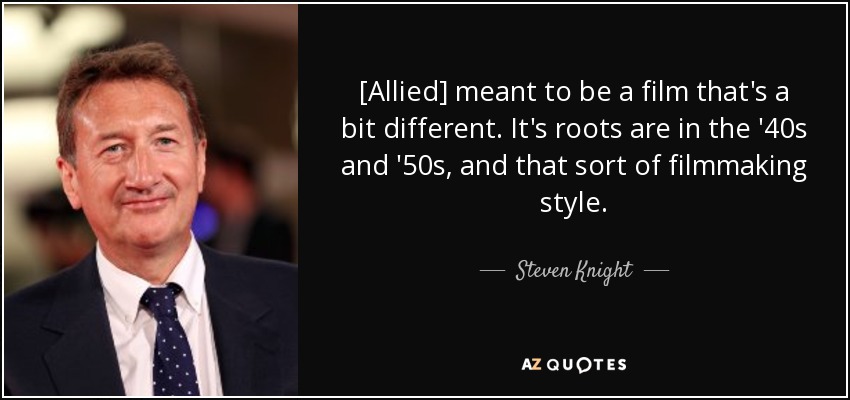
[Allied] meant to be a film that's a bit different. It's roots are in the '40s and '50s, and that sort of filmmaking style.
Howard Hughes innovation was in the aviation field. His designs and spirit of experimentation was at the forefront. As far as his work as film producer, he certainly went after a bigger and more ambitious kind of filmmaking, even if he wasn't necessarily a cinema artist.
[Howard Hughes ] approached filmmaking like he approached all of his inventiveness - it gave him an opportunity to make a name for himself in the world.
Otherwise [digital revolution] hasn't changed my way of filmmaking, I'm not nostalgic in postulating we should still make films on celluloid. I love celluloid but I don't need to continue on celluloid.
Of course subjects are changing, and since I started so early in filmmaking, I did my first film at age 19, of course you grow up with your films and you are not trotting the same path all the time.
I'm older and wiser. So and now having segued into filmmaking I'm looking at [Ridley Scott ] and what he does in an entirely different way and I have respect for what he does and how he composes shots. So that was what was completely fascinating.
I get rejections from the New Yorker. When I had to give a little talk to the people graduating from the MBA program at Columbia who were going into writing and filmmaking and everything, I said, "When I tried to think of what to say, the only subject I thought was appropriate for people doing what you're going to do is rejection." That's what it's all about.
It's difficult to find new solicitations, new expressions. But this is talking about filmmaking. Cinema.
That's the magic of filmmaking, to draw the audience into an exotic world and keep them there and keep the suspense.
Making music has been connected to one of my greatest heartaches, because my own music has never quite connected with audiences. But it was this heartache that pushed me to explore other artistic avenues, like writing and filmmaking, and I ultimately feel most at home in a multidisciplinary environment.
A large part of my filmmaking self has to do with my love of being in the cinema audience, and my relationships to what I want to see on the screen, what I have seen on the screen and what I don't want to see on the screen again.
I'm peripheral in Colab's history because others were involved in media, filmmaking, and music, and I was always a studio artist.
I think every filmmaker in Europe would be lying if they didn't say one day they just wanted to make a movie here in Hollywood or at least try it. It's very different from European filmmaking, because here it's like a real industry. It's very much about money and making money, which I think is fine, because it's very expensive to make movies.
To me the recognition of the audience is part of the filmmaking process. When you make a movie, it's for them.
I just enjoy the filmmaking side of things. I feel like when you're an actor, sometimes you're in other people's hands and they're in charge of your creative life. Whereas with my production company, I'm the one that gets to make those choices for how I'm gonna spend my time and what content I'm going to be creating. I definitely learn a lot, especially about acting, by producing and directing and seeing how it all comes together, and seeing the other side of things, appreciating what goes into pre- and post-production, and all those things you don't see when you're an actor.
Being a TV comedian, actor, writer, columnist, and all that is quite helpful to me in acquiring wide varieties of knowledge, which is crucial for filmmaking.
My filmmaking education consisted of finding out what filmmakers I liked were watching, then seeing those films. I learned the technical stuff from books and magazines, and with the new technology you can watch entire movies accompanied by audio commentary from the director. You can learn more from John Sturges' audio track on the 'Bad Day at Black Rock' laserdisc than you can in 20 years of film school. Film school is a complete con, because the information is there if you want it.
I felt like I was a writer, and I just thought filmmaking was the best way for me to express that, because it allows me to embrace the visual world that I love. It's allows me to interact with people, to be more social than fiction or poetry, and it felt like the right way for me to tell the stories that felt pressing to me.
Filmmaking, like any other art, is a very profound means of human communication; beyond the professional pleasure of succeeding or the pain of failing, you do want your film to be seen, to communicate itself to other people.
Basically, I'm afraid of everything in life, except filmmaking.
People love to be swept off their feet, to go into an environment where they've never been, to experience things they only dream about. And filmmaking offers that potential.
I love that about filmmaking - seeing final product and getting to see everyone else that you don't necessarily engage with on set every day and getting them to showcase their talents. Whether it's effects, music, the edit, the rhythm of a film is driven by that, so it's cool to see it come together. It's great to be standing in front of something you're genuinely proud of.
The Ramones were a great bunch of guys. They were very quiet, very shy. They were a little in awe of the filmmaking process, probably because we started at 7 a.m. I do remember the very first day of shooting, I met them and did the scene in the bedroom where Joey sings to me, and they were all scattered around my bedroom in my little fantasy scene. That was the first scene we shot of the movie. That scene is kind of a strange way to start a movie. "Okay, get undressed, and these weird guys in leather jackets and ripped jeans are going to sing to you."
Several years ago, as I was transitioning from film finance to film production and writing again, someone asked me how long I would try to get back into filmmaking before I gave up? My response was "giving up" was not an option.
The 90s were the decade in which studio filmmaking became a much more purely corporatized process, when their crassness ceased to operate on such a relatively individual scale.
Follow AzQuotes on Facebook, Twitter and Google+. Every day we present the best quotes! Improve yourself, find your inspiration, share with friends
or simply: