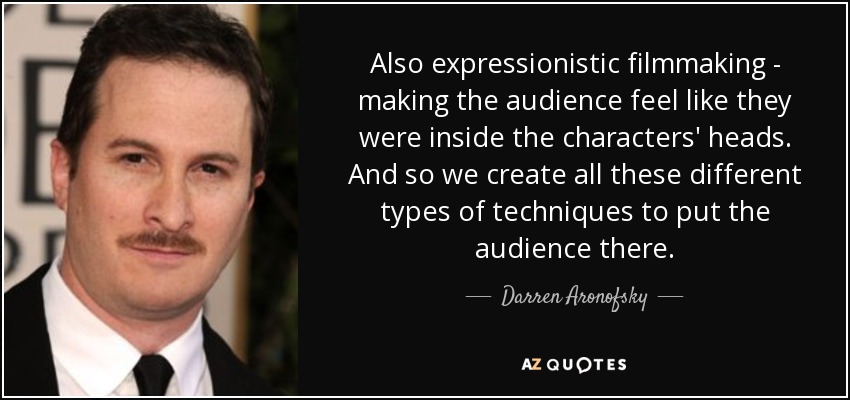
Also expressionistic filmmaking - making the audience feel like they were inside the characters' heads. And so we create all these different types of techniques to put the audience there.
My filmmaking background has really just been making movies with my friends since I was 12 years old. That's how I feel I learned how to tell a story visually, by just going out with a video camera and making movies with my friends and family.
The documentaries were something that I could do for a small amount of money, and then I felt like as long as I found the truth in the stories I was telling as a doc, I could teach myself filmmaking through doc filmmaking.
There's a thing I really mind hearing, when someone says: "That's not my kind of film, I don't want to go and see that..." I don't believe that, I don't believe that it's possible to write off a whole genre of filmmaking - "oh I don't like subtitled films", or "I don't like black and white films", or I don't like films made before or after, a certain date" - I don't believe that.
While the creative aspects of my filmmaking style are challenging in their own ways, I have developed such confidence and passion over the years that it has become much easier.
When I was in New York I heard many people saying that the independent film industry was in big trouble. I was reflecting on this when I came home. Realizing that ever since I started filmmaking, people have being saying that. But somehow it keeps going. Filmmakers keep going. We need stories to make sense of the world and some people like me are driven to tell them. I have faith this will always be possible.
Filmmaking and television series are team sports. Look for the best team for you. Plan, budget your time, money and spirit. You need all three to get serious work done. Never say no because something scares you. Never say yes because you're flattered. Stay open, but stay proud. It never gets easy. Get over that part. Get on with it.
I never think that being a woman is so hard. Maybe don't think about your gender and be confident as you go forward rather than try to single yourself out as some underserved part of filmmaking.
My advice to emerging documentary filmmakers would be: try to find other people, a group, a cooperative that you can work with. Filmmaking is hard and lonely and decidedly unglamorous. Find like-minded souls and share the joy and the misery.
Celebrate your victories and mark your defeats. Ultimately documentary filmmaking is not a job, it's a calling.
The most important part of filmmaking is the collaboration and the ensemble element of it. If you just all focus on the task and the work and try and make the best film that you can then people will come.
Documentary filmmaking ruins you for real life, because you learn to be extremely attentive.
Its amazing what you can do without in terms of filmmaking when a story is really important.
There is a great tradition of independent filmmaking in the U.S. that I absolutely respect. There's some wonderful stuff that comes out in this country against all the odds.
Independent filmmaking has always been there and it's not to be forgotten.
I became a documentary filmmaker because I wanted to make socially conscious films. I never studied filmmaking - everything I have learned has been on the field.
The relationship with actor and director is probably closer to theater, in that, when we record the dialogue, there is very little in the way of the creative collaboration - no cameras, lighting or even locations. Then, once we record, the post process is very similar to the post flow in filmmaking - editing, sound design, mixing, etc. At the end of the day, it's all about storytelling and honing in on a tone by developing a rhythm and structure that suits the storytelling.
I always think of comedy as being spontaneous, and yet everything about filmmaking is not spontaneous.
I've always had good relationships with directors. I'm one of those people where, if there's a good idea coming from the sound guy, I'll take it. Filmmaking is a collaborative effort, whether it's a first-time director or it's Mike Nichols. I think that's the standard that the great ones set.
I went for a more classical approach to filmmaking with lots of dolly, track and cranes, and slightly slower, more choreographed fight moves, so you get more fight moves in one take.
3D really altered the way I shot the movie completely, and it was exciting because, after 20 years of filmmaking, I felt like I was making my first movie, all over again.
I'm going in a really weird I-don't-know-where direction, but I prefer anything [different] from how standardized filmmaking has become.
News makes things black and white. Documentary filmmaking should do the opposite.
I was extremely shy. And I simply didn't know how to go about it. It seemed a lot easier to write than to make films. All I needed was a pencil and a piece of paper, whereas filmmaking was something I had no access to.
There is something missing in a lot of digital filmmaking, something I call "poetic reality." That's something you see played out in film noir, where the technique establishes the mood.
Follow AzQuotes on Facebook, Twitter and Google+. Every day we present the best quotes! Improve yourself, find your inspiration, share with friends
or simply: