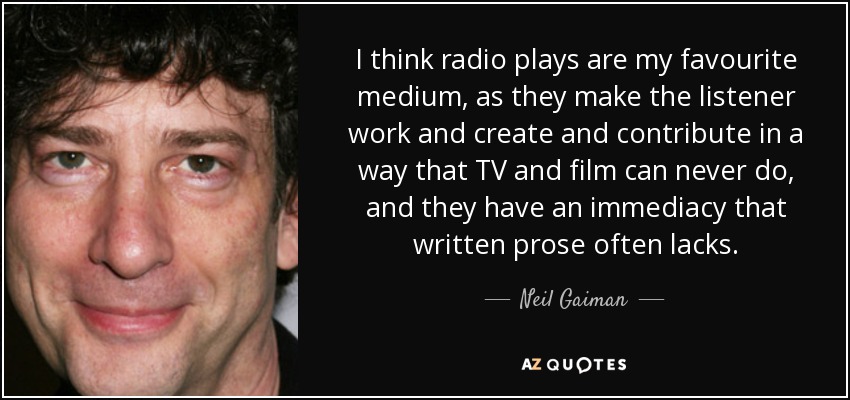
I think radio plays are my favourite medium, as they make the listener work and create and contribute in a way that TV and film can never do, and they have an immediacy that written prose often lacks.
Back in my day, we called it rock 'n' roll, but then we always reminded listeners that it was no big deal if they didn't like it.
I think what is important for things to be funny is if you the listener, or the reader, get a chance to supply the humor of it yourself.
When you gossip about another person, listeners unconsciously associate you with the characteristics you are describing, ultimately leading to those characteristics' being “transferred” to you. So, say positive and pleasant things about friends and colleagues, and you are seen as a nice person. In contrast, constantly complain about their failings, and people will unconsciously apply the negative traits and incompetence to you.
Getting 10,000 listeners for a free podcast novel is a lot easier than selling 10,000 hardcover novels at $25 a pop.
I'm passionate about the issues that I care about and I'm a really good listener.
The listeners got some such insights into their past lives, as one gets into the darker parts of the woods, when a stray gleam of sunshine finds its way down to the roots of the trees.
You know, I just don't believe that art is supposed to make sense. I really don't think it's supposed to be analyzed to death. It's left to the listener or looker to get what they can get from it.
Listeners instinctively detect that when we lower the usual pitch of our voice, we are sad, and when we raise it, we are angry or fearful.
Speech belongs half to the speaker, half to the listener. The latter must prepare to receive it according to the motion it takes.
Even non-commercial media rely on transferring cost to users through licence fees, donations from listeners, viewers, or readers, or grants from companies and foundations that have wrestled their funds from the public in some form of earlier commercial activity.
Prophetic utterance, like poetic utterance, transforms experience and moves the receiver to new attitudes. The kinds of experience--the recognitions or revelations--out of which both prophecy and poetry emerge, are such as to stir the prophet or poet to speech that may exceed their own known capacities; they are "inspired," they breathe in revelation and breathe out new words; and by so doing they transfer over to the listener or reader a parallel experience, a parallel intensity, which impels that person into new attitudes and new actions.
Talk is a pure art. Its only limits are the patience of listeners who, when they get tired, can always pay for their coffee or change it with a friendly waiter and walk out.
The way in which the photograph records experience is also different from the way of language. Language makes sense only when it is presented as a sequence of propositions. Meaning is distorted when a word or sentence is, as we say, taken out of context; when a reader or listener is deprived of what was said before, and after. But there is no such thing as a photograph taken out of context, for a photograph does not require one. In fact, the point of photography is to isolate images from context, so as to make them visible in a different way.
The musical emotion springs precisely from the fact that at each moment the composer withholds or adds more or less than the listener anticipates on the basis of a pattern that he thinks he can guess, but that he is incapable of wholly divining. . . .
Country music was a part of my life. Now it isn't. We had a good relationship, really, but we wanted each other at arm's length. The people in Nashville didn't want to be responsible for my looks or my actions. But they sure did like the listeners I brought.
A flutist who is moved to tears by his own performance will soon make the listeners laugh because of the sounds that he produces.
An artist should make concessions to the listener. That is why Bruckner dedicated one of his symphonies to the Good Lord.
If you want to be a good conversationalist, be a good listener. To be interesting, be interested.
In fiction, I exercise my nosiness. I am as curious as my cats, and indeed that has led to trouble often enough and used up several of my nine lives. I am an avid listener. I am fascinated by other people's lives, the choices they make and how that works out through time, what they have done and left undone, what they tell me and what they keep secret and silent, what they lie about and what they confess, what they are proud of and what shames them, what they hope for and what they fear. The source of my fiction is the desire to understand people and their choices through time.
A young professor I watched in action at one of our large eastern colleges used to stand with his back to the class and mumble explanations of blackboard problems. He was "let out" at the end of two years because students refused to attend his classes. He was given an evasive reason for his dismissal and he left with justifiable bitterness toward the administration. If someone had told him the truth he could have avoided this denouement. Sometimes professors go on for years without any conception of remediable faults which irritate their listeners.
To me, that's what music is: creating a mood, and taking the listener to the place that you're going.
Not every man with a heart is understanding, nor every man with an ear a listener, and nor every man with eyes able to see.
In my experience when a friend unloaded about a boyfriend or spouse, the listener soaked up the complaint and remembered it long after the speaker had forgiven the offense.
I always love to put hidden messages in my music videos, because I know there are people like me who, when they watch something, are really active, involved participants. I'm not usually a really passive listener or observer. So I do put those messages in there for people who spend a great deal of time [looking for them].
Follow AzQuotes on Facebook, Twitter and Google+. Every day we present the best quotes! Improve yourself, find your inspiration, share with friends
or simply: