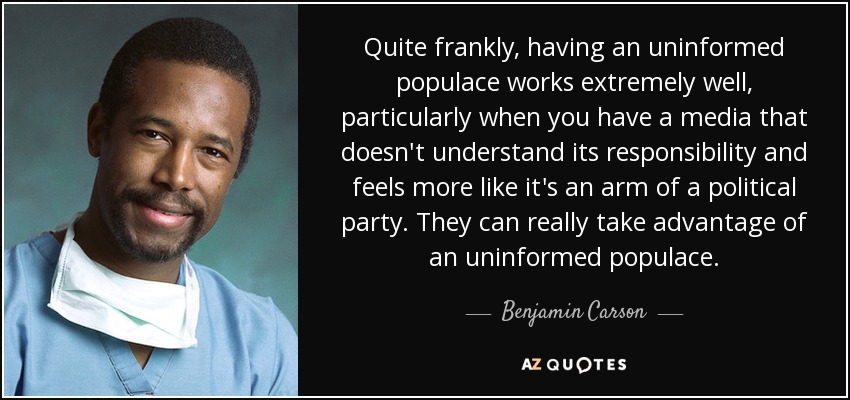
Quite frankly, having an uninformed populace works extremely well, particularly when you have a media that doesn't understand its responsibility and feels more like it's an arm of a political party. They can really take advantage of an uninformed populace.
The United States is unusual among the industrial democracies in the rigidity of the system of ideological control - 'indoctrination,' we might say - exercised through the mass media.
You can go into neighborhoods in the United States where people dress a certain way because they don't want to be out of touch, where boys wear pants down to their knees, which nobody has compelled them to do but they pick up the cultural norms, or where girls are improperly dressed by my eyes, but that's what they see in the media.
I'm like anybody else that's in media. I've got my opinions. I share them. I'm not afraid of them.
People want everything quick and now. We live in the age of social media and hyper digital. Tweets are published in less than a second, Safari pages load in less than three seconds.
Language is butchered by the media
The media is in the business of finding exceptions to everyday life. Bad things are still the exception. That's good, because once bad things stop being news, we really are in trouble. If people forget that bad is the exception, they think they live in a horrible world. There is so much that works and is right and friendly and warm. But we take that for granted.
I don't need any more avenues of communication, and frankly I think people are still working out to realize that it's just a tool[social media] rather than something that you have to do or participate in.
There are good reasons why everybody should heed politicians' advise not to believe the media. One of the best is that the media report what politicians say.
Universities want to recruit the students that they believe will best represent the university while in school and beyond. Students with a robust social media presence and clearly defined personal brand stand to become only more influential.
The strange anthropological lesson of social media is that human beings, if given a choice, often prefer to socialise alone.
Of course, it is possible for any citizen with time to spare, and a canny eye, to work out what is actually going on, but for the many there is not time, and the network news is the only news even though it may not be news at all but only a series of flashing fictions.
Media manipulation in the U.S. today is more efficient than it was in Nazi Germany, because here we have the pretense that we are getting all the information we want. That misconception prevents people from even looking for the truth.
It is ... necessary to whip up the population in support of foreign adventures. Usually the population is pacifist, just like they were during the First World War. The public sees no reason to get involved in foreign adventures, killing, and torture. So you have to whip them up. And to whip them up you have to frighten them.
[W]hat suffers in the atmosphere of immediacy is analysis. What suffers in this search for speed is depth. The media in the wealthy world are becoming increasingly simplistic, superficial, and celebrity-focused.
Talk radio has made an enormous run around establishment media. But the Interne is making an end run around talk radio. Suddenly we're faced with an information age.
The most puzzling thing about TV is the steady advance of the sponsor across the line that has always separated news from promotion, entertainment from merchandising. The advertiser has assumed the role of originator, and the performer has gradually been eased into the role of peddler.
Television is to news as bumperstickers are to philosophy.
Im a soulless lawyer. Give me any opinion and I can argue it.
Violent video games played in public places are a tiny fraction of the media violence to which modern American children are exposed. Tiny - and judging from the record of this case, not very violent compared to what is available to children on television and in movie theaters today.
Democracy was regarded as entering into a crisis in the 1960s. The crisis was that large segments of the population were becoming organized and active and trying to participate in the political arena.
I don't see social media as lending my voice as much as I see it speaking my truth. If you look at my open letters, the one I wrote about Blue Ivy too - you see, I am always as the foundation, talking about us being a better humanity. I believe in that.
Television saved the movies. The Internet is going to save the news business.
People have to be atomized and segregated and alone. They're not supposed to organize, because then they might be something beyond spectators of action. They might actually be participants if many people with limited resources could get together to enter the political arena. That's really threatening.
In the years of the Reagan-Bush administration alone, about 1.5 million people were killed by South Africa just in the surrounding countries. Forget what was happening in South Africa and Namibia.
Follow AzQuotes on Facebook, Twitter and Google+. Every day we present the best quotes! Improve yourself, find your inspiration, share with friends
or simply: