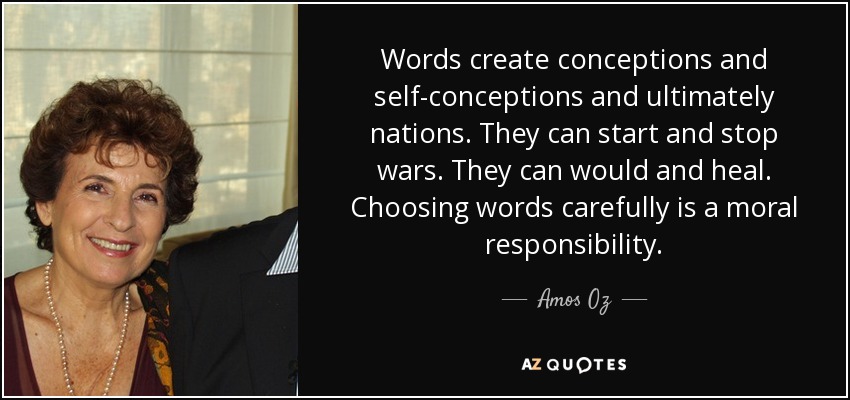
Words create conceptions and self-conceptions and ultimately nations. They can start and stop wars. They can would and heal. Choosing words carefully is a moral responsibility.
The intellectual and moral failures common to America's general officer corps in Vietnam and Iraq constitute a crisis in American generalship. Any explanation that fixes culpability on individuals is insufficient. No one leader, civilian or military, caused failure in Vietnam or Iraq. Different military and civilian leaders in the two conflicts produced similar results. In both conflicts, the general officer corps designed to advise policymakers, prepare forces and conduct operations failed to perform its intended functions.
Unless we believe the gospel, we will be driven in all we do-whether obeying or disobeying-by pride ('self-love') or fear ('of damnation'). Apart from 'grateful remembering' of the gospel, all good works are done then for sinful motives. Mere moral effort may restrain the heart, but does not truly change the heart. Moral effort merely 'jury rigs' the evil of the heart to produce moral behavior out of self-interest. It is only a matter of time before such a thin tissue collapses.
These days - with the decline of the traditional churches - I'm concerned about where we obtain some form of moral direction.
If the "rich" were swarming into poor neighborhoods and beating the poor until they coughed up the dimes they swallowed for safekeeping, yes, this would be a transfer of income from the poor to the rich. But allowing taxpayers to keep more of their money does not qualify as taking it from the poor - unless you believe that the poor have a moral claim to the money other people earn.
The men of Normandy had faith that what they were doing was right, faith that they fought for all humanity, faith that a just God would grant them mercy on this beachhead or the next. It was the deep knowledge - and pray God we have not lost it - that there is a profound moral difference between the use of force for liberation and the use of force for conquest.
Music is moral law. It is the essence of order and leads to all that is good, true and beautiful.
Animal experimentation is the blackest of all the black crimes that a man is at present committing... We should be able to refuse to live if the price of living be the torture of sentient beings... I abhor [animal] experimentation with my whole soul. All the scientific discoveries stained with innocent blood I count as of no consequence... The greatness of a nation and its moral progress can be judged by the way its animals are treated.
Eroticism is mystique; that is, the aura of emotion and imagination around sex. It cannot be 'fixed' by codes of social or moral convenience, whether from the political left or right. For nature's fascism is greater than that of any society. There is a daemonic instability in sexual relations that we may have to accept.
Noir is where the clarity of moral divisions break down, the black and whites turn into grays.
If you think half of America votes badly because they are stupid or religious, you are trapped in a matrix ... Take the red pill, learn some moral psychology and step outside the moral matrix.
The propensity to avoid moral considerations was producing not simply a politically illiterate and authoritarian society, but one that was increasingly saturated in violence and a culture of cruelty. Needless to say, all of these forces intensified the increasing militarization and corporatization of higher education, along with the privatizing of everyday life.
But we need more than a broader understanding of what is a good society or a moral and political critique of the existing market fundamentalism engulfing American society, we also need to create new forms of solidarity, new and broad based social movements that move beyond the isolated and fractured politics of the current historical moment.
I don't think our lives actually unfold with morals attached to them, or meanings that are easily extracted, or jokes designed to generate sympathy. I wanted to do the opposite - to offer up a life whose meanings can only be perceived through a tangle of desires, confusions, and textural details.
Writing is a mode of agency in the world that is different from mere employment. There has to be some sort of ethical or moral drive, even if you are unaware of it.
But then you say, Well, who makes the decision? Does the government make the decision? The reason this is such a national dispute and moral issue for people is because it occurs inside the body of a woman. That makes it really complicated. What are you going to do? Put women in prison? How much do we want the government to intrude on this?
The cool thing about Watchmen is it has this really complicated question that it asks, which is: who polices the police or who governs the government? Who does God pray to? Those are pretty deep questions but also pretty fun questions. Kind of exciting. It tries to subvert the superhero genre by giving you these big questions, moral questions. Why do you think you're on a fun ride? Suddenly you're like how am I supposed to feel about that?
I think we should really discourage this sort of empathic engagement when it comes to making moral decisions. I think we should focus on something like compassion, on getting people to care more for others without putting ourselves in their shoes.
I love to read things that have moral messages, and I love to hear stories where it's not just a hook, you have to follow the story, you have to listen to the message of the song, and get it and use it in your everyday life.
Since I hold no judgments against my characters, no matter how heinous they might seem, I present them as real people with their own moral centers. We might feel those moral centers are mis-calibrated, but they are there and are the rudders that propel them. This makes reading my work a visceral roller coaster, 'cause the reader must embark on the journey of the protagonist equipped only with his or her own moral center.
I'm interested in the limits of personality, in the possibility of change, and the saving power of art. Do powerful works of art raise our consciousness to such a degree that we refrain from sliding into moral hazard? Do we take note? Or are we doomed to repetition?
Illustrators are usually illustrating something big or commercial if not outright advertising. It's a form of prostitution, but that's cool because we don't have any moral hang-up about it.
I don't regard the real and true and authentic as something to claim as a moral high ground.
I studied Hitchcock and Josef von Sternberg under Richard Dillard at Hollins, and that year under his tutelage just completely rewired my brain. Both directors combine moral seriousness with great artistry and, certainly in Hitchcock's case, an enormous respect for plot, for its power to enthrall and delight.
Most writers are lazy intellectuals, and it's a goddamn shame because a writer with an audience has a moral responsibility to make readers think about the world in a different way than what they're used to. Why else would you pick up a book if not to inhabit another realm of existence for a while?
Follow AzQuotes on Facebook, Twitter and Google+. Every day we present the best quotes! Improve yourself, find your inspiration, share with friends
or simply: