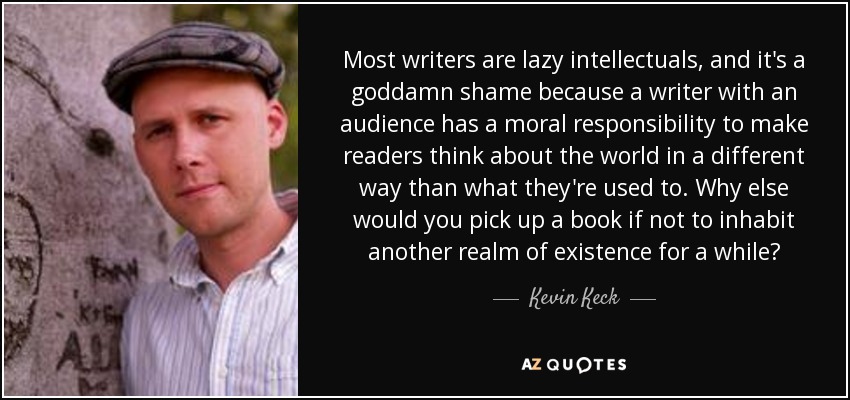
Most writers are lazy intellectuals, and it's a goddamn shame because a writer with an audience has a moral responsibility to make readers think about the world in a different way than what they're used to. Why else would you pick up a book if not to inhabit another realm of existence for a while?
There is no comfortable middle path where we get to provide a rational justification for our basic moral, religious and common sense beliefs.
I think we should really discourage this sort of empathic engagement when it comes to making moral decisions. I think we should focus on something like compassion, on getting people to care more for others without putting ourselves in their shoes.
I'm really interested in the pleasure we get from stories and the pleasure we get from movies, and certainly the pleasure we get from virtual experiences. My complaint is against empathy as a moral guide. But as a source of pleasure, it can't be beat.
Again, although I'm not a particularly religious person, I go back to the religious left that I come out of: There are moral imperatives to fight back. As Daniel Berrigan says, "We're called to do the good." And then we have to let it go. It's not our job to know where the good goes.
An act of violence against any innocent person eludes moral justification, disgraces the millions of Americans and people throughout the world who have united in peaceful protest against police brutality, and dishonors our proud inheritance of nonviolent resistance.
I like the idea of being a postmodern moral philosopher - or perhaps a perverse moral philosopher.
I don't believe our country will last the way we know it much longer unless there's a change. And we just continue this moral decline going down, and the only hope, I believe, is God. We just hope and pray that maybe he'll hear our prayers and give us some godly leadership.
I was raised Catholic and didn't like the dogma and exclusivity of that teaching but I was moved by the moral teachings and by the power of the Jesus fellow.
Robert Nozick [a Havard philosopher, famous for his book "Anarchy, State and Utopia"] defined revenge as delivering the message that you know what someone has done, and it doesn't involve hurting them or doing anything to them beyond that. It's just delivering the message that their crime has been noted not just by its victims, because the victim might be dead, but by another who has a different moral view and will challenge the perpetrator's view.
I would say I am very much more interested in ethics than in code/ morality. I think it's in this way that one avoids the conservatism inherent in "the moral".
Schiller never wanted to replace the moral with the aesthetic but he did want the moral to be one part of the aesthetic. He rightly notes the aesthetic dimension of morality, that we use concepts like grace to characterise people who do their duty with ease and pleasure.
The cool thing about Watchmen is it has this really complicated question that it asks, which is: who polices the police or who governs the government? Who does God pray to? Those are pretty deep questions but also pretty fun questions. Kind of exciting. It tries to subvert the superhero genre by giving you these big questions, moral questions. Why do you think you're on a fun ride? Suddenly you're like how am I supposed to feel about that?
I am certainly open to the idea that this might be used to explain other philosophical categories besides knowledge. I have some real sympathy with the work of those moral realists who have tried to give naturalistic accounts of human flourishing, and who offer accounts of right action in such terms. (I suppose this is more evidence that I really do have deep affinities with Aristotle!)
I have a general moral: great philosophers may be great, but that is not a reason to follow them. Don't be a follower. Work it out for yourself.
For me, most comedy scripts fail in the mechanical playing-out of the setup. They'll pay lip service to a moral lesson or a psychological progression.
I'm a supporter of embryonic stem cell research. I do think there are very important moral and also religious questions at stake in the debate over embryonic stem cell research.
Vaclav Havel was the most amazing man in terms of being the combination of somebody with massive moral authority, great courage for having espoused the concepts of democracy, freedom throughout a very difficult communist period, a very modest man, and somebody with a fabulous sense of humor and the idea of being able to see the absurd in situations.
Vaclav Havel had moral stature. The president in first Czechoslovakia and the Czech Republic in many ways is a ceremonial role. And so, speaking out and having that strong moral fiber, people just knew that he told the truth to people who had only heard lies. And so I think his - that's his legacy.
The men can have a moral compass that is just unshakeable, they can have ethics that run to the core.
One of the ways in which parenting is a learning experience and an opportunity for moral growth is that we learn as parents that we don't choose the kind of child that we have.
I am trying to get at the moral arguments and the ethical status of various attempts at enhancement, or genetic engineering, or the bid for designer children. But there are implications for society at large.
So, first, I wanted to be a part of the project because I thought it was an important story to tell. On top of that, it's rare to find roles for strong, young, feisty women, especially in a military film. And I love that Suarez ends up being the moral compass of the story, and that she's also brave enough to stand up to all these men.
I don't need to think that I'm being loomed over my shoulder in order to behave in a way that's moral.
I now feel that I have a moral duty to course correct and say wait a minute, it's not just for adults.
Follow AzQuotes on Facebook, Twitter and Google+. Every day we present the best quotes! Improve yourself, find your inspiration, share with friends
or simply: