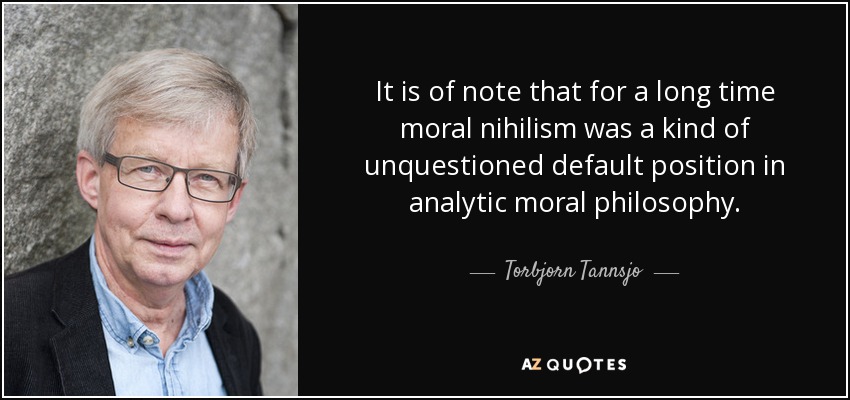
It is of note that for a long time moral nihilism was a kind of unquestioned default position in analytic moral philosophy.
These theories, deontology, the moral rights theory, and utilitarianism, contradict one another. Moreover, they give conflicting (inconsistent) recommendations. It is hence not possible to hold them together, in a pursuit of moral truth.
Gentlemanly, principled, helpful behaviour by older men vis-a-vis young women goes unnoticed, but it deserves real moral credit, and we could use more first-person testimony from the beneficiaries and practitioners about that too.
I am indeed a moral realist.
I believe that one basic question, what we ought to do, period (the moral question), is a genuine one. There exists a true answer to it, which is independent of our thought and conceptualisation.
I think as a moral question, restaurant workers should get paid more.
We should not accept moral nihilism unless we find strong arguments to do so.
Normative ethics, pursued as a free, systematic, and critical attempt to find moral truth, regardless of religious and other authorities, is a rather new adventure. Let's wait and see what will happen!
Being a moral realist I see normative ethics as a search of the truth about our obligations and a search of explanation; the idea is that moral principles can help us to a moral explanation of our particular obligations.
There are some particular moral truths that I believe we have access to (such as the one not to inflict pain on a sentient being for no reason).
I believe in good, having morals, be a decent person.
Democracy needs a moral compass.
I think you should live your moral values, but the last thing, the very last thing, the government should do is have laws that would punish women who make reproductive choices.
Liberalism downplays certain of our moral senses: loyalty, authority, and sanctity.
Owen [Suskind], in a sense, grew up on a diet of myth and fable, and has become an expert on their themes, which contain a moral guide that connects people.
People talk about apathy, especially in developed countries. We're kind of lulled into these tranquil lives, and we are pursuing our own thing and there is so much suffering on a mass scale around the world that you kind of become fatalistic. You might think suffering is inevitable, you kind of lose your sense of moral urgency. But there is always something you can do for someone in the world.
People in red states and blue states can agree that if we can fight pollution and poverty at the same time, letting people work their way out of poverty without undermining community health, we have a moral obligation to do so.
People in different cultures think very differently about abortion. Abortion is not seen as a moral problem for example in Sweden or Russia, but it is seen as a difficult moral problem in China and in the USA.
Moral revolutions are typically seen retrospectively. Prospectively, the revolutionaries tend to look like crazy people, and sometimes they are.
The Consequentialist trinity is typically regarded in this way: Bentham is crude, Mill's writings are full of howlers and inconsistencies, and Sidgwick was too smart to fully embrace Consequentialism. All of these great traditions in moral philosophy express strands of our moral consciousness and they should all be treated as research programs rather than as fully determinate views that can be leveled by a counterexample or by a clever argument.
Since for me moral demands necessarily flow from human psychology, I don't think we can be obliged to do something that we are not motivated in any way to do. In other words, I'm an "internalist" about morality.
I think you have a certain level of confidence in what you do. "Arrogance" is the wrong word. I think when you go into it, you're aware that you're doing it for the right reasons - and you have your own moral and ethical code. And we weren't driven by money, but by a a desire to make music and make a statement.
Very little appears to escape the infantilizing and moral vacuity of the market.
As the pleasure principle is unconstrained by a moral compass based on a respect for others, it is increasingly shaped by the need for intense excitement and a never-ending flood of heightened sensations.
Maybe there was a time that you could count on the American home as being the moral fabric center and that they would teach you right, but with the liberty of just divorcing without a thought, it's horrible.
Follow AzQuotes on Facebook, Twitter and Google+. Every day we present the best quotes! Improve yourself, find your inspiration, share with friends
or simply: