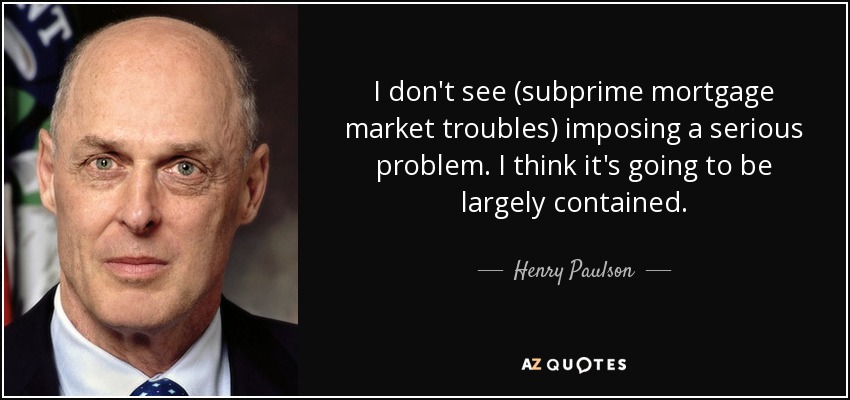
I don't see (subprime mortgage market troubles) imposing a serious problem. I think it's going to be largely contained.
Gold has intrinsic value. The problem with the dollar is it has no intrinsic value. And if the Federal Reserve is going to spend trillions of them to buy up all these bad mortgages and all other kinds of bad debt, the dollar is going to lose all of its value. Gold will store its value, and you'll always be able to buy more food with your gold.
University administrators are the equivalent of subprime mortgage brokers selling you a story that you should go into debt massively, that it's not a consumption decision, it's an investment decision. Actually, no, it's a bad consumption decision. Most colleges are four-year parties.
The ethics of excellence requires a sense of perspective. Look at the big picture. If you live for the moment you might mortgage the future? What happens if you put your reputation at risk and lose the bet?
Owning your own home is America's unique recipe for avoiding revolution and promoting pseudo-equality at the same time. To keep citizens puttering in their yards instead of sputtering on the barricades, the government has gladly deprived itself of billions in tax revenues by letting home owners deduct mortgage interest payments.
Homeowners who refinanced their mortgages took out cash and reduced their monthly payments at the same time. Much of the cash obtained by refinancing was spent on consumer durables, home improvements and the like.
When the congregation becomes the norm by which sermons are measured, a minister has put a mortgage on his soul.
We will not, on the altar of money, mortgage our conscience, mortgage our faith, mortgage our salvation.
When you default on a secured debt, the creditor takes the asset that backs up that debt. When you convert credit card debt to mortgage debt, you are securing that credit card debt with your home. That's a risky proposition.
My father loved to complain about big business and big government, but we had a solid middle class upbringing. We had good public schools. We had accessible health care. We had our little, you know, one-family house that, you know, he saved up his money, didn't believe in mortgages.
People are looking back and trying to, you know, get compensation for bad mortgages and all the rest of it in some of the agreements that are being reached. There's nothing magic about regulations, too much is bad, too little is bad.
Google's AdWords, they allow you to bid on words that people will type into the search engine, and they cost more or less. For example, I think mortgage refinancing can cost - now, it's probably hundreds, maybe thousands of dollars. So, in other words, they are allowing you to bid on what people are going to type, and that is the AdWords program. So you own certain terms, and then your ads show up as opposed to someone else's.
How do you think we have the home mortgage deduction? We have it because way back when it was determined that the American dream equaled home ownership. And everybody knows that the vast majority of the American people will never be able to write a check for a house. You have to finance it.
The people that did it the way they were supposed to do it, the way they were taught in school: save your money, so that when you retire.They get nothing. They have nothing. They were going to live off the interest of the money. They don't have money. And then on top of it you had the problems of nine years ago [in 2005] with the mortgages so half of them their houses have been taken away.
There was a time when people thought that if you piled a bunch of mortgages together, the top of the pile was AAA. There are a lot of things that become consensus.
[Steven] Lerner's plan starts by attacking JP Morgan Chase with demonstrations on Wall Street, protests at the annual shareholder meeting, and then calls for a coordinated mortgage strike.
We have to be pretty tough with mortgage companies and say you have got to give people the chance to work out their debts, sort out future mortgages.
We can help people. We have got to move this economy from its over-dependence on debt. People should have manageable debts, a manageable mortgage.
There are times when a market such as housing, transportation or the stock or mortgage market keep rising and people with capital want to join in this growth. Soon the markets become overheated, partly because of the abundance of investment money and speculation. This is when the government should raise interest rates and increase the cost of borrowed money. Governments are shy about doing this because it could cause the very recession. Yet this is the best time to do this so that the inevitable recession never reaches the magnitude of the recent Great Recession.
The working poor are the people suffering out subprime mortgages and fatal loans and more and more of our money - you know, capitalism is operated by extracting money, not so much directly being paid.
Already, new forms of short-term and long-term rental housing are popping up in some metro areas. You can take on a house or apartment for a few months or even a year or two in developments that are striving to provide critical elements of community - schools, healthcare, social and cultural institutions - even for people who are living there only temporarily. People invested in a home, mortgage, or community are less likely to move to more economically vibrant locales. That kind of entrenchment is going to be an impediment to the coming spatial fix.
There's power in the collective. If you don't believe me, just watch a symphony orchestra with a conductor and 120 people who are thinking about exactly the same thing at the same moment - no babies, no stock markets, no mortgages. Just 32nd notes.
We no longer have a significant middle class in the US due to Barack Obama's job-killing ban on oil drilling in Zion Park. While a small middle class remains in the coastal blue states, our tax bill devastates them by curbing deductions for state and local taxes and large mortgages. In a few years, everyone except the 1% will be a tricklee.
Imagine if the pension funds and endowments that own much of the equity in our financial services companies demanded that those companies revisit the way mortgages were marketed to those without adequate skills to understand the products they were being sold. Management would have to change the way things were done.
The people who did the collateralized mortgage obligations, sold them to pension funds, then sold them short, then bought credit default swap insurance on them, are just amazing. They are a law unto themselves.
Follow AzQuotes on Facebook, Twitter and Google+. Every day we present the best quotes! Improve yourself, find your inspiration, share with friends
or simply: