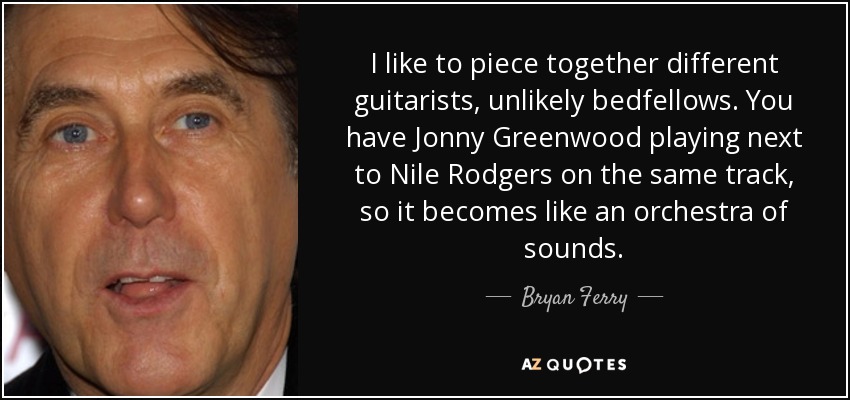
I like to piece together different guitarists, unlikely bedfellows. You have Jonny Greenwood playing next to Nile Rodgers on the same track, so it becomes like an orchestra of sounds.
I'm just not arbitrarily choosing to have five guitars play one type of thing. In that way there's a definite similarity between a symphony orchestra and the 100 guitar symphony.
Women play cellos and violins in symphony orchestras. They're playing Beethoven and Bach. What do you mean they can't play rock and roll?
And he [Louis Brandeis] talks to his young acolyte, Horace Kallen, who wrote this beautiful book called Cultural Pluralism, and he comes to believe that by being better Jews, or better members of our ethnic group, we can be better Americans, because America is like an orchestra in which identity is defined by the diversity of perspectives that we bring to the table.
I really love performing with an orchestra and am very excited to do so with the Kalamazoo Symphony.
If an ensemble - I don't care if it's a duet or a forty-piece orchestra - the musicians, the two of them or the forty of them, are all trying to play as tight as possible, as one person. They're trying to play like they are one person.
It is not enough to do a desktop exercise of a Beethoven symphony. You need to practice with an orchestra. The musicians need to read the notes. Otherwise it will be a disaster.
People who are qualified are symphonic orchestra players and jazz musicians; they're qualified to do what they do. Rock stars are lucky. It's a combination of right time, right place and having certain genes or a gimmick or whatever, but it's really not anything more than sugar. It tastes good and goes away fast.
Satyagraha is an opera which I wrote for the Netherlands Opera, so it uses an orchestra of around fifty, a chorus of forty, and there are about seven soloists. The opera ... Satyagraha means truthful, so it was a name [Mahatma] Gandhi used to describe his civil disobedience movement.
There is no greater thrill than to sing with a beautiful orchestra.
When managers overdo micromanaging of others, they probably hired the wrong people or failed to give them a clear idea of what each one is to accomplish. I prefer to train employees to be self-managers, just as in an orchestra each performer knows his or her role without being micromanaged.
And at the same time, I had my very first concert at the age of 16. I hadn't heard a symphony orchestra before, and I was so deeply impressed I said I have to be a conductor.
The great myth is the manager as orchestra conductor. It's this idea of standing on a pedestal and you wave your baton and accounting comes in, and you wave it somewhere else and marketing chimes in with accounting, and they all sound very glorious. But management is more like orchestra conducting during rehearsals, when everything is going wrong.
I have ambitions to do a Broadway record one of these days and get in the studio with like, a real orchestra. I'm a big musical theatre geek.
I'm a little less hungry as an actor than I used to be. When you're a director, you're the conductor of the orchestra, and when you're an actor, you're playing the violin. There's a thrill to each of them, but as the conductor, you get the fuller sound.
Lately, my mind is like an orchestra. If you don't have the conductor, you don't know what to do. One guy is playing jazz, one guy is playing rock and roll, another classical. It's a big mess.
I tend to work in layers. There's a huge orchestra in the film, but I also record a lot things with very intimate groups, and I like to be able to use the textures of those intimate groups.
I studied music all the way through college, but as soon as I graduated from university, I got straight into London and got straight into film music. So really my experiences have been being around the orchestras in London and being around the people who work in film music.
I had a big background in listening to classical music and I started trying to compose, like I was playing the guitar but I heard an orchestra in my head.
Actors want to work with you but they want you to do their thing. Actors, whom I love with a blind partiality, sometimes they want to be soloists in the symphony, not a part of the orchestra.
I grew up listening to my grandfather's stories of our musical past. He would often talk about the orchestras that played at concerts and the musicians who played on Sunday evenings on street corners. By the time I grew up in the '80s, all of this was a thing of the past. I lived vicariously through his stories and often wondered what it would have felt like to have been part of his generation.
I feel like people used to leave their homes and go to their local theatre, and they used to watch ballet dancers and musical theatre performers and tap dancers and orchestras and dog acts. You had to leave your home, be in the presence of other people, know how to behave, and enjoy the human being whose beating heart was in front of you.
Every philharmonic orchestra merely interprets the composer. My goal was to create new music by that composer. In doing so, I wanted to find the painter's creative center and become familiar with it, so that I could see through his eyes how his paintings came about and, of course, see the new picture I was painting through his eyes - before I even painted it.
I was raised a musician and I played classic music, violin, in orchestras and music comedy theaters, I have music running around in my head all the time, and if I hear music that's too interesting, I have to pay attention to it.
It's really not a stretch. The checks and balances are the same. The drums are the executive branch. The jazz orchestra is the legislative branch. Logic and reason are like jazz solos. The bass player is the judicial branch. One our greatest ever is Milt Hinton, and his nickname is "The Judge."
Follow AzQuotes on Facebook, Twitter and Google+. Every day we present the best quotes! Improve yourself, find your inspiration, share with friends
or simply: