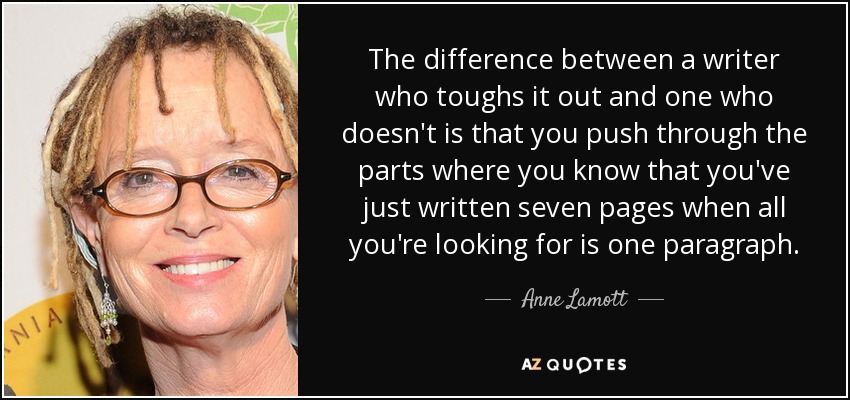
The difference between a writer who toughs it out and one who doesn't is that you push through the parts where you know that you've just written seven pages when all you're looking for is one paragraph.
My experience as a writer is that you really do write seven and eight pages to find the paragraph you were after all along.
No new reader, however charitable, could open “Fifty Shades of Grey,” browse a few paragraphs, and reasonably conclude that the author was writing in her first language, or even her fourth.
Paymasters come in only two sizes: one sort shows you where the book says that you can't have what you've got coming to you; the second sort digs through the book until he finds a paragraph that lets you have what you need even if you don't rate it.
Our conviction that the world is meaningless is due in part to the fact (discussed in a later paragraph) that the philosophy of meaningless lends itself very effectively to furthering the ends of political and erotic passion; in part to a genuine intellectual error - the error of identifying the world of science, a world from which all meaning has deliberately been excluded, with ultimate reality.
I try to get a feeling of what's going on in the story before I put it down on paper, but actually most of this breaking-in period is one long, fantastic daydream, in which I think about anything but the work at hand. I can't turn out slews of stuff each day. I wish I could. I seem to have some neurotic need to perfect each paragrapheach sentence, evenas I go along.
You keep working on your piece over and over, trying to get the sections and paragraphs and sentences and the whole just right, but there's a point at which you can tell you've begun hurting the work with your perfectionism. Then you have to release the work to new eyes.
Over the years, I've trained myself to speak using the same language I would use if I were typing: meaning using full sentences in the way that paragraphs and scenes are arranged.
If we have dwelled on Godel's work at some length, is it because we see it in the mathematical analogy of what we would call the the ultimate paradox of man's existence. Man is ultimately subject and object of his quest. While the question whether the mind can be considered to be anything like a formalized system, as defined in the preceding paragraph, is probably unanswerable, his quest for an understanding of the meaning of his existence is an attempt at formalization.
Most writers write too much. I have the exact opposite problem. I feel I could write almost anything in a paragraph. I have a natural ability to condense, and so I often think, "Are you kidding me? Five thousand words? How am I gonna make 5,000 words out of that?"
Nonfiction narratives are really powerful and valid in themselves. But one thing that you don't get sometimes from the more clinical or academic books or nonfiction books is that you don't get to hear the person's voice; you don't get them as individuals. You get a few quotes and you hear them as sort of a case study: numbers, examples, anecdotes, maybe a paragraph here, and that's about it.
Most personal correspondence of today consists of letters the first half of which are given over to an indexed statement of why the writer hasn't written before, followed by one paragraph of small talk, with the remainder devoted to reasons why it is imperative that the letter be brought to a close.
Anyone can see that to write Uncle Tom's Cabin on the knee in the kitchen, with constant calls to cooking and other details of housework to punctuate the paragraphs, was a more difficult achievement than to write it at leisure in a quiet room.
My movies were not reaping the kind of emotional rewards that I wanted. I wanted them to be appreciated and they weren't. I didn't want the reviews to say, "Mel Brooks has made another movie," and you get the title somewhere in the second paragraph.
With a book you can read the same paragraph four times. You can go back to page 21 when you're on page 300. You can't do that with film. It just charges ahead.
Every artist of importance creates his own world, with its own laws - creates and shapes it in his own shape and image, and no one else's. This is why it is difficult to fit the artist into a world that has already been created, a seven-day, fixed and solidified world: he will inevitably slip out of the set of laws and paragraphs, he will be a heretic.
I never quite know when I'm not writing. Sometimes my wife comes up to me at a party and says, "Dammit, Thurber, stop writing." She usually catches me in the middle of a paragraph.
[Glenn] Thrush's emails to [Hillary] Clinton campaign chairman John Podesta were splashed across screens in newspapers nationwide. Thrush was criticized for sharing a half dozen paragraphs of a draft of a story for Podesta to rebut. Some reporters do just that. Other newsrooms have policies discouraging or forbidding it. Thrush says he does the same for Republicans.
Unfortunately for Hillary Clinton she's a competent politician, which means she seldom says anything in less than three paragraphs. So people like the guy who just goes, "Nuh-uh, no puppet, no puppet, you're the puppet."
Research is all well and good, but I definitely enjoy writing the most. I will happily sit at my computer and work on a single paragraph for hours. And there's no better feeling than when your writing is going well.
I also write the last paragraph or page of a story first. That way I always know what I'm working towards.
Technically I've improved - I might turn a metaphor in five words now, where years ago, it would have taken me a paragraph. I can't say it was intentional - but you know what they say about practice making perfect...!
Writing is the act of creation. Put words on page. Words to sentences, sentences to paragraphs, paragraphs to 7-book epic fantasy cycles with books so heavy you could choke a hippo. But don't give writing too much power, either. A wizard controls his magic; it doesn't control him. Push aside lofty notions and embrace the workmanlike aesthetic. Hammers above magic wands; nails above eye-of-newt. The magic will return when you're done. The magic is what you did, not what you're doing.
Writing is a form of herding. I herd words into little paragraph-like clusters.
I used to do miserably in English literature, which I thought was a sign of moral turpitude. As I look back on it, I think it was rather to my credit. The notion of actually putting writers' words into other words is quite ridiculous because why bother if writers mean what they mean, and if they don't, why read them? There is, I suppose, a case for studying literary works in depth, but I don't quite know what 'in depth' means unless you read a paragraph over and over again.
Follow AzQuotes on Facebook, Twitter and Google+. Every day we present the best quotes! Improve yourself, find your inspiration, share with friends
or simply: