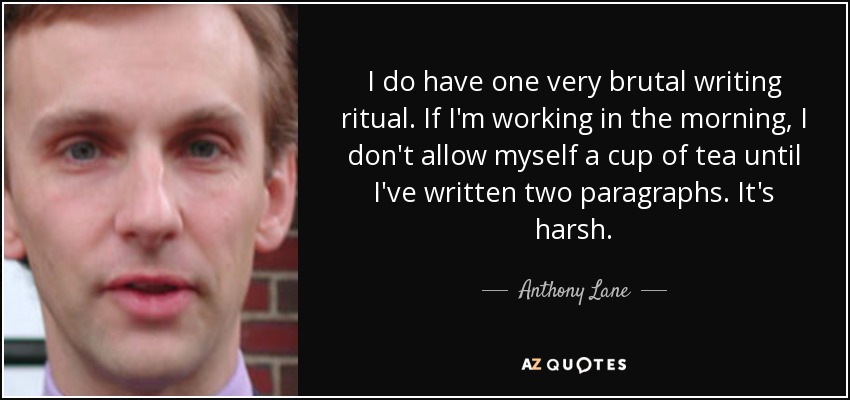
I do have one very brutal writing ritual. If I'm working in the morning, I don't allow myself a cup of tea until I've written two paragraphs. It's harsh.
With Salvage the Bones, Jesmyn Ward has written the best sort of novel-a beautiful, important book that's both unflinching and tender, heartbreaking and triumphant. A lyrical and riveting testament to the strength of the human spirit, as well as the power of family and community. Ward's paragraphs are like songs, lifting us even as the authenticity of this world and these characters keeps the ground in clear sight. This is an extraordinary book by an extraordinary writer.
Being a nerd, which is to say going too far and caring too much about a subject, is the best way to make friends I know. For me, the spark that turns an acquaintance into a friend has usually been kindled by some shared enthusiasm . . . At fifteen, I couldn't say two words about the weather or how I was doing, but I could come up with a paragraph or two about the album Charlie Parker with Strings. In high school, I made the first real friends I ever had because one of them came up to me at lunch and started talking about the Cure.
Once I got started, I wanted the life of a writer so fiercely that nothing could stop me. I wanted the intensity, the sense of aliveness that came from writing fiction. I'm still that way. My life is worth living when I've completed a good paragraph.
You kill yourself and you make a big old sacrifice and try to get your revenge. That all you're gonna end up with is a paragraph in a newspaper. In the end, it does nothing. Nothing changes. The world goes on and you're gone. The best revenge is to live on and prove yourself.
Ideally, I would create a book so interdependent and self-sustaining in its parts, so wondrously connected word by word and paragraph by paragraph, so charged with the joy of language, that it would actually float three or four inches above any table where you try to set it down.
Media reporters have pointed out that the paragraphs in my Time column this week bear close similarities to paragraphs in Jill Lepore's essay in the April 22nd issue of The New Yorker. They are right. I made a terrible mistake. It is a serious lapse and one that is entirely my fault. I apologize unreservedly to her, to my editors at Time, and to my readers.
The process of composition, messing around with paragraphs and trying to make really good prose, is hardwired into my personality.
It gave me no chance. He (Nolan Ryan) just blew it (strikeout #5,000) by me. But its an honor. I'll have another paragraph in all the baseball books. I'm already in the books three or four times.
Ideas become powerful only if they appear in the flesh; an idea which does not lead to action by the individual and by groups remains at best a paragraph or a footnote in a book.
And that's one thing that helps me is I learn it blandly, vanilla, then I don't try to act it too soon because you start to act it, and you kind of go away from what the next sentence is, what the next paragraph is. So get it down so it kind of can - it's in there so you can then, as I call it, dance on top of it.
When you're writing for newspapers you have all these parameters. You can't swear, you have to use short paragraphs, all that. If you stay within those parameters, you have lots of freedom because you're writing for the next day.
During my last year of college I wrote the same ten pages over and over again. Those ten pages became the first few pages of my first novel. I can still recite the opening paragraph from memory - only now I cringe when I do it because they are - surprise! - a classic example of overwriting, in addition to being a more than a little pretentious.
I begin by writing paragraphs that don’t have an immediate relation to a plot. The sound of the story comes first.
I never leave a sentence or a paragraph until I'm satisfied with it
If enough money is involved and enough people believe that two plus two equals five the media will report the story with a straight face always adding a qualifying paragraph noting that mathematicians however say that two plus two still equals four.
If you ask me to tell you anything about the nature of what lies beyond the phaneron… my answer is “How should I know?”… I am not dismayed by ultimate mysteries… I can no more grasp what is behind such questions as my cat can understand what is behind the clatter I make while I type this paragraph.
Public opinion is a compound of folly, weakness, prejudice, wrong feeling, right feeling, obstinacy, and newspaper paragraphs.
To one who has enjoyed the full life of any scene, of any hour, what thoughts can be recorded about it seem like the commas and semicolons in the paragraph-mere stops.
Writing for children is murder. A chapter has to be boiled down to a paragraph. Every word has to count.
Elisabeth Sheffield's new novel is multilayered, smart, beautifully written, and funny. I was taken in by the first paragraph and held firmly through the roller coaster of a ride. The depth of the novel was evidenced by the constantly shifting meaning of the title itself. In fact, the entire work never changes its meaning, but somehow, seamlessly, simply means more. This is a rare and memorable piece of work.
I just wanted to speak to you about something from the Internal Revenue Code. It is the last sentence of section 509A of the code and it reads: 'For purposes of paragraph 3, an organization described in paragraph 2 shall be deemed to include an organization described in section 501C-4, 5, or 6, which would be described in paragraph 2 if it were an organization described in section 501C-3.' And that's just one sentence out of those fifty-seven feet of books.
I'll get a three-page letter and the last paragraph says 'I know you'll never read this, but here's my number.' I love to call those people because the first thing they say is, 'Governor, I didn't mean everything I said in the letter about you.'
Read him slowly, dear girl, you must read Kipling slowly. Watch carefully where the commas fall so you can discover the natural pauses. He is a writer who used pen and ink. He looked up from the page a lot, I believe, stared through his window and listened to birds, as most writers who are alone do. Some do not know the names of birds, though he did. Your eye is too quick and North American. Think about the speed of his pen. What an appalling, barnacled old first paragraph it is otherwise.
This infantile sense of order tended to infect my life at large. Up at 5:30 a.m., coffee, oatmeal, perhaps sausage (homemade), and fresh eggs giving one of the yolks to Lola. Listening to NPR and grieving more recently over the absence of Bob Edwards who was the sound of morning as surely as birds. Reading a paragraph or two of Emerson or Loren Eiseley to raise the level of my thinking. Going out to feed the cattle if it was during our six months of bad weather.
Follow AzQuotes on Facebook, Twitter and Google+. Every day we present the best quotes! Improve yourself, find your inspiration, share with friends
or simply: