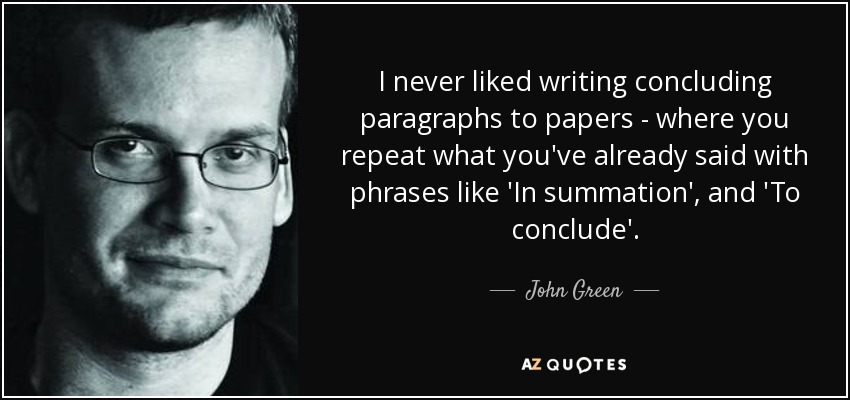
I never liked writing concluding paragraphs to papers - where you repeat what you've already said with phrases like 'In summation', and 'To conclude'.
He wrote one more paragraph for his own sake, to see what he had to say.
To me, merely and pretty were words that had nothing to do with each other. Pretty went with miraculously, and merely belonged in another paragraph entirely.
As a writer, even as a child, long before what I wrote began to be published, I developed a sense that meaning itself was resident in the rhythms of words and sentences and paragraphs...The way I write is who I am, or have become.
Kid, not everything in life can be summed up neatly in a paragraph. No book has all of the answers. Not even the really good ones. You have to find the answers yourself sometimes.
Elisabeth Sheffield's new novel is multilayered, smart, beautifully written, and funny. I was taken in by the first paragraph and held firmly through the roller coaster of a ride. The depth of the novel was evidenced by the constantly shifting meaning of the title itself. In fact, the entire work never changes its meaning, but somehow, seamlessly, simply means more. This is a rare and memorable piece of work.
I just wanted to speak to you about something from the Internal Revenue Code. It is the last sentence of section 509A of the code and it reads: 'For purposes of paragraph 3, an organization described in paragraph 2 shall be deemed to include an organization described in section 501C-4, 5, or 6, which would be described in paragraph 2 if it were an organization described in section 501C-3.' And that's just one sentence out of those fifty-seven feet of books.
Sometimes words are not enough. There are some circumstances so utterly wretched that I cannot describe them in sentences or paragraphs or even a whole series of books.
Force yourself to reflect on what you read, paragraph by paragraph.
To what level does your patriarchal blessing reach in your life? Can you recollect the time you received it and recover any of the spirit of the occasion? Do you in quiet moments ponder it? Does Karl G.Maeser's phrase, "paragraphs from the book of our possibilities" rest upon you with a sense of mission so that, as President Heber J.Grant exemplified, "you "dream nobly and manfully" and prepare ceaselessly? Do you ever think of Heber C.Kimball's faith that you can "write your own patriarchal blessing" under inspiration, for, saith the Lord, "No good thing will I withhold...
This infantile sense of order tended to infect my life at large. Up at 5:30 a.m., coffee, oatmeal, perhaps sausage (homemade), and fresh eggs giving one of the yolks to Lola. Listening to NPR and grieving more recently over the absence of Bob Edwards who was the sound of morning as surely as birds. Reading a paragraph or two of Emerson or Loren Eiseley to raise the level of my thinking. Going out to feed the cattle if it was during our six months of bad weather.
Our patriarchal blessings are paragraphs from the book of our own possibilities.
I had some words with my wife, and she had some paragraphs with me.
On May 15, 1957 Linus Pauling made an extraordinary speech to the students of Washington University. ... It was at this time that the idea of the scientists' petition against nuclear weapons tests was born. That evening we discussed it at length after dinner at my house and various ones of those present were scribbling and suggesting paragraphs. But it was Linus Pauling himself who contributed the simple prose of the petition that was much superior to any of the suggestions we were making.
Lagrange, in one of the later years of his life, imagined that he had overcome the difficulty (of the parallel axiom). He went so far as to write a paper, which he took with him to the Institute, and began to read it. But in the first paragraph something struck him that he had not observed: he muttered: 'Il faut que j'y songe encore', and put the paper in his pocket.' [I must think about it again]
Begin where you are. Read every word, every phrase, every paragraph of the mind, as it operates through thought.
What is easy to read has been difficult to write. The labour of writing and rewriting, correcting and recorrecting, is the due exacted by every good book from its author, even if he knows from the beginning exactly what he wants to say. A limpid style is invariably the result of hard labour, and the easily flowing connection of sentence with sentence and paragraph with paragraph has always been won by the sweat of the brow.
I know that if I have been working on one paragraph and I have written it three times, it goes in the bin. Unless it comes straight out, it is wrong, it is awkward, it does not fit.
And that's one thing that helps me is I learn it blandly, vanilla, then I don't try to act it too soon because you start to act it, and you kind of go away from what the next sentence is, what the next paragraph is. So get it down so it kind of can - it's in there so you can then, as I call it, dance on top of it.
Writing for children is murder. A chapter has to be boiled down to a paragraph. Every word has to count.
During my last year of college I wrote the same ten pages over and over again. Those ten pages became the first few pages of my first novel. I can still recite the opening paragraph from memory - only now I cringe when I do it because they are - surprise! - a classic example of overwriting, in addition to being a more than a little pretentious.
I begin by writing paragraphs that don’t have an immediate relation to a plot. The sound of the story comes first.
I never leave a sentence or a paragraph until I'm satisfied with it
If enough money is involved and enough people believe that two plus two equals five the media will report the story with a straight face always adding a qualifying paragraph noting that mathematicians however say that two plus two still equals four.
If you ask me to tell you anything about the nature of what lies beyond the phaneron… my answer is “How should I know?”… I am not dismayed by ultimate mysteries… I can no more grasp what is behind such questions as my cat can understand what is behind the clatter I make while I type this paragraph.
Follow AzQuotes on Facebook, Twitter and Google+. Every day we present the best quotes! Improve yourself, find your inspiration, share with friends
or simply: