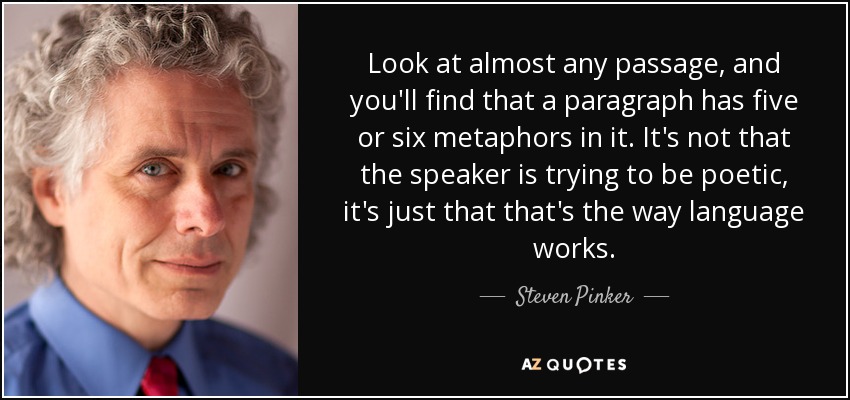
Look at almost any passage, and you'll find that a paragraph has five or six metaphors in it. It's not that the speaker is trying to be poetic, it's just that that's the way language works.
You can do the best research and be making the strongest intellectual argument, but if readers don't get past the third paragraph you've wasted your energy and valuable ink.
I count it a high honor to belong to a profession in which the good men write every paragraph, every sentence, every line, as lovingly as any Addison or Steele, and do so in full regard that by tomorrow it will have been burned, or used, if at all, to line a shelf.
Footnotes are the finer-suckered surfaces that allow testicular paragraphs to hold fast to the wider reality of the library.
When I see a paragraph shrinking under my eyes like a strip of bacon in a skillet, I know I'm on the right track.
It's Nathaniel Hawthorne Month in English. Poor Nathaniel. Does he know what they've done to him? We're reading The Scarlet Letter one sentence at a time, tearing it up and chewing on its bones. It's all about SYMBOLISM, says Hairwoman. Every word chosen by Nathaniel, every comma, every paragraph break -- these were all done on purpose. To get a decent grade in her class, we have to figure out what he was really trying to say. Why couldn't he just say what he meant? Would they pin scarlet letters on his chest? B for blunt, S for straightforward?
One thing I'd do was put a great writer's book beside the typewriter and... type out a beautiful and moving paragraph... and see those sentences rising up... and... think, 'Someday maybe I can write like that....' It was like a dream of possibilities for my own self. And maybe I began to know that there was no other way for the sentence... to... arouse the same feeling. The someone writing whose words were rising from the typewriter became like a mentor for me.... You shouldn't do it more than a few times because you must get on with your own work.
There is no exercise of the intellect which is not, in the final analysis, useless. A philosophical doctrine begins as a plausible description of the universe; with the passage of the years it becomes a mere chapter if not a paragraph or a name in the history of philosophy.
Time passes, as the novelist says. The single most useful trick of fiction for our repair and refreshment: the defeat of time. A century of family saga and a ride up an escalator can take the same number of pages. Fiction sets any conversion rate, then changes it in a syllable. The narrator’s mother carries her child up the stairs and the reader follows, for days. But World War I passes in a paragraph. I needed 125 pages to get from Labor Day to Christmas vacation. In six more words, here’s spring.
When people start writing there is this idea that you have to get everything right first time, every sentence has to be perfect, every paragraph has to be perfect, every chapter has to be perfect, but what youre doing is not any kind of public show, until youre ready for it.
The story of this man who had killed a messenger and hanged himself would make interesting reading. One could almost write a whole chapter on him. Perhaps not a whole chapter but a resonable paragraph, at any rate. There was so much else to include, and one must be firm in cutting out details. He had already chosen the title of the book, after much thought: `The Pacification of the Primitive Tribes of the Lower Niger.'
I'm very concerned with questions of language. This is what I think of when I think of myself as a writer: I'm someone who writes sentences and paragraphs. I think of the sentence - not only what it shares but, in a sense, what it looks like. I like to match words not only in a way that convey a meaning, possibly an indirect meaning, but even at times words that have a kind of visual correspondence.
For the speedy reader paragraphs become a country the eye flies over looking for landmarks, reference points, airports, restrooms, passages of sex.
The first paragraph. The last paragraph. That's where the story is going and how it's going to end. Or else you'll go off in a hundred different directions.
I write, fighting for every sentence, fighting to hold the reader with every paragraph.
Like so many aspiring writers who still have boxes of things they've written in their parents' houses, I filled notebooks with half-finished poems and stories and first paragraphs of novels that never got written.
I have such bad memories, sitting in the back of a classroom, being told, you know, everybody is going to read a paragraph, and skipping ahead to my paragraph and being mortified and trying to read it enough times so that I wouldn't stutter and stammer, getting called on, even in high school.
Sometimes when I'm really enjoying a book, I'll read a sentence or paragraph and just think - how can someone's head be wired in such a way that they'd come up with that?
This skipping is another important point. It should be done whenever a proof seems too hard or whenever a theorem or a whole paragraph does not appeal to the reader. In most cases he will be able to go on and later he may return to the parts which he skipped.
There would be a paragraph about some veteran digging tunnels for the Germans in a slave labor camp, or something like that. Finally I decided to look it up and go further into it.
Each letter of the alphabet is a steadfast loyal soldier in a great army of words, sentences, paragraphs, and stories. One letter falls, and the entire language falters.
There is a tendency to try to dumb everything down and turn everything into a one-paragraph press release or even less, just a slogan.
I huff and puff and struggle with every sentence, paragraph and page - sometimes every word as well.
The books we enjoy as children stay with us forever -- they have a special impact. Paragraph after paragraph and page after page, the author must deliver his or her best work.
How fascinating to a child are words: the shapes, sounds, textures and mysterious meanings of words; the way words link together into elastic patterns called "sentences." And these sentences into paragraphs, and beyond.
Follow AzQuotes on Facebook, Twitter and Google+. Every day we present the best quotes! Improve yourself, find your inspiration, share with friends
or simply: