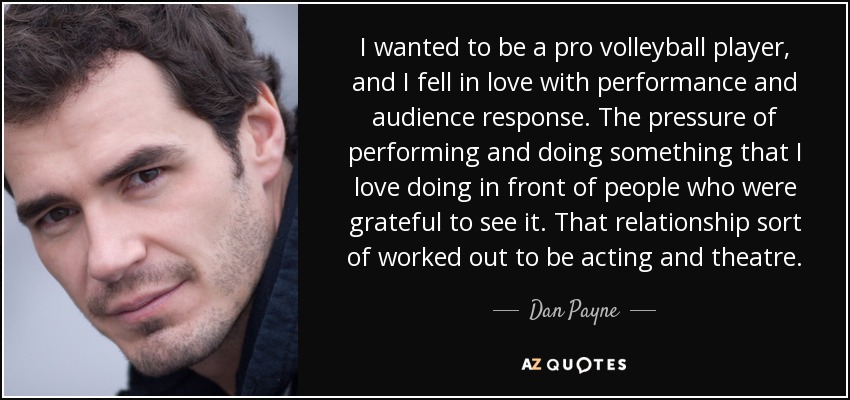
I wanted to be a pro volleyball player, and I fell in love with performance and audience response. The pressure of performing and doing something that I love doing in front of people who were grateful to see it. That relationship sort of worked out to be acting and theatre.
There is a remarkable nimbleness of style, a balancing act of tone, in Voltaire, which is hard to bring off on stage. When you speak the words out loud, the effect is very different from when you read them. So one needs to do something new with a stage performance, not simply 'tell the story'.
I have a variety of ways that I make music, but I'm working with the Thingamajigs in a particular way, which is: They are bringing to me their performance skills and their unusual instruments, which I'm relishing. They're really beautiful. The other thing is improvisation - these players improvise and they do it very beautifully, as a matter of fact.
Joey being one of my finest performances ever. Matt LeBlanc's basically doing the same thing right now, playing himself on Episodes. When I did Joey, I really leaned on them to make me the biggest ass they possibly could, because, frankly, everyone in their heart of hearts thinks of themselves that way. Or at least I do, anyway.
One of the problems of a director on the set is that we become overwhelmed by all the factors and threads of production, that sometimes we can't focus on our main job, which is steering the performances to create the whole film.
I think it's one of those things about live performance - anything goes, anything can happen, and you have to just be ready and able to roll with the punches.
When I first had a video camera to document a performance, it was in Sweden and I remember it was really crucial for me.
Typically, the performance has a story - a beginning, the crescendo and the end.
My job is to try and present the most fully-rounded character that I can, and bring a performance that people believe in.
If you mess up the performance on stage, you do it again the next night. You're like alright, you let yourself off the hook, and you've got to go back in there. Whereas, with a film, I would go home and be like, "Well, I've ruined the arc of the character forever. That scene is never going to work. I know because I can never shoot it again." So, it's all miserable, but in different ways.
As actors, we want to challenges ourselves and put ourselves in different situations to see how we react and deliver a performance.
Animators do amazing working translating and interpolating the characters [in the Planet of the apes], the facial performances. What we're creating on set - if you don't get it on the day, in the moment, on set, in front of the camera, with the director and the actors. The emotional content of the scene and the acting choices.
If someone's performance is down we do not say, 'Hey pick up your things here.' We do not yell and scream at them, we say, 'Are you okay?' The idea of putting our financials goal aside for one minute to express empathy for the human being for that work and saying, 'Are you okay?' That is part of the sacrifice.
You'll see some great performances [in Fences]. And I'm not just saying that because I directed it either! You'll see!
That's where you can find things and modulate your performance and give the other actors something fresh to respond to. We've probably all worked with actors who when it's suddenly your close up, they get sleepy. I don't like that. It's selfish acting, and I won't tolerate it.
The performances in the future would be like an audience wired to somebody who was sort of instigating, and then moment-to-moment creation would be transmuted individually.
There are performances in which the people who have the best muscle skills and musical history may be on the stage, but it's not - like a Dead show is not like a usual sit-down performance; the audience does participate.
For the actors, there's something very important about that first showing of the scene to the crew, becomes like a little performance.
I'm there [on Moana] with the other actors, so you play off one another. It's not just your idea of what the character is and what the world is like it would be in an animated [film], where it all sort of exists in your head. It's all right there, and if Diego's performance is doing what it's doing, it affects yours.
We [with Rick Rubin] would focus on the ones that we did like, that felt right and sounded right. And if I didn't like the performance on that song, I would keep trying it and do take after take until it felt comfortable with me and felt that it was coming out of me and my guitar and my voice as one, that it was right for my soul.
Having done stand-up on television and in stand-up specials for like Comedy Central, you learn quickly that for that type of performance you're playing to the camera.
I would say that I am proud of my performance from Cracker and I think a lot of that was due to the writing was just so good. It's so rare that you get such good writing these days but it was awhile ago.
There was something about Beyoncé that felt like a vessel, I guess, that I could kind of impose all of these feelings and thoughts onto. I was drawn to a little bit of a dichotomy between the glamour and celebrity and the very deep and complex legacy of black women, and what that means in terms of performance.
I think a lot of teachers want to talk about how to continually improve performance.
We need to increase the capacity; we need to improve performance so that we are more effective at lending that kind of support.
Follow AzQuotes on Facebook, Twitter and Google+. Every day we present the best quotes! Improve yourself, find your inspiration, share with friends
or simply: