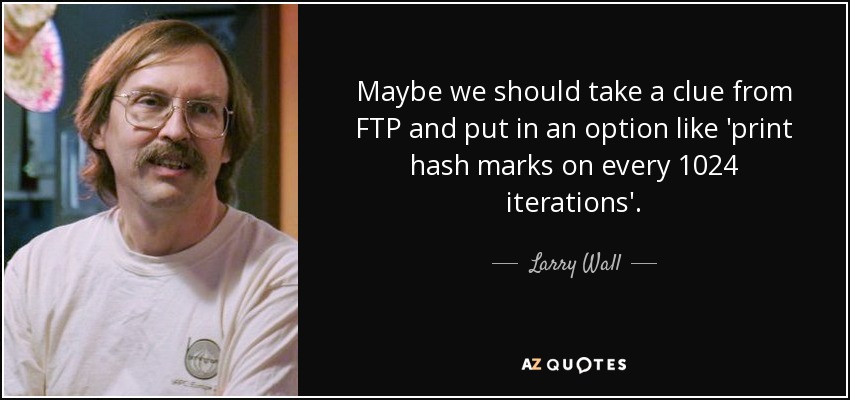
Maybe we should take a clue from FTP and put in an option like 'print hash marks on every 1024 iterations'.
Collage – SS13 offers a very controlled and pure do-it-yourself attitude. The collection shows a juxtaposition of very different materials, prints and colours, therefore giving the wearer a possibility to combine the garments in different ways.
I have always been drawn to the beauty of things designed to function. Mixing technical pieces with more traditional prints and patterns creates not only a quality experience, but a look that is unique, and for me, very exciting.
I had rather, if cruelty has been prevented by the four prints [The Four Stages of Cruelty], be maker of them than of the [Raphael] cartoons.
Bond investors want growth much like equity investors, and to the extent that too much austerity leads to recession or stagnation then credit spreads widen out - even if a country can print its own currency and write its own cheques.
As I always say, leopard print is a neutral.
Why does the UN need to raise money for ebola? Can't the gov just print the damn dollars themselves and get this done already.
Basically, any material you can squeeze, melt or generate into a powder, you can print.
From the season I did the butterfly faux tattoos on the models on the runway, every collection we do has to have a butterfly t-shirt or trim or print. People come to me for butterflies!
In the media, traditional media like print, we had boundaries. You know, we had spaces that ads didn't leave. They stayed where they were on the page. They didn't float around over the text. And we're kind of lost on the internet. We don't have any barriers. We have a demand for growth that is insistent.
Reporters are not merely recording devices that take down what people say and repeat it in print; we are expected to use our knowledge and experience both for triage - deciding what's important to cover and what isn't - and for contextualizing, analyzing and such.
Native advertising covers an awful lot of stuff. In many ways, it's just an extension of what in print had been called for years an advertorial.
The issues for journalism and journalists, we see obvious places where presentation is very different in a digital space from traditional print. If you go to a New York Times homepage, you cannot get to a story about the Ukraine without a click-off on a banner ad or a slide show. They're not alone in that - you think you're clicking on a video about a news event and you have a 30-second ad that you have to watch before you can get to it.
If our brands are going to be in print and on mobile handsets and in video and events, we have to acknowledge that the playing fields are going to be different than a print-only product or a print product with extensions to it.
Especially with a magazine like Lampoon, which was very dependent on newsstand sales. Our readers didn't usually occupy the same address long enough to get a subscription, because they were in college, or they were hippies. So it was very up-and-down, and we had to calculate how many to print, which was always sort of a headache from a business point of view.
I've never told anybody this, so I don't know if maybe you shouldn't print it, but I've made plans. I'm only going to continue doing this for another 25 years.
The New York Times claims that they publish all the news that's fit to print but what they really do is print all the news that supports their agenda. What they are is the power base of the left.
When Emily Dickinson's poems were published in the 1890s, they were a best-seller; the first book of her poems went through eleven editions of a print run of about 400. So the first print run out of Boston for a first book of poems was 400 for a country that had fifty million people in it. Now a first print run for a first book is maybe 2,000? So that's a five-time increase in the expectation of readership. Probably the audience is almost exactly the same size as it was in 1900, if you just took that one example.
When I look at a digitally acquired and projected image, it looks inferior against an original negative anamorphic print or an IMAX one.
One-newspaper towns are not good because all the surviving newspaper does is print money. They make 25 percent on their money every year, and if they go down to 22 percent, they start laying people off.
For me, I don't even like to promote my films but I have to because it's in the fine print of my contract.
In the '30s, the Keynesian stuff worked at least in the sense that you could print money without inflation because there was all this productivity growth happening. That's not going to work today.
That said, I can't emphasise enough - and I hope you print this - that I absolutely don't judge anybody at all who has an abortion, nor do I think they are murderers, nor do I think they are baby killers.
I have asked students at the beginning of their careers, what things of that sort might haunt them – what things they must photograph, things they have to try to shoot even before they master the intricacies of making dye transfer prints.
In the sea of words, the in print is foam, surf bubbles riding the top. And it's a dark sea, and deep, where divers need lights on their helmets and would perish at the lower depths.
Follow AzQuotes on Facebook, Twitter and Google+. Every day we present the best quotes! Improve yourself, find your inspiration, share with friends
or simply: