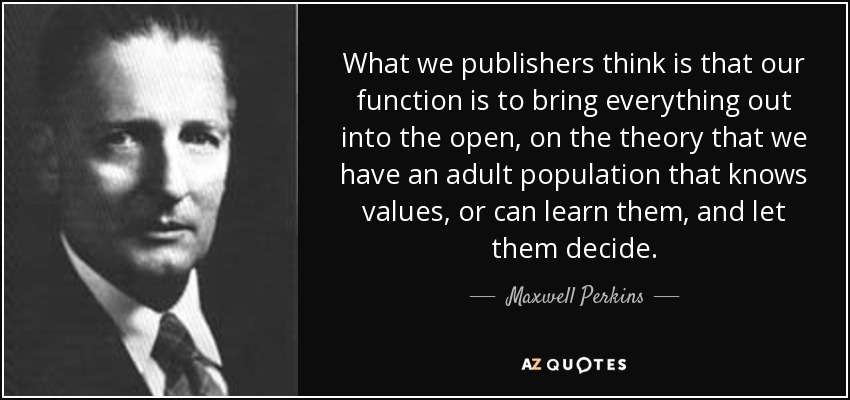
What we publishers think is that our function is to bring everything out into the open, on the theory that we have an adult population that knows values, or can learn them, and let them decide.
Never the less, at the age of fifteen, having never seen a writer, a poet, a publisher or a magazine editor, and having only the vaguest ideas of procedure, I began working on the profession I had chosen.
Freedom of the press, or, to be more precise, the benefit of freedom of the press, belongs to everyone – to the citizen as well as the publisher… The crux is not the publisher’s ‘freedom to print’; it is, rather, the citizen’s ‘right to know.’
The model of publishing is changing and its happening right now, but most publishers are so frightened, they just dont know how to embrace it.
I am my brain's publisher.
My father was a writer, so I grew up writing and reading and I was really encouraged by him. I had some sort of gift and when it came time to try to find a publisher I had a little bit of an "in" because I had his agent I could turn to, to at least read my initial offerings when I was about 20. But the only problem was that they were just awful, they were just terrible stories and my agent, who ended up being my agent, was very, very sweet about it, but it took about four years until I actually had something worth trying to sell.
In the usual way I submitted manuscripts to publishers. This was not so much a feeling that I should be published as a wish to escape the feared and hated drudgery of "normal" work. In my twenties some of my work for children was published by Macmillan. However, I was twenty-seven before my adult novel, The Birthgrave, was taken by DAW Books in the USA. This enabled me finally to stop doing stupid and soul-killing jobs, and start working day and night as a professional writer. It felt like a rescue from damnation, and still does.
Many of the early greats of sf Hugo Gernsback (publisher of Amazing Stories) in particular saw themselves as educators. The didactic thrust of science fiction got the genre initially pegged as children's fare. It was seen, at its best, as an extension of school and, at its worst, as teenage wish fulfillment.
WikiLeaks is really a litmus test for those people who walk the talk in the media. How much will they really follow their protestations to be brave publishers, and how much do they really want to lick the boots of power? Well, you can tell by their engagement with us and what they do.
I never had a plan, except to write. I love what I do, and have from the beginning. Loving what you do makes it a lot easier to work, every day, to face the tough spots and heel in for the long haul. Nothing against plans; they work for some people. But for me, if I'd been planning, worrying about numbers, trying to micro-manage my career, I wouldn't have focused on the writing. If you don't write, you're not read. If you're not read, you don't sell. So that's my Master Plan, I guess. Write the books, let the agent agent, the editor edit, the publisher publish.
I guess I'm what you call a slush-piler. I just sent my manuscripts to the slush pile of publishers and hoped for the best. Over seven years, I was rejected seven times on three different books. The fourth attempt was picked up by a small publisher, and I still have great memories of staying up all night, talking to my brother and sisters (my dad called me at 2:30 in the morning because I was overseas).
Character is everything, especially these days when that's what publishers are asking for. Make sure that yours have child appeal. Also don't have a huge cast of characters. One or two is best, four, the maximum.
No book, no matter how good, has a chance of reaching a large audience unless the publisher SEES the book's value.
I didn't write professionally at first. It took me nine years to get anything published. At the beginning I mostly wrote picture books, which were rejected by every children's book publisher in America. The first book of mine to be accepted for publication was ELLA ENCHANTED, and not one but two publishers wanted it. That day, April 17, 1996, was one of the happiest in my life.
The Revelation was my master's project, and after I finished it, I thought I'd send it off to a publisher and within a year or so be a rich and famous writer. Two years later I finally sold it. For a whopping $4,000. A year after that, it finally came out. Which explains why there are all those terrible jobs on my resume!
Indeed, being a beginner is very difficult right now. Book publishers are in a crisis, sales are dwindling, and publishing houses are losing money, doing their best to survive. It's a sign of the times, the emergence of new kinds of entertainment -- there's nothing we can do about it. I don't think books will perish for good. They could become less widespread, though, falling even further behind movies and computer games. But we shouldn't be afraid of this, because books will always remain the entertainment of choice for intelligent people, of whom there are still many in this world.
Publishers are humane men, and rarely commit crimes. Authors, however, are a hardened set, who usually perpertrate a felony every time they issue a book.
I had a publisher who felt comics were just for little kiddies, so he never wanted me to use words of more than two syllables.
Much as constitutional guarantees of press freedom do little good for prospective publishers if they do not have access to paper or ink, the right to aid in dying is strikingly useless if nobody is willing to help.
Paper publishers are doing everything they can to slow the transition to eBooks because, in a digital world, paper publishers' high hardback margins essentially disappear.
I make a good living selling hardback books through paper publishers and I have many friends in the industry who will suffer as it changes, so on a personal level the transition to digital isn't something I welcome wholeheartedly.
All publishers are Columbuses. The successful author is their America. The reflection that they-like Columbus-didn't discover what they expected to discover, and didn't discover what they started out to discover, doesn't trouble them. All they remember is that they discovered America; they forget that they started out to discover some patch or corner of India.
In the long run, the quality of your work is all that matters. That is your only resumé. Be professional. Make sure your editor or publisher can always reach you. Do what's asked of you if your conscience can bear it.
The idea that comics stores, distributors and publishers simply 'give the customers what they want' is nonsense. What the customers wanted they didn't get - and they left.
We'd love to do Space Ace 3D. It has a lot of potential. But, it is really up to the publishers.
Follow AzQuotes on Facebook, Twitter and Google+. Every day we present the best quotes! Improve yourself, find your inspiration, share with friends
or simply: