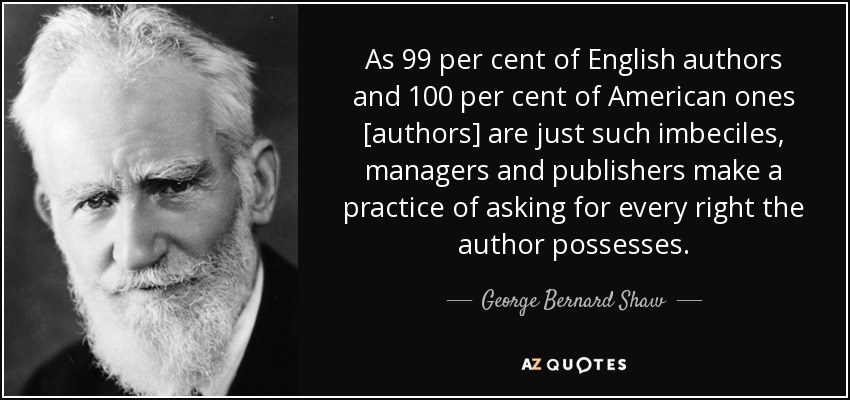
As 99 per cent of English authors and 100 per cent of American ones [authors] are just such imbeciles, managers and publishers make a practice of asking for every right the author possesses.
Every author knows what a stimulus it is to have an understanding publisher.
Many persons erroneously suppose that an author has always on hand an unlimited number of her own books; or that the publisher will kindly give her as many as she can want for herself and friends. This is by no means the case.
Publishers never tell writers anything. They're all crazy and they drive me crazy.
Whenever I go to work I wear a jacket and a tie, because I'm inherently quite lazy, and my books take so long to do, and my publishers don't bug me, so it's so easy to fool yourself into thinking you're working harder than you really are.
I object to publishers: the one service they have done me is to teach me to do without them. They combine commercial rascality with artistic touchiness and pettishness, without being either good business men or fine judges of literature.
A young poet in America should not be advised at the outset to give up all for the Muse-to seclude himself in the country, to live hand from mouth in Greenwich Village or to escape to the Riviera. I should not advise him even to become a magazine editor or work in a publisher's office. The poet would do better to study a profession, to become a banker or a public official or even to go in for the movies.
I think in daily newspapers, the way comic strips are treated, it's as if newspaper publishers are going out of their way to kill the medium. They're printing the comics so small that most strips are just talking heads, and if you look back at the glory days of comic strips, you can see that they were showcases for some of the best pop art ever to come out.
I don't believe in publishers who wish to butter their bannocks on both sides while they'll hardly allow an author to smell treacle. I consider they are too grabby altogether and like Methodists they love to keep the Sabbath and everything else they can lay hands upon.
My first two books did nada. I ended up paying the publishers.
Each of my books has taken me a different length of time to write - eight months for Seesaw Girl, eight months for Shard, three years for When My Name Was Keoko! The publisher takes another year and a half to work on the book, so altogether each book can take up to three or four years to publish.
"Eight Days of Luke" was refused by another confused publisher on the grounds that children shouldn't strike matches. When my agent pointed out that David in the book was twelve years old, the publisher said that he was striking matches to summon the devil, then, and this couldn't be allowed.
As a writer, its important to stay true to your story without giving a hoot about publishers, critics and readers. You should do your karma as an author the way you want to, and rest is up to God.
Publishers are private businesspeople who must reach their economic goals independently.
We were to found a University magazine. A pair of little, active brothers-Livingstone by name, great skippers on the foot, great rubbers of the hands, who kept a book-shop over against the University building-had been debauched to play the part of publishers. We four were to be conjuct editors and, what was the main point of the concern, to print our own works; while, by every rule of arithmetic-that flatterer of credulity-the adventure must succeed and bring great profit. Well, well: it was a bright vision.
I had been writing comic books for years and I was doing them to please a publisher, who felt that comics are only read by very young children or stupid adults. And therefore, we have to keep the stories very simplistic... And those were all things I hated.
The cliché I tried to avoid was I hated "teenage sidekicks." I always figured if I were a superhero, there's no way on God's earth that I'm gonna pal around with some teenager. So my publisher insisted I have a teenager in the series, because they always felt teenagers won't read the books unless there's a teenager in the story; which is nonsense.
I like the idea of standalone novels. I always found with series of books, it's something that publishers love obviously because they can make a lot of money and they build an audience from book to book, but I don't like that as a writer. I prefer the idea of just telling a story, completing it within your book, and moving on and not forcing a child to read eight of them.
I actually produced other people's vocals for a long time when I first signed my publishing deal and I had just sort of decided that I only wanted to be a writer. I would be in all of these writing sessions, and a lot of times my publisher would say, "You should get a demo singer to sing it because then it doesn't identify as a Solange song."
There is always a certain leap of faith that editors have made with their nonfiction writers. If the trust is broken, things can get very embarrassing for the writers and the publisher.
Although I still write, research and investigate, my role is primarily that of a publisher and editor-in-chief who organises and directs other journalists.
I can understand the allure of a venerable Big Six imprint, of a shot at the New York Times list, of a publisher-sponsored book tour, of seeing your hardbacks in bookstores and your paperbacks in supermarkets.
I don't relax. My main relaxation is meeting illustrators and publishers in restaurants and bars.
Bookstores will not disappear but will exploit digital technologies to increase their virtual and physical inventories, and perhaps become publishers themselves.
Writers generally get into writing because they want to write, not because they want to be independent publishers, and you can't really fault someone for saying, 'What I'm doing right now works, so there's no reason to change it.'
Follow AzQuotes on Facebook, Twitter and Google+. Every day we present the best quotes! Improve yourself, find your inspiration, share with friends
or simply: