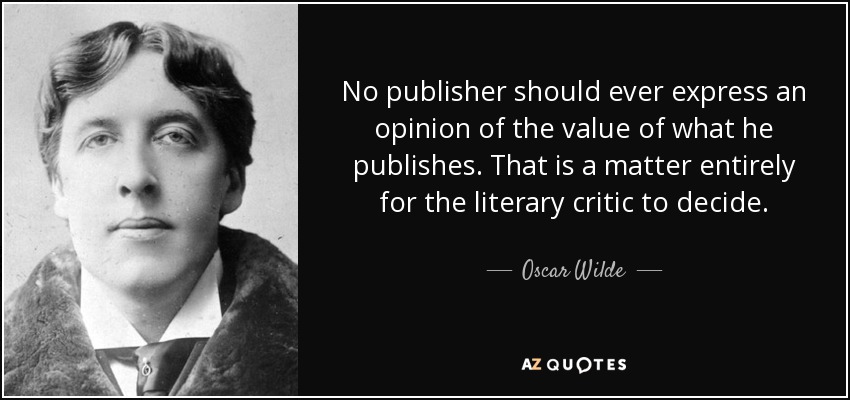
No publisher should ever express an opinion of the value of what he publishes. That is a matter entirely for the literary critic to decide.
No one wants to see a play called 'Lady Windermere's Fan'. It's going to be called 'Cocks in Frocks II' or I will find another publisher
A publisher is simply a useful middle-man.
One, I have a wonderful publisher, Black Sparrow Press; as long as they exist, they will keep me in print. And they claim they sell very respectable numbers of my books, so I guess, and it's true, every place I go, my books are in libraries and on bookshelves.
Printed books usually outlive bookstores and the publishers who brought them out. They sit around, demanding nothing, for decades. That's one of their nicest qualities - their brute persistence.
I've worked with many large and small publishers, and nearly all of them love the value that Instapaper provides to their readers.
Once in 1919, when I was traveling at night by train, I wrote a short story. In the town where the train stopped, I took the story to the publisher of the newspaper who published the story.
But if I worried too much about publishers' expectations, I'd probably paralyze myself and not be able to write anything.
As I said, I had no publisher for What a Carve Up! while I was writing it, so all we had to live off was my wife's money and little bits I was picking up for journalism.
When you are out of favor, so to speak, it's not just the reviewers. It's the editors, the publishers, they don't want you anymore, you're just gone and you've been written out of history as effectively as the old Stalinists would write someone else out, take their photograph out of a book.
I had an idea for a medical conspiracy thriller. Since it was non-horror, I didn't want the publishers and editors bringing a lot of baggage - my history as a genre writer in the SF and horror fields, for instance - to the novel when they read it. I wanted them to consider the book solely on its own merits. So I called myself Colin Andrews. I was tired of seeing my books at floor level. Not that Herman Wouk and Phyllis Whitney and William Wharton are bad company, but I wanted to be up at eye level for a change, where people with bad backs could get a chance to see my books.
I just hope that readers and publishers continue to appreciate good writing and good storytelling in all their various forms. And I hope that people continue to read books, even though we have so many other options for entertainment.
I started with small-press publishers, who were willing to publish all sorts of forms. I didn't move to the larger presses until they knew what they were getting in for.
As for the multiple editions, in the case of a truly great writer - Shakespeare, Emily Dickinson, Proust, someone with a canon - there is often a "variorum" edition of the work that presents its variants. I think publishing most other writing that way would be impossible, economically, for publishers, and very ill-advised for authors.
Most writers can write books faster than publishers can write checks.
Your turn Imagine that the world had no middlemen, no publishers, no bosses, no HR folks, no one telling you what you couldn’t do. If you lived in that world, what would you do? Go. Do that.
The real effect of the WTC calamity has been depressed spirits, anxiety, and uncertainty among publishers, and of course those emotions are not restricted to publishers.
By preventing a free market in education, a handful of social engineers - backed by the industries that profit from compulsory schooling: teacher colleges, textbook publishers, materials suppliers, et al. - have ensured that most of our children will not have an education, even though they may be thoroughly schooled.
Madly, futilely, I wrote novel after novel, eight in all, that failed to find a publisher. I persisted because for me the novel was the supreme literary form: not just one among many, not a relic of the past, but the way we communicate to one another the subtlest truths about this business of living.
But every fool describes, in these bright days, His wondrous journey to some foreign court, And spawns his quarto, and demands your praise,-- Death to his publisher, to him 'tis sport.
At forty my faculties may have closed up like flowers at evening, leaving me unable to write my memoirs with a fitting and discreet inaccuracy, or, having written them, unable to carry them to the publisher.
The most evil person I ever met was a toss-up between Pablo Picasso and the publisher-crook Robert Maxwell.
Critics have found in the narrative a veneer of erudition that cloaks nothing more than a James Bond-style romp, albeit a highly addictive one. His publisher has described it as 'a thriller for people who don't like thrillers'. One newspaper put it thus: 'It is terribly written, its characters are cardboard cutouts, the dialogue is excruciating in places and, a bit like a computer manual, everything is overstated and repeated - but it is impossible to put the bloody thing down.
I do not like the reappearance of the Jesuits.... Shall we not have regular swarms of them here, in as many disguises as only a king of the gipsies can assume, dressed as printers, publishers, writers and schoolmasters? If ever there was a body of men who merited damnation on earth and in Hell, it is this society of Loyola's. Nevertheless, we are compelled by our system of religious toleration to offer them an asylum.
The syndicates take the strip and sell it to newspapers and split the income with the cartoonists. Syndicates are essentially agents. Now, can you imagine a novelist giving his literary agent the ownership of his characters and all reprint, television, and movie rights before the agent takes the manuscript to a publisher? Obviously, an author would have to be a raving lunatic to agree to such a deal, but virtually every cartoonist does exactly that when a syndicate demands ownership before agreeing to sell the strip to newspapers.
Follow AzQuotes on Facebook, Twitter and Google+. Every day we present the best quotes! Improve yourself, find your inspiration, share with friends
or simply: