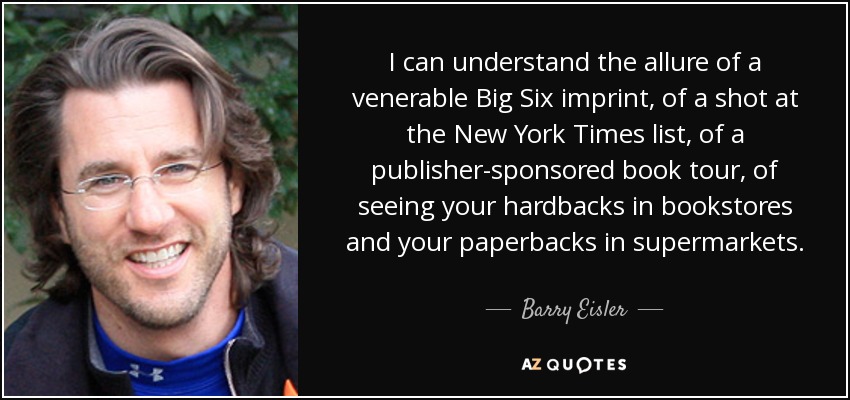
I can understand the allure of a venerable Big Six imprint, of a shot at the New York Times list, of a publisher-sponsored book tour, of seeing your hardbacks in bookstores and your paperbacks in supermarkets.
I don't relax. My main relaxation is meeting illustrators and publishers in restaurants and bars.
Bookstores will not disappear but will exploit digital technologies to increase their virtual and physical inventories, and perhaps become publishers themselves.
Publishers seem to be in an alcoholic haze most of the time. Well, the publishers have no idea what a writer is.
No publisher should ever express an opinion of the value of what he publishes. That is a matter entirely for the literary critic to decide.
No one wants to see a play called 'Lady Windermere's Fan'. It's going to be called 'Cocks in Frocks II' or I will find another publisher
A publisher is simply a useful middle-man.
Publishing is no longer simply a matter of picking worthy manuscripts and putting them on offer. It is now as important to market books properly, to work with the bookstore chains to getterms, co-op advertising, and the like. The difficulty is that publishers who can market are most often not the publishers with worthy lists.
Publishers are all cohorts of the devil; there must be a special hell for them somewhere.
No author is a man of genius to his publisher.
I was dropped by my publisher after my first two books. But I always believed in myself.
The talk shows are stuffed full of sufferers who have regained their health--congressmen who suffered through a serious spell of boozing and skirt-chasing, White House aides who were stricken cruelly with overweening ambition, movie stars and baseball players who came down with acute cases of wanting to trash hotel rooms while under the influence of recreational drugs. Most of them have found God, or at least a publisher.
It wasn't the Supreme Court that expelled God from our public school classrooms. It was the textbook publishers.
Postal inspectors have been given advanced warning that Publishers Clearinghouse is sending packets of laundry detergent that could be mistaken for anthrax. Oh, good timing. What genius came up with this promotion? What's next - a ticking alarm clock? Let's put that in a box.
a. Critics: people who make monuments out of books. b. Biographers: people who make books out of monuments. c. Poets: people who raze monuments. d. Publishers: people who sell rubble. e. Readers: people who buy it.
I believe that all brands will become storytellers, editors and publishers, all stores will become magazines, and all media companies will become stores. There will be too many of all of them. The strongest ones, the ones who offer the best customer experience, will survive.
Authors by the hundreds can tell you stories by the thousands of those rejection slips before they found a publisher who was willing to 'gamble' on an unknown.
You had censorship. If you brought a manuscript to the publisher, you knew he would suggest changes. If you wanted to write and speak what you thought had to be written and spoken, you had to act against all these suppressive rules.
Music is everybody's possession. It's only publishers who think that people own it. If you were going to give Rock 'n' Roll another name you might as well call it Chuck Berry. We're more popular than Jesus now; I don't know which will go first - Rock and Roll or Christianity.
To aspiring writers, I would tell them that we live in a wonderful time where you're able to make your work visible, easily. If you think about it, even ten years ago or twenty years ago, there was a middle man, there was a publisher, there were studios, there was this world of rejection letters. Now, we're in a place where we have the technology and the ability to go shoot our own movies or to put stuff on YouTube or a blog, if you're a writer, or self-publish.
That's absolutely true, but one problem with the digital revolution, which may tie into what I said earlier, is that there can be a collapse of quality. You may not have liked the decisions made by publishers in the past, you may not have liked the decisions made by magazine editors or newspaper editors in the past. At least there was some quality control
If the big publishers are doing so well, why do they require writers to send return postage with their manuscripts?
I prefer short stories, but publishers would, of course, rather that writers produce novels, since novels are still more commercially viable.
Write what you want to read. So many people think they need to write a particular kind of book, or imitate a successful style, in order to be published. I've known people who felt they had to model their book on existing blockbusters, or write in a genre that's supposed to be "hot right now" in order to get agents and publishers interested. But if you're writing in a genre you don't like, or modeling yourself on a book you don't respect, it'll show through. You're your first, most important reader, so write the book that reader really wants to read.
Chapter books are often written in series and kids have come to expect that they'll come out once a year, so publishers want to keep the momentum going. It's the kind of art I love to make, except that the time frame is really nutty.
Follow AzQuotes on Facebook, Twitter and Google+. Every day we present the best quotes! Improve yourself, find your inspiration, share with friends
or simply: