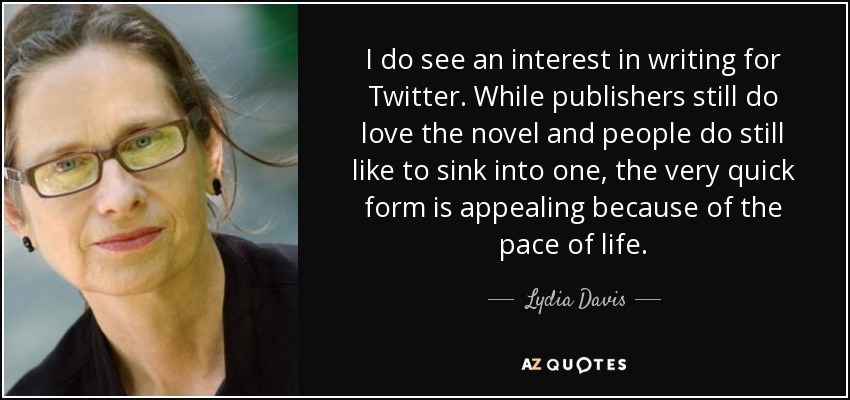
I do see an interest in writing for Twitter. While publishers still do love the novel and people do still like to sink into one, the very quick form is appealing because of the pace of life.
I'm not a great shopper but I do buy a lot of books. I'm the publishers' friend - I buy a hundred books a year and read four.
We need an unambiguous rule - a law - that nobody will step between the publisher and the consumer, full stop.
I think it would be a shame for any writer to let their publishers in any way corral them into a single genre.
Jonah Peretti is one of the smartest web publishers out there. And Buzzfeed is an aggressive and dynamic company.
As soon as I finish a book, I sell the paperback rights to different publishers and that's where I recoup my money.
Publishers give you deadlines for those last phases of production that are perfectly comfortable for them. So, to whatever extent I can, I like to push those to give me a little more time, and make it so that they're as uncomfortable as I am.
The Nobel Prize is the best thing that can happen to a writer in terms of how it affects your contracts, the publishers, and the seriousness with which your work is taken. On the other hand, it does interfere with your private life, or it can if you let it, and it has zero effect on the writing. It doesn't help you write better and if you let it, it will intimidate you about future projects.
Elizabeth Barrett Browning could write a poem two pages long. Could she have brought it to a music publisher?
The expectation was that 'True Confessions' would be my first published book, but that didn't happen. After it was rejected by every publisher in New York and Canada, I shoved it in a closet and went on to write and publish my next three books.
New York is the Hollywood of the publishing industry, complete with stars, starlets, suicidal publishers/producers, intrigues, and a lot of money.
People have bad things to say about publishers, but I think they still have services, and I want to see what they are. And if they end up not being any good, I don't have to keep using them.
My publishers are wonderful because they have let me write what I wanted to. They're wise enough to know that, with any author who's not simply writing formulas - who's trying to create something new - pressuring them to do something for market purposes almost always backfires. I can't imagine working under those circumstances, actually.
Coming into the business, you'd pass through these little agencies until you got to understand what was happening in the business, unless you were really able to have a style strong enough to go directly to the publishers.
That the Op-Ed page is very important in readers' and the nation's perception of the Times, the perception of its editorial positions, and of its implicit editorial positions as expressed by the publisher's choice of people who are given the freedom to write opinion columns.
I think writers have to be proactive: they've got to use new technology and social media. Yes, it's hard to get noticed by traditional publishers, but there's a great deal of opportunity out there if you've got the right story.
My first novel was turned down by half a dozen publishers. And even after having published five or six books, I wasn't making enough money to live on, and was beginning to think I'd have to give up the dream of being a full-time writer.
I had a job, I got ill, I left the job to get better, and while I was getting better, I wrote some stories. I sent them to some publishers and the fifth one who replied said they'd take them. Then they went bankrupt. Then that bankrupt publisher got bought by a bigger firm. Story: in the end is the beginning, and in the beginning is the end.
And books that were published in much larger numbers than Selfish, Little are hard to find. And publishers who wanted to publish my last few works have them stuck in limbo while new distribution ideas and legal issues and fears are blown away.
Many of the early greats of sf Hugo Gernsback (publisher of Amazing Stories) in particular saw themselves as educators. The didactic thrust of science fiction got the genre initially pegged as children's fare. It was seen, at its best, as an extension of school and, at its worst, as teenage wish fulfillment.
Can a one judge sitting somewhere in a trial court issue an order that says nobody in the world is allowed to have, to use, to improve or to develop software for playing multimedia content without the permission of the manufacturers of the content themselves? .. This is an astonishing development in the course of our understanding of what we call the copyright bargain, the relationship between authors' rights, publishers' leverages and consumers' needs.
What we publishers think is that our function is to bring everything out into the open, on the theory that we have an adult population that knows values, or can learn them, and let them decide.
Never the less, at the age of fifteen, having never seen a writer, a poet, a publisher or a magazine editor, and having only the vaguest ideas of procedure, I began working on the profession I had chosen.
Freedom of the press, or, to be more precise, the benefit of freedom of the press, belongs to everyone – to the citizen as well as the publisher… The crux is not the publisher’s ‘freedom to print’; it is, rather, the citizen’s ‘right to know.’
The model of publishing is changing and its happening right now, but most publishers are so frightened, they just dont know how to embrace it.
Follow AzQuotes on Facebook, Twitter and Google+. Every day we present the best quotes! Improve yourself, find your inspiration, share with friends
or simply: