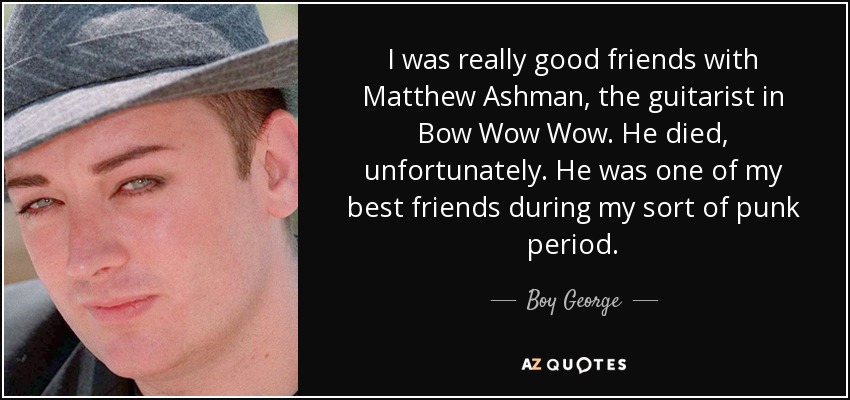
I was really good friends with Matthew Ashman, the guitarist in Bow Wow Wow. He died, unfortunately. He was one of my best friends during my sort of punk period.
I was about 16 when punk started to happen. It was so exciting. You had a social depression going on in the U.K. There was a sanitation strike. London was really grim, gray. You had Margaret Thatcher coming in. It was a really revolutionary time.
I was about 16 when punk started to happen... It felt like you had this naive idea that you could change things just by wearing something.
Certain punk bands were influential because I thought, If they can do that then I can .Hanging around those bands was how I started my first band - In Praise of Lemmings.
What characterized the whole punk scene for me in 1977 was there was no racism or sexism. It was an anarchy of -isms, and a matter of abolishing it all.
It seems like the powers that be are really trying to separate everything and really divide the genres and divide the trends. If you're metal and you don't sound like Slayer would sound now, then you're not metal. If you're punk rock and you don't sound like and preach about what The Sex Pistols would have preached about back in the day, then you're not really punk rock.
I think I take my style from all walks of life, and all generations and decades of life as well. I love mixing '50s with '80s and classic with punk.
On a scale of one to ten, how punk am I? Apple. I don't use your scale.
When the 'godfather of punk' thing started floatin' around, it was, I was really, really embarrassed. I thought I should have a great, big rig and a cape and everything, and it was very embarrassing. And then after a while, you learn that if people call you anything, this is a great gift.
In Fall Out Boy, we were all playing with our pop punk influences, so that was always within that kind of framework.
I'd been a Bowie fan before punk and used to get no end of trouble. I was always getting knocked about and having to run up the street, getting chased by people. It was horrible.
The underground scene is still a cool way to meet a lot of cool people, see a lot of interesting bands and get a lot of food for thought, but people have to remain curious and get their brain activity food from other places besides punk.
Caitlin Cary and I were always talking about X when we talked about whiskeytown, before it became an actual band. We like the concept of there being no real front person in X, yet this kind of switch up of vocals and really their sheer power, and their ability to sort of bastardise punk rock and midwetsren rock and even country into their own sound.
I grabbed my drummer's cymbal in my teeth just as he crashed down on it with his sticks-I blacked out. I was a punk in those days. It was in Seattle. I still have all my teeth too, it's amazing.
TALLAHASSEE LASSIE was a record I wrote with my mom. A number of other famous groups have also recorded it such as Led Zeppelin (I understand they are currently touring) and several other English bands and also some various "Punk Bands".
I have a theory that musicians recognize each other and if they are destined to collaborate together they will. Mainly, they recognize each other according to the class they belong to. If they are punk-rocker kids from the neighborhood, they are going form a band. If they happen to be musicians that are going to play in pubs and restaurants, they are going to recognize each other, form a band and play together. If it's about musicians that are playing jazz and are going to jazz festivals, for e.g., then they are going to meet and work together.
The first thing that got to me was seeing David Bowie on a children's TV show, but Bowie was way beyond my aspirations. The Buzzcocks' Spiral Scratch came out in 1977 and it had a breakdown of the recording costs, then you saw Pete Shelley playing a broken guitar from Woolworths. We already had an idea of the kind of music we wanted to do, but punk showed us a way to do it.
It's funny how film is the slowest art form to adapt to freedom. It's had freedom all along. It could've done whatever it wanted to. You know the same freedom that do-it-yourself punk and post-punk musicians had in the late 70s and ever since. That's about the time I started getting interested in film, and I assumed that film would be moving along with the other pop culture forms. Its finally done it but it's taken decades for it to catch up just to basement band level.
I was starting to play the ukulele at the same time I was having all these conversations with [the late Ramones guitarist] Johnny Ramone, these intense tutorials staying up late and listening to the music he grew up on, and picking up what's a great song and what makes a great song. He was all about lists and dissecting songs, like what's a better song by Cheap Trick: "No Surrender" or "Dream Police"? Sometimes you'd be surprised by the answer. It was an interesting dichotomy between hanging out with the godfather of punk rock and starting to play the ukulele. They came together.
Punk and all that was just an image that ripped people off. Johnny Rotten's a wanker, and that's all there is to it.
Punk is the way of those who are unable to express themselves, but they aren't dangerous; at worst, they may kill their audience.
Punk [rock] seemed like rock 'n' roll music utterly without the music.
When skateboarding and punk merged, it really became a large teen subculture.
I've played death metal, punk rock, hardcore, funk... I've done it all. And all there really is music and at the end of the day, anybody who has a record and puts out a record that's basically the same song 13 times over on one record; to me they're just cheating the fans.
Jealous punks can't stop my dunks.
Follow AzQuotes on Facebook, Twitter and Google+. Every day we present the best quotes! Improve yourself, find your inspiration, share with friends
or simply: