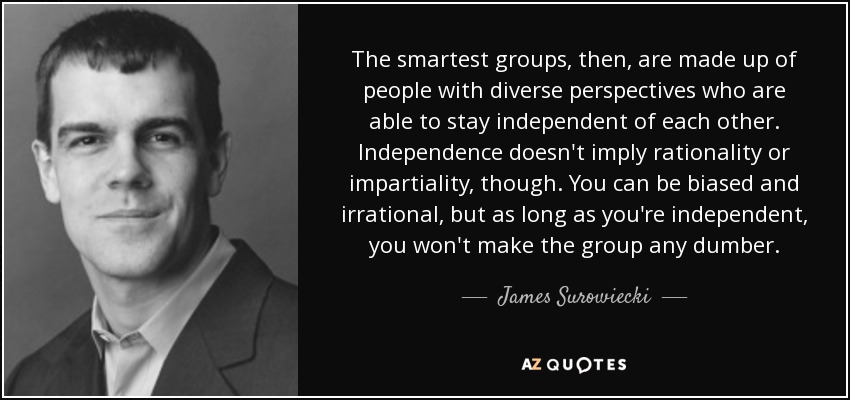
The smartest groups, then, are made up of people with diverse perspectives who are able to stay independent of each other. Independence doesn't imply rationality or impartiality, though. You can be biased and irrational, but as long as you're independent, you won't make the group any dumber.
In healthy individuals, emotions don't distort rationality, they enhance it!
The rationale for accepting or rejecting any theory is thus fundamentally based on the idea of problem-solving progress. If one research tradition has solved more important problems than its rivals, then accepting that tradition is rational precisely to the degree that we are aiming to "progress," i.e., to maximize the scope f solved problems. In other words, the choice of one tradition over its rivals is a progressive (and thus a rational) choice precisely to the extent that the chosen tradition is a better problem solver than its rivals.
Addressing the conclusions of The God Delusion point by point with the devastating insight of a molecular biologist turned theologian, Alister McGrath dismantles the argument that science should lead to atheism, and demonstrates instead that Dawkins has abandoned his much-cherished rationality to embrace an embittered manifesto of dogmatic atheist fundamentalism.
What should we think of someone who never admits error, never entertains doubt but adheres unflinchingly to the same ideas all his life, regardless of new evidence? Doubt and skepticism are signs of rationality. When we are too certain of our opinions, we run the risk of ignoring any evidence that conflicts with our views. It is doubt that shows we are still thinking, still willing to reexamine hardened beliefs when confronted with new facts and new evidence.
Even intellectuals should have learned by now that objective rationality is not the default position of the human mind, much less the bedrock of human affairs.
The hope for the twentieth century rests on recognition that war and depression are man-made, and needless. They can be avoided in the future by turning from the nineteenth-century characteristics just mentioned (materialism, selfishness, false values, hypocrisy, and secret vices) and going back to other characteristics that our Western Society has always regarded as virtues: generosity, compassion, cooperation, rationality, and foresight, and finding a increased role in human life for love, spirituality, charity, and self discipline.
Capitalism demands the best of every man - his rationality - and rewards him accordingly. It leaves every man free to choose the work he likes, to specialize in it, to trade his product for the products of others, and to go as far on the road of achievement as his ability and ambition will carry him.
In general, we’re least aware of what our minds do best.
Rationality went down the drain donkey's years ago and hasn't been seen since.
If man has been kicked up out of that which is only impersonal by chance , then those things that make him man-hope of purpose and significance, love, motions of morality and rationality, beauty and verbal communication-are ultimately unfulfillable and thus meaningless.
A scientist, an artist, a citizen is not like a child who needs papa methodology and mama rationality to give him security and direction, he can take care of himself, for he is the inventor not only of laws, theories, pictures, plays, forms of music, ways of dealing with his fellow man, institutions, but also entire world view, he is the inventor of entire forms of like.
The term "rational" and its variants (rationality, rationalism) are used in a lot of contexts in economic debate, both positively and negatively, but nearly always sloppily or dishonestly. A specimen I've seen on more occasions than I can count is the line (usually presented with a sense of witty originality) "if you are opposed to economic rationalism, you must be in favor of economic irrationalism"... I've come to the conclusion that the word "rational" has no meaning that cannot better be conveyed by some alternative term and that the best advice is probably to avoid it altogether.
The battle for evolution seems never-ending. And the battle is part of a wider war, a war between rationality and superstition.
Institutional psychiatry is a continuation of the Inquisition. All that has really changed is the vocabulary and the social style. The vocabulary conforms to the intellectual expectations of our age: it is a pseudo-medical jargon that parodies the concepts of science. The social style conforms to the political expectations of our age: it is a pseudo-liberal social movement that parodies the ideals of freedom and rationality.
The man who would emancipate art from discipline and reason is trying to elude rationality, not merely in art, but in all existence.
No reason can be given for the nature of God, because that nature is the ground of rationality.
Nothing sedates rationality like large doses of effortless money.
Fear cannot be without hope nor hope without fear. [They are the two sides of a coin, so learning how to manage fear through learning, understanding, rationality, controlled imagination, preparation, mental focus (including distraction) and a gratitude attitude is very helpful.]
People who have cut their teeth on philosophical problems of rationality, knowledge, perception, free will and other minds are well placed to think better about problems of evidence, decision making, responsibility and ethics that life throws up.
In a society where rationality has ruled so long, the church frequently fails to see that in forsaking the weekly pursuit of the transcendent, we have given up the only ground that was uniquely ours in this world. In attempting to make the church something that can attract and add value to secular mind-sets, we have turned our backs on our one true proposition - transcendence.
Anger may bring extra energy, but it eclipses the best part of our brain: its rationality. The energy of anger is almost always unreliable.
Logic, like whiskey, loses its beneficial effect when taken in too large quantities.
To know one's own desires, their meaning and their costs requires the highest human virtue: rationality.
Man has been called a rational being, but rationality is a matter of choice... Man has to be a man-by choice; he has to hold his life as a value-by choice; he has to learn to sustain it-by choice; he has to discover the values it requires and practice his virtues by choice. A code of values accepted by choice is a code of morality.
Follow AzQuotes on Facebook, Twitter and Google+. Every day we present the best quotes! Improve yourself, find your inspiration, share with friends
or simply: