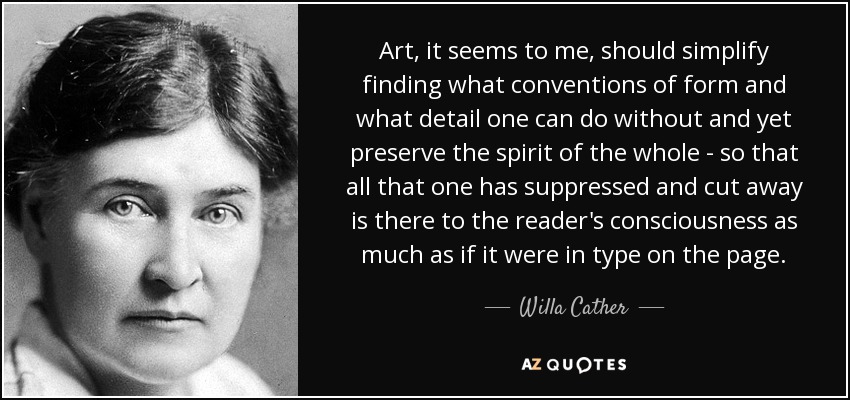
Art, it seems to me, should simplify finding what conventions of form and what detail one can do without and yet preserve the spirit of the whole - so that all that one has suppressed and cut away is there to the reader's consciousness as much as if it were in type on the page.
A comic will always be more 'personal' than a DVD or CD, both of which require electronic 'players' to decode their content. With comics, the reader is the player so the engagement with the material is always more fundamental and dynamic. Reading comics is a much less passive activity than consuming CDs and DVDs.
What I worry about is working in this serial medium, where people are talking about your stories before they're done, we have this instant feedback loop now. I'm very active on Tumblr and I have a very active engagement with readers and I love it, but I don't want to start writing to try to please someone else. I don't want my meter to get skewed.
Nobody knows what will work until they try it. Some of comics' biggest success stories in recent years have explored subjects that no one was writing about at the time - stories no one had any reason to think would succeed. My advice? Write what you want to read. You'll have more fun doing it - and if all else fails, you'll always have at least one loyal reader.
The poet's other readers are the ancient poets, who look upon the freshly written pages from an incorruptible distance. Their poetic forms are permanent, and it is difficult to create new forms which can approach them.
I trust it will not be giving away professional secrets to say that many readers would be surprised, perhaps shocked, at the questions which some newspaper editors will put to a defenseless woman under the guise of flattery.
Our amended Constitution is the lodestar for our aspirations. Like every text worth reading, it is not crystalline. The phrasing is broad and the limitations of its provisions are not clearly marked. Its majestic generalities and ennobling pronouncements are both luminous and obscure. This ambiguity of course calls forth interpretation, the interaction of reader and text. The encounter with the Constitutional text has been, in many senses, my life's work.
Existentialism does not offer to the reader the consolations of an abstract evasion: existentialism proposes no evasion. On the contrary, its ethics is experienced in the truth of life, and it then appears as the only proposition of salvation which one can address to men.
People who are readers of fiction aren't particularly interested in comic books.
Marie Houzelle is a master of the first-person narrative. In Tita she has created a strange, utterly original child whose deadpan certainties are a beguiling invitation to readers of all ages.
Wright and Cowen, who have separately written important scholarly works on the financial history of the early republic, here repackage their research for readers of popular history, and do so impressively.
In the broadest possible sense, writing well means to communicate clearly and interestingly and in a way that feels alive to the reader. Where there’s some kind of relationship between the writer and the reader - even though it’s mediated by a kind of text - there’s an electricity about it.
English dramatic literature is, of course, dominated by Shakespeare; and it is almost inevitable that an English reader should measure the value of other poetic drama by the standards which Shakespeare has already implanted in his mind.
The point is that the reader's journey through our site is a narrative experience. Our job is to make the narrative satisfying.
And if something should be found, particularly in the first part of the dissertation, that one is generally not accustomed to come across in scholarly writings, the reader must forgive my jocundity, just as I, in order to lighten the burden, sometimes sing at my work.
Ranganathan's 5 Laws: Books are for use. Books are for all. Every book its reader, or every reader his book. Save the time of the reader. A library is a growing organism.
ELEGY, n. A composition in verse, in which, without employing any of the methods of humor, the writer aims to produce in the reader's mind the dampest kind of dejection.
Once he became a series character, I made the conscious choice that he would never act like a series character, never wink at the reader, never pull his punches. Better for him, better for me.
Well, it's a humor strip, so my first responsibility has always been to entertain the reader... But if, in addition, I can help move readers to thought and judgment about issues that concern me, so much the better.
I have deliberately left Sylvester and Julia's appearances to the reader's imagination.
I do want to write about Jane Whitefield again, but only when I have a good enough idea - something I've figured out about her that's news and that's worth a reader's time.
We English majors...need to promote public libraries as a tool in the war against terror. How many readers of Edith Wharton have engaged in terroristic acts? I challenge you to name one...Do we need to wait until our cities lie in smoking ruins before we wake up to the fact that a first-class public library is a vital link in national defense?
The reader will find no figures in this work. The methods which I set forth do not require either constructions or geometrical or mechanical reasonings: but only algebraic operations, subject to a regular and uniform rule of procedure.
For the far higher task of teaching fortitude and patience I was never fool enough to suppose myself qualified, nor have I anything to offer my readers except my conviction that when pain is to be borne, a little courage helps more than much knowledge, a little human sympathy more than much courage, and the least tincture of the love of God more than all.
In a manner of speaking, the poem is its own knower, neither poet nor reader knowing anything that the poem says apart from the words of the poem.
Follow AzQuotes on Facebook, Twitter and Google+. Every day we present the best quotes! Improve yourself, find your inspiration, share with friends
or simply: