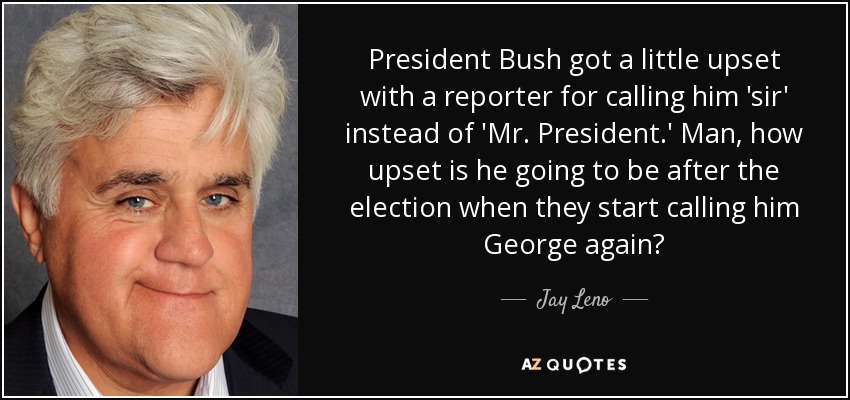
President Bush got a little upset with a reporter for calling him 'sir' instead of 'Mr. President.' Man, how upset is he going to be after the election when they start calling him George again?
Everything is a narrative in life. I learned that early on as a reporter at the Washington Post.
I think my wife ... is sure of my loyalty.... She knows how hard I work. She knows how tired I am every night. She knows I have fifty or sixty reporters watching me day and night.
People don't live their lives in a series of scenes that form a dramatic narrative, they don't speak in dialogue, they're not lit by a cinematographer or scored by a composer. The properties of real life and the properties of drama have almost nothing to do with each other. The difference between writing about reporters and being a reporter is the same as the difference between drawing a building and building a building.
I've learned that the best political reporters never make predictions!
In 2014, impunity in journalism murder cases reached a staggering 96 percent and the remaining 4 percent obtained only partial justice, we have become targets. Insurgent groups no longer use reporters to transmit news, but instead kidnap them to make news. They treat us as enemy combatants and spies. This is our everyday reality.
To this day it cracks me up to think that my debut on national British television as a reporter ends with me turning a trick.
I was asked by an NPR reporter once, why don't I talk about race that often. I said it's because I'm a neurosurgeon. And she thought that was a strange response. And you say - I said, you see, when I take someone to the operating room, I'm actually operating on the thing that makes them who they are. The skin doesn't make them who they are.
When I was 15 or 16 and I started climbing up the ladder of success in amateur boxing, a reporter asked me, "What do you want to be?" I think he was expecting me to say, "A champion." I said, "I want to be special." I don't know why I said that, but I didn't just want to be a fighter. I wanted to have an impact with people, particularly kids.
Foreign correspondence has a natural element of romanticism - and this could be seen as soon as that class of professional reporter emerged in the last half of the 19th century.
I sort of think in a way that many of us young reporters who had the opportunity to go overseas for our organizations were kind of, in a sense, war profiteers. We were enhancing our careers while covering that terrible conflict.
Reporters aren't stupid. We were standing around talking about which of the 900 health-care proposals that nobody's going to accept is that day's hot news. They know how silly that is. But that's what they do.
I don't do research for my novels. Obviously, in my other line of work as a reporter and a columnist, I've had the opportunity to get to know both social workers and TV talk-show hosts.
And there are two types of stories. One type is one's own story. The other type is telling the stories of others. Thanks to this genre, writers of nonfiction can now use the tools of the reporter, the points of view and ear for dialog of a novelist, and the passion and wordplay of the poet.
I didn't go to university. They offered me a job as a junior reporter and I went off to work for the Southern Reporter. They sent me to college to do my NCTJ, which is a professional exam for journalists, and I started work as a print journalist purely because I was just a pest. They couldn't think of anything other than giving me a job to stop me hanging around.
The archives recall not one single incriminating incident, not one drunken escapade, not one reported affair, not one spat with a team-mate or reporter - As Matthew Parris wondered of Barack Obama in these pages recently, is he human?
There is an obligation both moral, but also legal, I believe, against a reporter disclosing something which would so severely compromise national security.
Reporters are faced with the daily choice of painstakingly researching stories or writing whatever people tell them. Both approaches pay the same.
I told [reporters] that I sprinkled marijuana on my organic buckwheat pancakes, and then when I ran my five miles to the ballpark, it made me impervious to the bus fumes. That's when [Baseball Commissioner] Bowie Kuhn took me off his Christmas list.
There aren't enough good journalists. There are too many who really weren't groomed to be reporters and, as a result, some of the reporting is shallow.
Why not just tell people I'm an alien from Mars. Tell them I eat live chickens and do a voodoo dance at midnight. They'll believe anything you say, because you're a reporter. But if I, Michael Jackson, were to say, 'I'm an alien from Mars and I eat live chickens and do a voodoo dance at midnight', people would say, 'Oh, man, that Michael Jackson is nuts. He's cracked up. You can't believe a damn word that comes out of his mouth.
Read like a detective and write like a conscientious investigative reporter.
I was a news reporter for 16 years, seven of them a foreign correspondent in the Middle East, Africa and the Balkans. Perhaps the most useful equipment I acquired in that time is a lack of preciousness about the act of writing. A reporter must write. There must be a story. The 'mot juste' unarriving? Tell that to your desk.
The illustrator is essentially a reporter: his subjects come from the outside, lit by a flash. A subject comes to the classical artist from inside, and when he discovers confirmation of it in the outside world he feels that it has been there all the time.
My fellow journalists called themselves correspondents; I preferred the title of reporter. I wrote what I saw. I took no action -- even an opinion is a kind of action.
Follow AzQuotes on Facebook, Twitter and Google+. Every day we present the best quotes! Improve yourself, find your inspiration, share with friends
or simply: