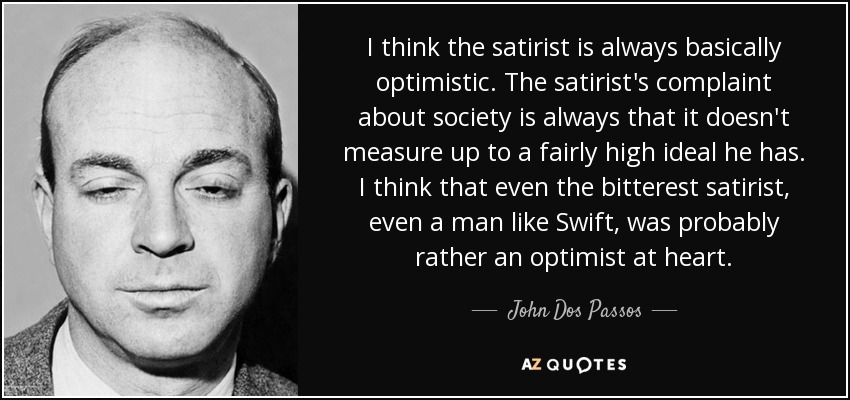
I think the satirist is always basically optimistic. The satirist's complaint about society is always that it doesn't measure up to a fairly high ideal he has. I think that even the bitterest satirist, even a man like Swift, was probably rather an optimist at heart.
Mr. Searle became a satirist, he once said, because ‘in the late '30s, things in general and politics in particular were no longer neatly divided into things black and white. On top of this,’ he added, ‘there was the irresistible impulse to draw. I cannot remember wanting to be anything else other than an artist.’
The political satirist usually votes against their own interests, but the bottom line is that it doesn't really matter.
Some critics of my work took the view that a satirist should defer to the finer feelings of his readers and respect widely held beliefs.
I first adventure, follow me who list And be the second English satirist
Our most noted satirists are true columnists and their opinions can be worth more than any well-documented exposé.
There is scarce any passion so heartily decried by moralists and satirists, as AMBITION; and yet, methinks, ambition is not a vice but in a vicious mind: in a virtuous mind it is a virtue, and will be found to take its color from the character in which it is mixed. Ambition is a desire of superiority; and a man may become superior, either by making others less or himself greater.
Statistics, one may hope, will improve gradually, and become good for something. Meanwhile, it is to be feared the crabbed satirist was partly right, as things go: "A judicious man," says he, "looks at Statistics, not to get knowledge, but to save himself from having ignorance foisted on him."
I've spent my entire career being a satirist.
Life is so absurd now that it is almost impossible to be a satirist in this era.
A satirist, often in danger himself, has the bravery of knowing that to withhold wit's conjecture is to endanger the species.
I read the best works of some of the best satirists, and indeed best writers from the beginning of the Victorian era to about the 1960s. If you want to be a blacksmith, you go and watch the blacksmith working, and you work out what the blacksmith does.
I believe no satirist could breathe this air. If another Juvenal or Swift could rise up among us tomorrow, he would be hunted down. If you have any knowledge of our literature, and can give me the name of any man, American born and bred, who has anatomised our follies as a people, and not as this or that party; and who has escaped the foulest and most brutal slander, the most inveterate hatred and intolerant pursuit; it will be a strange name in my ears, believe me.
[The satirist] must fully possess, at least in the world of the imagination, the quality the lack of which he is deriding in others.
I'm glad to be able to announce that the UK now has it's very own mindless twit. || Either that or he's a damn good satirist.
Minnesotans know the difference between the job of satirist and the job of senator. And so do I.
I know that it's probably not a good idea for a comedian, especially a satirist, to support a public policy group or a politician. This is something I learned only too well years ago when I did a fundraiser for Pol Pot. A few years later I saw 'The Killing Fields,' and I've got to tell you, I just felt like a schmuck.
Satire has its limits. It is really up to the people to make the change. The satirist's role ends at the screen.
The public is gullible. ... If [many satirists are] making the same joke, that's the danger. Then there's a solidifying effect and it becomes a truth.
I would say I'm an ironist not a satirist. All you do is you take existing tendencies and crank them up, just turn up the volume dial. Which is a technique of science fiction, apart from anything else.
I've learned to have absolutely no regrets about any jokes I've ever done. You can tune me out, you can click me off, it's OK. I am not going to bow to political correctness.
No novel has ever changed anything, as far as I can see. And the great satirists, like Swift and Dickens, tend to write about abuses and injustices that have already been partially corrected - you write about it after it's over.
A satirist is someone who has a very skeptical view of human nature, but who still has the optimism to make some sort of a joke out of it. However brutal that joke might be.
Blessed is the satirist; and blessed the ironist; blessed the witty scoffer, and blessed the sentimentalist; for each, having seen one spoke of the wheel, thinks to have seen all, and is content.
The satirist isn't just looking at things ironically but militantly - he wants to change them, and intends to have an effect on the world.
Follow AzQuotes on Facebook, Twitter and Google+. Every day we present the best quotes! Improve yourself, find your inspiration, share with friends
or simply: