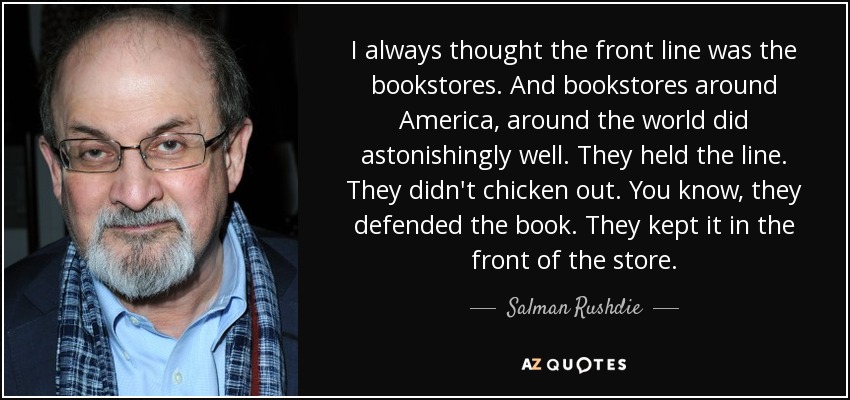
I always thought the front line was the bookstores. And bookstores around America, around the world did astonishingly well. They held the line. They didn't chicken out. You know, they defended the book. They kept it in the front of the store.
I think Shazam is one of the coolest inventions on the planet, and whether I was in a thrift store or in my car, every other week I was Shazaming another Best Coast song.
In a way, all recorded music is reduced to the same level, no matter what it is. You find it in the store, you put it on and, "Oh, that's not cool. That's gangsta rap. That's white supremacist punk." But in a way, the content is removed from the intention of the people that made it. That's the commercial level of music.
I became alcoholic at around age of 13 or 14. I was full-blown. Every day we would hide the alcohol, stealing from stores or stealing it from our parents and hiding out in dirt fields and drinking it before school and after school.
Oddly, I think if you look at comic books, you look at the shelves in the store, it's predominantly male characters, historically. But if you look outside the window it's 52-percent female, and something odd is going on there. So I do think it's your responsibility as a writer, really, to create stuff that little girls can get into too. I want my daughters to have role models that are female.
The first job I got when I was in high school was working for a department store in New York. I worked in the stockroom. That's when I learned that I couldn't work for anyone else, because I was spoken to in a way that I wasn't spoken to at home.
I wasn't a great improviser when I started there; I'm not really up on current events. I would always just mug, just try to get my laughs from making faces. So I decided to do a character who should never have become a comic - somebody you would see at the Comedy Store and go, "This person is never going to make it."
In my world [of fashion] there's more things that kind of affect it. There's the retailers we do business with, our own stores, my merchandising team... Everybody has opinions, and so you definitely have to filter through a lot.
I used to go to this store called Draeger's and you had a little bit of that same feeling because this was a store that offered you so many varieties, things you'd never contemplated before, you know like 250 mustards and vinegars and over 500 different kinds of fruits and vegetables, or over 2 dozen different types of water.
This is at a time when you know most of us drank tap water, so I used to go to this store and examine all the varieties and we used to marvel at all the choices out there, but I found that I rarely bought anything and I kind of thought that was kind of curious. I mean, they had things that the other grocery stores didn't have and yet I never bought anything.
In fact, even in that store Draeger's they had 348 different kinds of jam actually in the jam aisle. And what we found over about, say, 10 years of research is that as the number of choices actually increase people are less likely to make a choice and sometimes they do this even when it's really bad for them.
I mean it wasn't that they sat around thinking oh gosh I needed more choices in my grocery stores the way I had come to think about it as an American growing up.
It's like the iPod playlist has killed the way we think of the normal album, so let's think of this as just saying you go into your record store and all those categories and all those different ways of segregating music have been thrown out the window, so the difference between myself in real life in that is that I'm the opposite.
Try this experiment: one day go in a record store and just try and guess what the music sounds like by looking at the album cover.
I don't think goal setting is an important basis for a retail business - or for anyone. Most of the time goal setting puts too much energy and attention on being someplace else, instead of helping you appreciate where you are.If I ran a retail store, which I have done in my life, I would go into it from a place of "I am thrilled to be here, and I am honored to be able to serve other people." I would not be telling myself constantly that I have to double my sales in order for me to be happy. I would tell myself, "I am content to be here in this moment, and I love this work."
You are connected to God.You are enjoying every single day you have.Then, the growth of you - and your store, if you have one - will take care of themselves.
Many people theorize poverty, but so many elements of poverty, individually, for most people who theorize about poverty would be really difficult to even comprehend the individual things. Just take homelessness. If you are homeless, what does it mean not to have a post box where people can contact you; what does it mean not knowing where you're going to sleep at the end of the day; what does it mean not having a place where you can store what little you might possess. So dealing with homelessness in itself is a huge thing for most people who are commentators [on] or benefactors to poverty.
I grew up, really, in the country.When I was a kid there were three country stores, a railroad depot, and a post office.
[My father] was interested. He read the newspapers and read Time and U.S. News and World Report and people in stores would come along, you know, and they would talk politics.
I've speculated about what my life might have been like as a musician, but I'm afraid I came to the conclusion that I probably would've either been teaching piano or maybe gotten to play at Nordstrom's department store.
I was in a store in Halifax, Nova Scotia that I love, sort of like an environmental friendly sort of store. But they had a great book section. So I went in there all the time. The woman who worked there - which I feel so bad; I've forgotten her name - she handed me the book and she said, "Hey, you should read this. I think it would make a good movie." I remember reading the back of it and I was like, "Huh." Then I just devoured the book and I was so moved by it and said, "Why don't we start developing this into a film?" So that's how it ['Into the Forest'] all started.
I always see the filming as basically going to the grocery store and buying a bunch of ingredients and that's about as far from having a dinner as you can possibly be. Then editing is the cooking, the preparation of the meal and if you don't edit it you've just got a pile of raw meat.
I think in my generation, when I came along in the early '60s, the type of music that was in vogue in society in those days had moved on to another kind of music. I was trying to sell antiques in a modern appliance store.
This is many, many years ago. It was shortly after "Starman" I think. I don't know how close I was to getting the part. I met with [director] Penny Marshall and that's one that I knew would be a hit. It just felt hit-ish. But it's like you go to a store and you see a jacket and you go "I love that jacket" and you try it on and it's too big or too small for you and it's the only one they have. For some reason that part just didn't fit me.
My husband had a clothing store in Paris, and I had his factory make specifically for me something similar to the one I was looking for. We made it in different colours, and decided to sell them in the store...and in a day, they were sold out! This sweater became later known as the "poor boy sweater" and it ended up making the cover of Elle magazine, and in a day, I became the "Queen of knit", without knowing anything about knitting!
Follow AzQuotes on Facebook, Twitter and Google+. Every day we present the best quotes! Improve yourself, find your inspiration, share with friends
or simply: