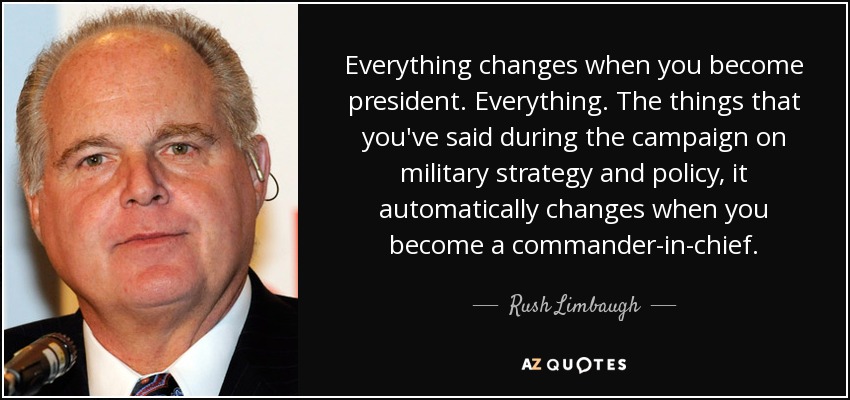
Everything changes when you become president. Everything. The things that you've said during the campaign on military strategy and policy, it automatically changes when you become a commander-in-chief.
I prefer people to disagree with me because I really don't think I'm smart enough to know what all the answers are and I think the back and forth ... we have a lot of it in our office, strong personalities, big intellects, good ideas - I think that back and forth has produced better strategies and tactics for us than if I sat in my office and decided we're doing those 10 things and that's the end of it.
People sometimes talk about me as being a brand, having a strategy and whatever else. I wish. Seriously. I wish I had it together enough to have a strategy. But it's so instinctual. It usually comes down to two things: the person I'm working with - the director is really important to me - and a line in a script.
An amazing piece of advice for a lot of kids, 50-year-olds, whoever is listening right now: Saving money is a good strategy. I didn't have stuff, but it was because my parents were saving. They were saving. We didn't get toys. They told us to go outside and paint a rock. It was very, very smart because after seven or eight years, he was able to buy a liquor store of his own in Springfield, New Jersey - Shoppers Discount Liquors. He built up a great business.
Firing someone who is investigating you is a counterproductive strategy.
America's grand strategy did not come from nowhere. It followed from our deeper conception of ourselves, and our American identity. Who are we, Americans? What is our nation? We are not an ethnostate with identity rooted in shared blood. The option of a white man's republic ended at Appomattox.
There is an arc of spontaneous revolts, beautiful in their creative beginnings, which traverses boundaries and borders and creates new solidarities and imaginations but which under the whip of the forces of order and strategies to buy-off sectors of the revolt becomes fragmented.
One of the really key things to look at in terms of crafting strategy when you're in an economic crises is how do you maximize essentially your liquidity position? Your ability to both take kind of profits and revenues and business and then convert that into a stronger lead. And so those companies that can do that can actually, you know, get a march on their competitors.
Even in our own agriculture strategy, if we got a great new drought-resistant seed and we managed to get it distributed in the system, we just assumed that it would reach female farmers. That's a false assumption, because women don't interact with agro-dealers. So if you don't develop specific programming to ensure that seed gets in a woman's hands, then the extra income [generated by higher-yielding crops] goes into her husband's hands.
The continuous networks of neural circuitry accomplish their functions using multiple, independently discovered strategies. The brain lends itself well to the complexity of the world, but poorly to clear-cut cartography.
Remember, the American grand strategy works when other countries feel secure. But it doesn't work if we acquiesce in the aggression of other countries.
[Steven] Lerner's strategy is, "How do we bring down the stock market? How do we bring down their bonuses? How do we interfere with their ability to be rich?" This is what his objective is, and he believes that Wall Street's wealth has been stolen.
Strategy is indeed about choosing what not to do as well as what to do. A business unit needs to decide what need it aims to satisfy in what group of people and with what value proposition that distinguishes the business from its competitors.
The effective strategies in politics are ones that are so clear and obvious that people can grasp it.
Let me name three of the people who influenced me, although it's definitely not a complete list. Ayesha Jalal, the formidable Pakistani-American historian, has rigorously re-evaluated Jinnah's political strategies leading up to Partition. Akbar Ahmed, a former diplomat and now a distinguished scholar, has documented Jinnah's life as a man who welcomed, worked with, and even married people of other faiths. And then there is Ardeshir Cowasjee, the great Parsi newspaper columnist, who in his mid-80s is a kind of living history of all of Pakistan, old enough to have known Jinnah himself.
Even on just the career level for your average officer, there's no incentive to end the wars. There's not even an incentive for these think-tank guys to end the wars. They would never admit it and say, "Oh, how could we at the Center for a New American Security not want the wars to end?" Well then, why the hell are you continuing to promote strategies that will keep us fighting for years?
I am not the representative of guerrilla in this hemisphere. I would say that the representative would be Fidel Castro which was the leader of our revolution and who had the most outstanding role in the direction of the revolutionary struggle and directs the strategy of the Cuban government.
In America, we need to develop communitywide structures of democratic ownership, we need to work out cooperative development, we need to work out participatory management, we need new ecological strategies developed at the local city, state, regional level.
The madman theory can work, but it only works if it's strategic. And I think one of the problems that President Trump faces is people don't really know how much strategy is here and how much is he just sort of talking off the top of his head. And I think North Korea is a really classic case of a potentially insoluble problem, a problem that you have to manage.
But I think the goal of all these attacks is the same, which is to seize maximum media attention. Maybe some of these attacks were meant to be small. Some of them might have been failed larger attacks. And some of them are just part of a new strategy of doing lots of tiny attacks, as opposed to one large one.
We've got to identify new strategies to use cleaner energy, because that is a recipe for reducing the overall amount of pollution that's out there.
I have to say my relationship with the horses is the biggest thing, and it grows. I love horses more and more every day, and I'm breeding, so when I'm playing a horse that's the son of a horse, the daughter of a horse I used to play, it's like bonding. So I think that's the most amazing part of it. It's the passion that we polo players have for the horses first, and then the game and the strategy of the game and winning and the team and your teammates, all of those things are a big part of it, but the horses are my favorite part.
30 years ago in white supremacy, we had a strategy called leaderless resistance. The concept was: stop shaving our heads, stop getting tattoos and instead try to blend in as much as possible. It was a really concerted effort to try and tone down the rhetoric and make it a little more palatable to the mainstream. And it certainly has penetrated the mainstream now. We're seeing people who were supportive of our cause back then also supportive of Donald Trump's cause, certainly with the recent cabinet appointments.
The thing is, allies is people who are friends, people you can rely on in the struggle. You're not always going to agree with your allies. For instance, Stevie Wonder I feel like is my ally when it comes to this Florida situation, but I don't agree with his strategy. That doesn't mean he isn't an ally.
I believe the minorities need to have a strategy of survival because needless aggression when you cannot change the situation does not help. Wisdom is more important than saving some cultural symbol.
Follow AzQuotes on Facebook, Twitter and Google+. Every day we present the best quotes! Improve yourself, find your inspiration, share with friends
or simply: