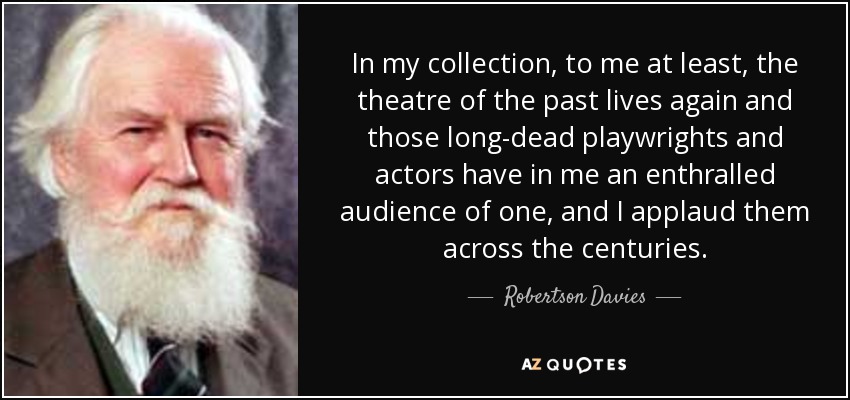
In my collection, to me at least, the theatre of the past lives again and those long-dead playwrights and actors have in me an enthralled audience of one, and I applaud them across the centuries.
In our own, theatre can be the place where we come together, reaching with and through stories, to who we are and to who we can be.
I started off dancing and playing sports, and I joined the drama stuff, the theatre stuff in middle school because my friends were involved, and it was kind of the cool thing to do.
People that went to art house theatre have more options, I used to go, but now think any movie can be delivered in a red envelope three months after it's released so why not watch it on my flat screen in the comfort of home.
As I had collaborated with visual artists before whether on installations, on performance pieces, in the context of theatre works and as I had taught for a time in art colleges the idea of writing music in response to painting was not alien.
There are lots of young vital playwrights who are experimenting, and these are the plays that people who are interested in the theatre should see. They should go off Broadway. They should go to the cafe theatres and see the experiments that are being made.
The condition of the theater is always an accurate measure of the cultural health of a nation. A play always exists in the present tense (if it is a valuable one), and its music -- its special noise -- is always contemporary. The most valuable function of the theater as an art form is to tell us who we are, and the health of the theater is determined by how much of that we want to know.
Any play that makes an audience think out of the box, that makes connections to life and names our pain and by doing so makes our pain subject to thinking and the process of understanding, is doing something inherently political. By promoting understanding, by putting experience in context, by making connections between the normal and the rational, theatre is an act of anti-terrorism. It stimulates courage and a survival spirit. In that sense of political, there are a lot of serious plays doing their work in the world.
Questions about political theatre always overlook America's most powerful and effective political theatre, which is always thriving: the American musical. The politics is conservative but, to my mind, effective and insidious.
The history of theatre is the history of first nights.
I hope to continue working in film, television and theatre.
Most of the people dishing out judgment have no working experience of the theatre, have not written a professional play, a sketch, or even a joke; have never worked in a theatre, taken an acting class, or published any extended piece of work. They are creative virgins; everything they know about theatre is book-learned and second-hand.
The only thing I get from the theatre is a sore arse.
Banks and churches and courtrooms all depend on the appurtenances of theatre. On illusion. Banks, the illusion of stability and honourable dealings to the rot and corruption of capitalist exploitation. Churches the illusion of sacred sanctuary of purposes of pacifying social discontent. Courtrooms of course designed to promote the illusion of solemn justice. If there was true justice why would such trappings be necessary? Wouldn't a table and chairs and an ordinary room serve just as well?
The poetics of the oppressed is essentially the poetics of liberation: the spectator no longer delegates power to the characters either to think or to act in his place. The spectator frees himself; he thinks and acts for himself! Theatre is action!
Theatre is the safe place to do the unsafe things that need to be done.
I have held the following jobs: office temp, ticket seller in movie theatre, cook in restaurant, nanny, and phone installer at the Super Bowl in New Orleans.
It was progressively more difficult to find work in the theatre, as well.
Television theatre, as is implied in its name, should rely on adaptations of scripts written for the theatre.
On the one hand, young theatre directors were coming to television theatre, because they wanted to get closer to the cinema, despite having studied and worked for the theatre.
At the same time, television theatre became more visibly active.
When I see someone filming me, I don't usually think, 'No, man, don't put this up online!' I'd think, 'Hey man, you don't get to go to shows very often, put down the camera and enjoy it!' I love going to theatre and to shows so much.
I'm an old-fashioned theatre major at heart.
Places like the National Theatre or Sheffield, these great engines of theatre, make us cutting edge because they can be experimental. They can do plays that nobody else can afford to do in ways nobody else can afford to do.
I've found that the only way to make theatre that gets the audience thinking is when I feel uncomfortable making it.
Follow AzQuotes on Facebook, Twitter and Google+. Every day we present the best quotes! Improve yourself, find your inspiration, share with friends
or simply: