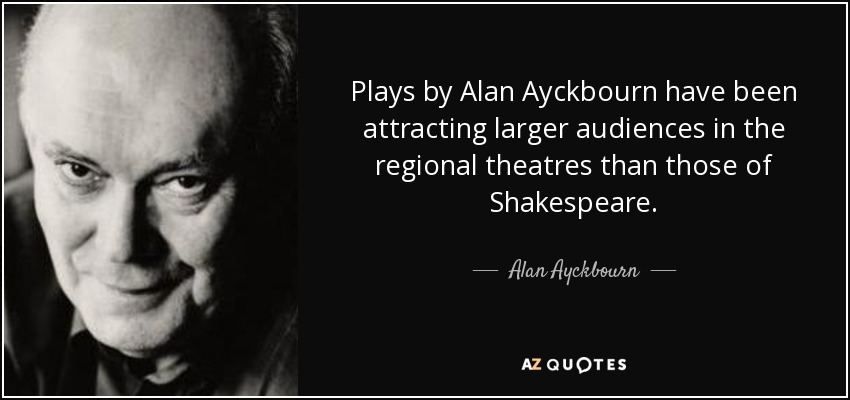
Plays by Alan Ayckbourn have been attracting larger audiences in the regional theatres than those of Shakespeare.
Theatre supposes lives that are poor and agitated, a people searching in dreams for a refuge from thought. If we were happier and freer we should not feel hungry for theatre. A people that is happy and free has need of festivities more than of theatres; it will always see in itself the finest spectacle.
The landscape, like Los Angeles itself, is transitional. Impermanence haunts the city, with its mushroom industries--the aircraft perpetually becoming obsolete, the oil which must one day be exhausted, the movies which fill America's theatres for six months and are forgotten. Many of its houses--especially the grander ones--have a curiously disturbing atmosphere, a kind of psychological dankness which smells of anxiety, overdrafts, uneasy lust, whisky, divorce and lies.
There are lots of young vital playwrights who are experimenting, and these are the plays that people who are interested in the theatre should see. They should go off Broadway. They should go to the cafe theatres and see the experiments that are being made.
The condition of the theater is always an accurate measure of the cultural health of a nation. A play always exists in the present tense (if it is a valuable one), and its music -- its special noise -- is always contemporary. The most valuable function of the theater as an art form is to tell us who we are, and the health of the theater is determined by how much of that we want to know.
Any play that makes an audience think out of the box, that makes connections to life and names our pain and by doing so makes our pain subject to thinking and the process of understanding, is doing something inherently political. By promoting understanding, by putting experience in context, by making connections between the normal and the rational, theatre is an act of anti-terrorism. It stimulates courage and a survival spirit. In that sense of political, there are a lot of serious plays doing their work in the world.
Questions about political theatre always overlook America's most powerful and effective political theatre, which is always thriving: the American musical. The politics is conservative but, to my mind, effective and insidious.
Pass the popcorn, please. Life is a film, theatre, a theatre of the soul. We play different roles on different stages. At death, we walk offstage. At birth, we walk onstage.
But then I got a job selling coffee at the York Theatre, and when I met theatre people, something clicked. I felt comfortable with them; I felt like myself. I decided to go to drama school based just on that feeling. I had never done any acting.
As far as I'm concerned, an audience is an audience. Whether it's an audience in Hull or the National Theatre, that's who you play to. It's not money - it's good to get some, but that's not why I do it. You do it because you have to, to tell a story.
I quite enjoy fame, especially when you go to conventions in America where they treat you like a god with stretch limos and the whole fame thing, but then when you come back to Britain, you end up changing in a toilet in a theatre off West End and that's really good, because that is what it's about.
As I had collaborated with visual artists before whether on installations, on performance pieces, in the context of theatre works and as I had taught for a time in art colleges the idea of writing music in response to painting was not alien.
As a kid who wasn't into sports, at school I felt almost alienated at times, whereas in the theatre community there was this amazing sense of camaraderie. Early on, we would go to rehearsals with my dad and I was like the mascot for the backstage crew. That was a big part of my childhood, so I dreamed of one day doing a play in London.
Is she perverted like me? Would she go down on you in a theatre?
Feelings are universal, and if an actor's doing his job, I think he's making people sit there, and if it's in a movie or a theatre, going 'Hmm, yeah, I know that... I know that.
My family were broadminded enough to support me when I wanted to pursue a life in the theatre.
When I'm doing theatre, I feel like my life's on hold. Even though you might go out for a coffee, or go and see a film, your brain is still there, pulling you back to it.
I've gotten to go wonderful places, meet interesting and intelligent people, and I started of course in the theatre and continue to work in the theatre where there is some intelligence involved in it.
I've played a lot of roles I haven't wanted to play, either because they needed someone in the theatre or because they couldn't do it without me 'cause they don't have anyone else the right age.
I grew up overseas in Indonesia, and my school had a great art, music, and theatre program.
When I was at drama school I wanted to do classical theatre. It just so happened that I did a film when I came out and I moved that way.
Musical theatre is something I'm familiar with, I've been doing that.
I studied at the Piccolo Teatro di Milano: I was a theatre actor.
When the cinematograph first made its appearance, we were told that the days of the ordinary theatre were numbered.
I have a dialect myself; it's more pronounced, because I have studied theatre and been in England. It's half-British, half-Indian.
Follow AzQuotes on Facebook, Twitter and Google+. Every day we present the best quotes! Improve yourself, find your inspiration, share with friends
or simply: