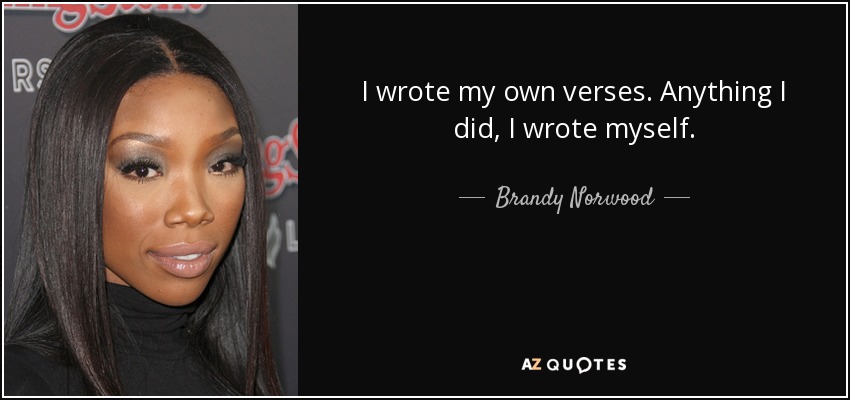
I wrote my own verses. Anything I did, I wrote myself.
One of the things I find depressing about some of the upper echelons of Anglicanism on both sides of the Atlantic is that it's sort of taken for granted that we all basically know what's in the Bible, and so we just glance at a few verses for devotional purposes and then get on to the real business.
What judgment I had increases rather than diminishes; and thoughts, such as they are, come crowding in so fast upon me, that my only difficulty is to choose or reject; to run them into verse or to give them the other harmony of prose.
I fell into writing, I suppose, being one of those awful children who wrote verses. I went to a convent in New York-the Blessed Sacrament... I was fired from there, finally, for a lot of things, among them my insistence that the Immaculate Conception was spontaneous combustion.
When you translate poetry in particular, you're obliged to look at how the writer with whom you're working puts together words, sentences, phrases, the triple tension between the line of verse, the syntax and the sentence.
I know I should be leaving this climate, I've got a verse, but can't rhyme it.
There is poetry even in prose, in all the great prose which is not merely utilitarian or didactic: there exist poets who write in prose or at least in more or less apparent prose; millions of poets write verses which have no connection with poetry.
Every verse a diamond, every chorus gold, the sound was my salvation. It was only everything, before money became king.
Yet, do thy worst, old Time; despite thy wrong, My love shall in my verse ever live young.
There is, however, a strong empirical reason why we should cultivate thoughts that can never be proved. It is that they are known to be useful. Man positively needs general ideas & convictions that will give a meaning to his life & enable him to find a place for himself in the universe. He can stand the most incredible hardships when he is convinced that they make sense; he is crushed when on top of all his misfortunes, he has to admit that he is taking part in a ‘tale told by an idiot.’
I could define poetry this way: it is that which is lost out of both prose and verse in translation.
Rhime being no necessary Adjunct or true Ornament of Poem or good Verse, in longer Works especially, but the Invention of a barbarous Age, to set off wretched matter and lame Meeter...the troublesom and modern bondage of Rimeing.
There are no ordinary people. You have never talked to a mere mortal.... Next to the Blessed Sacrament itself, your neighbor is the holiest object presented to your senses. If he is your Christian neighbor he is holy in almost the same way, for in him also Christ verse latitat - the glorifier and the glorified, Glory Himself, is truly hidden.
He capers, he dances, he has eyes of youth, he writes verses, he speaks holiday, he smells April and May.
He who writes prose builds his temple to Fame in rubble; he who writes verses builds it in granite.
We're not attacking Islam but Islam has attacked us. The God of Islam is not the same God. It's a different God, and I believe it [Islam] is a very evil and wicked religion.
The adventitious beauty of poetry may be felt in the greater delight with a verse given in a happy quotation than in the poem.
Ignorance is in relationship to content; it is not just a spirit of ignorance. In verse 21 it speaks of "the truth in Jesus." Truth is content, truth has something to do with reason. Truth has something to do with the rational creature that God has made us. The dilemma here in the internal world is not just some sort of grey fog, it is in relationship to content.
And I just hope that I'm forgiven for carin bout how they livin and loanin a little money and keepin em outta prison I aint lyin in my verses, I'm just tellin you the basics of growin up wit ya friends and becomin the one that made it
Youth is the time to go flashing from one end of the world to the other to try the manners of different nations; to hear the chimes at midnight; to see the sunrise in town and country; to be converted at a revival; to circumnavigate the metaphysics, write halting verses, run a mile to see a fire, and wait all day long in the theatre to applaud Hernani.
A verse from the Veda says, 'What you see, you become.' In other words, just the experience of perceiving the world makes you what you are. This is a quite literal statement.
But theological change happens though selective quoting. Every religious person does it: You quote those verses that resonate with your own religious insights and ignore or reinterpret those that undermine your certainties. Selective quoting isn't just legitimate, but essential: Religions evolve through shifts in selective quoting.
Some people like to read so many [Bible] chapters every day. I would not dissuade them from the practice, but I would rather lay my soul asoak in half a dozen verses all day than rinse my hand in several chapters. Oh, to be bathed in a text of Scripture, and to let it be sucked up in your very soul, till it saturates your heart!
Then my verse I dishonor, my pictures despise, my person degrade and my temper chastise; and the pen is my terror, the pencil my shame; and my talents I bury, and dead is my fame.
Universe is just a verse of me, I keep it generic and the niggas take it personally.
Follow AzQuotes on Facebook, Twitter and Google+. Every day we present the best quotes! Improve yourself, find your inspiration, share with friends
or simply: