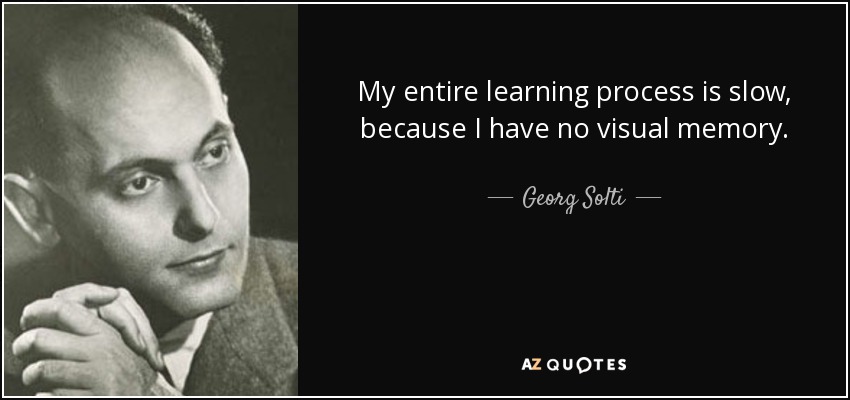
My entire learning process is slow, because I have no visual memory.
Gardeners often focus exclusively on plants, missing the absolutely essential visual role played by structures, from paths to pavilions.
No matter how many great performances or exciting visuals we put together for the movie, we found that it was all somewhat two dimensional until we added the emotional heart of Howard Shore's music. Then, and only then, did the film come to life.
I try to remember dreams, and occasionally I'll make a note or two in a notebook if it's something extra interesting. They do mean quite a lot to me, and they don't happen all that often. In other words, I don't have some kind of loud, Technicolor dream every night. But a few times a month, I'll have a rather interesting dream. They're mostly visual - oddly enough, I don't have much dialogue in my dreams. They just don't speak.
As my sons went into teenagehood, they started to look like some of the groups of people that I had photographed previously. They started to become like my old subjects. As if, as a photographer, you come around to the same visual points.
On some kind of unspoken, deep, deep level, I think we [with Ryan Murphy] have an aesthetic that we both understand or connect to. It's not that we see the world in the same way because we have very different points of view, but we're both visual stylists.
I love visual stylists like Bob Fosse and Vincente Minnelli and Michael Powell & Emeric Pressburger with The Red Shoes and The Tales of Hoffman.
I see my work as having a relationship to the visual world, not just some emotive residue of my feelings. It relates to something that exists, or might exist, rather than a transcendent mental state or something like that.
Even though I don't have any larger spiritual or ideological system, there is some logic in concert with a huge number of beautiful, disconcerting, screwed-up variables that results in a certain visual pleasure in violent things. Like a broken egg yolk can be the most violent thing I've seen all day, if I'm in the right mood. But also tons of trash in the woods or a burned-up trailer park can also come across as especially violent.
The Taboo scene was a kind of deconstructed version of the New Romantics. The Taboo crowd was using a lot of the visual ideas that had already been used. I remember the first time I spotted Leigh Bowery and Trojan parading around in clubs: They were in their "Pakis from Outer Space" look, and the makeup was quite similar to one of my old looks, because I was quite fond of wearing blue, green, or yellow foundation, and so I was pretty dismissive of them at first.
In movies, you can basically buy the audience into the theater. If you spend enough money on visual effects, even if you are lacking in story and character, you might still pull it off.
There's a level where the themes of a film are very relevant to me and also the idea of finding out how relevant one genre is to another. I think that westerns and samurai films and superhero films have a lot in common. It's just that the scale of the visuals in tentpole films can sometimes overwhelm the drama.
If I want to do something in the TV industry, I should be allowed to explore that, but not in a way where it has to cancel out or ruin my visual art career.
Art is good, bad, boring, ugly, useful to us or not. It does or doesn't disturb optical monotony, and succeeds or fails in surmounting sterility of style or visual stereotype; it creates new beauty or it doesn't.
A modeled form is less striking than one which is not. Modeling prevents shock and limits movement to the visual depth. Without modeling or chiaroscuro depth is limitless: movement can stretch to infinity.
I started connecting things to my body during my childhood. I approached the computer as a mediating element, as a form of visual art.
The visual arts must communicate to the human spirit, forcing individuals to reflect on themselves and their existence beyond their own self-interest.
The really great visual experience today is to fly over a huge city and look down into the night. It's like a tremendous jubilant Christmas tree. You just feel life is worth living when you come down you may have some doubts.
Visual tonics such as 'timed creativity' need to be introduced to refresh and refurbish the muse.
What sets you apart from the rest of humanity is your ability to give visual form to an idea - the skill to transform it into something more than merely the insight or perception alone.
It's always a challenge bringing a great story classic to the screen. Giving visual form to the characters and places that have only existed in the imagination. But it's the kind of challenge we enjoy.
. . . you [film critics] always overstress the value of images. You judge films in the first place by their visual impact instead of looking for content. This is a great disservice to the cinema. It is like judging a novel only by the quality of its prose. I was guilty of the same sin when I first started writing for the cinema. . . . Now I feel that only the literary mind can help the movies out of that cul de sac into which they have been driven by mere technicians and artificers.
There are so many films now where you know the story is a supporting role to the visual effects.
I was thinking about sort of the similarities between "art movies" and lowbrow movies like kitschy sexploitation films. I think they share certain qualities, whether they're hyper-stylized or overly emotive or just very visual.
Some directors, like Stevens [George Stevens], shoot full circle, 360 degrees, and that's what's right for them. I generally shoot at about a seven to one ratio. But part of that is because I've worked on every screenplay, so I'm further along in the visual concept.
Follow AzQuotes on Facebook, Twitter and Google+. Every day we present the best quotes! Improve yourself, find your inspiration, share with friends
or simply: