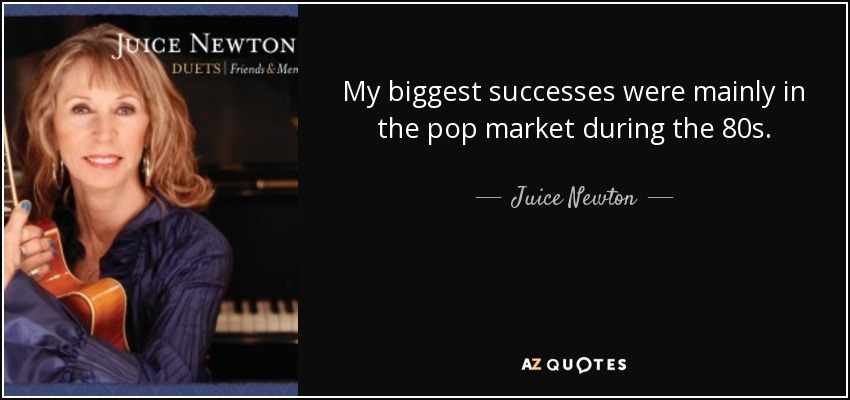
My biggest successes were mainly in the pop market during the 80s.
It has been difficult to hold onto many paintings but I have retained a few. Possibly the current favorite is titled 'Big Band' completed in 2005. It measures 13 feet x 9 feet. It has 18 nearly life size recognizable portraits of the biggest jazz stars that I knew and saw perform in the 1950s, '60s, '70s, '80s and includes Wynton Marsalis.
I do listen to Abba. And a lot of '80s and '90s pop music.
From folk to tribal to Cab Calloway, Cole Porter, Gershwin to the Rolling Stones, whose first record was all covers, to country-western, bebop, blues, and even the referencing in classic hip hop to cliched love ballads of the '80s or whatever - that is kinda gone, and that's just terrifying to me.
The '80s to me, more than anything else, represents a time of real criminal activity in the office of the president: an incredibly disparate economy in terms of the class distinctions and whatnot, and a tremendous shallowness - a lot of sort of bank robbery by executives.
I was like a total cliched '80s child. I had Barbies, obviously, as well as My Little Ponies and Cabbage Patch Kids, but I used to destroy them. I used to draw all over their faces and cut off their hair.
What was great about the 80s was that you still had record companies who would get behind developing you as an artist. You had these bonkers heads of department and A&R people who, even after a flop album, would let you make another one.
The Corcoran show was actually almost a reportage. The exhibit was, in many ways, pretty unique. It was one of the first pieces about DC culture that doesn't include some marble building or the Kennedy Center.
When I first started in rock, I had a big guy's audience for my early records. I had a very straight image, particularly through the mid '80s.
Tony Bennett is still giving concerts, still singing. It's keeping him alive. He's in his late 80s now and he keeps going and going. I maintain, God bless him, it's this devotion to duty and working and being in front his audience.
In the late 60s, 70s and possibly early 80s, social scientists were interested in researching the diffusion of innovation and studying the link between applied research and policy and program development. Recently there has been less interest in these issues and we feel that this interest must be rekindled.
Television in the '80s was very limited. There was no Food Network. When I opened Spago, I had the kitchen in the dining hall. It was probably the first restaurant to do so. The dining scene became more casual. All these cooking shows have transformed our profession one-hundred percent.
It was a revolution, but now it is an evolution. People know more ingredients, people know more techniques, and people look for more ingredients they've never looked for before. In the '80s, you couldn't find raw tuna in any restaurant that wasn't Japanese. Now, you can't find any restaurant without it or sashimi.
The Simpsons was pretty experimental at the time, but it attracted a lot of sitcom writers that felt confined by the limitations of live-action sitcoms in the '80s.
On the one hand, I loved being a banker. I loved how numbers could tell a story and how you can invest in ideas and see them translate into products and services and create jobs. What I didn't like, particularly where I was working in Brazil during the debt crisis of the early '80s, was how the poor were excluded from the banking system. I made the decision to try and experiment with whether we could use the tools of banking to extend the benefits of the economy to the poor.
I have a feeling of reverence about my father being in his 80s - a feeling that I want to whisper, take soft steps, not intrude too much. He's like a stately old cathedral to me now.
What I saw quite clearly in the '80s, before the internet, was that the whole world was shifting toward digital formats, and that didn't matter whether it's movies or writing or whatever. It was something that was coming. And with the invention of the World Wide Web in the early '90s, when we were teaching our first courses, or the arrival of the internet by way of the browser, which opened up the internet to everybody - soon it was just revolutionary.
I've always been a fan of 3D, going back to movies in the '50s. I was part of the early '80s 3D craze, which was coming at you in Jaws 3D, so I've always wanted to make a 3D film.
I love Steven Wright. I was in high school in the '80s, and there was a lot of stand up on television.
We've become a little spoiled with menswear in particular because, of course, we've come off a period in the '70s and '80s when Armani, which is very soft, dominated menswear. And we've become obsessed with comfort. I actually don't like that.
I was a choreographer in the '80s and I was doing these videos. I did an Extreme video, which was really weird having them here. I did "Get the Funk Out".
I don't know what it was like in the '80s. I don't really even know what it was like in the '90s, because I was broke and wasn't selling any art. I was in a few group shows, but I didn't have a gallery until 2006.
You make decisions, and that's what separates art from some other pop music. It doesn't mean that you can't make an embarrassing amount of money, for a borderline Marxist, doing something that you love, but it does mean that this huge pool of money that was out there when I started making records in the '80s is gone.
One of the great things about Houston is that they police themselves. It's the way Boston was in the '80s. No hacks or thieves are tolerated in the community, and that's HUGE.
Jesus is magic, because he turned water into wine. I think he made the statue of liberty disappear in the 80s or something.
Follow AzQuotes on Facebook, Twitter and Google+. Every day we present the best quotes! Improve yourself, find your inspiration, share with friends
or simply: