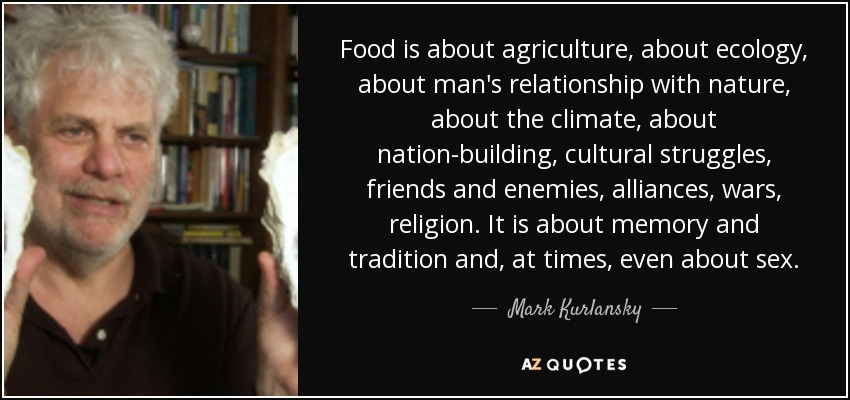
Food is about agriculture, about ecology, about man's relationship with nature, about the climate, about nation-building, cultural struggles, friends and enemies, alliances, wars, religion. It is about memory and tradition and, at times, even about sex.
If Mother Culture were to give an account of human history using these terms, it would go something like this: ' The Leavers were chapter one of human history -- a long and uneventful chapter. Their chapter of human history ended about ten thousand years ago with the birth of agriculture in the Near East. This event marked the beginning of chapter two, the chapter of the Takers. It's true there are still Leavers living in the world, but these are anachronisms, fossils -- people living in the past, people who just don't realize that their chapter of human history is over. '
There is no 'need' for us to eat meat, dairy or eggs. Indeed, these foods are increasingly linked to various human diseases and animal agriculture is an environmental disaster for the planet.
Just like if you were brought up on a farm, you would most likely carry on your father's business as a farmer; I was brought up in the kitchen and ended up becoming a chef.
What is fetus farming? Simply put, it is the creation and development of a human fetus for the purposes of later killing it for research or for harvesting its organs.
It [The Gesundheit Institute] also won't separate the healing arts. All of them work together - traditional medicine and surgery with acupuncture, homeopathy, etc. We want to make the hospital a place a person can't wait to come to, whether they are working there or being there as a patient. Because we are interested in promoting wellness, we will integrate medicine with performing arts, arts and crafts, agriculture, recreation, nature, and social service. Those are some skeletal parts.
We would be foolish and silly not to unite with people in the public health sector, the environmental community, [and] unions, to try to challenge corporate agriculture.
Here are two facts that should not both be true: - There is sufficient food produced in the world every year to feed every human being on the planet. - Nearly 800 million people literally go hungry every day, with more than a third of the earth's population -- 2 billion men and women -- malnourished one way or another, according to the United Nations Food and Agriculture Organization.
African agriculture today is among, or is, the most under-capitalized in the world. Only seven percent of arable land in Africa is irrigated, compared to 40 percent in Asia.
Women's worst invention was the plow. With the beginning of plow agriculture, men's roles became extremely powerful. Women lost their ancient jobs as collectors.
Loss of genetic diversity in agriculture is leading us to a rendezvous with extinction--to the doorstep of hunger on a scale we refuse to imagine. To simplify the environment as we have done with agriculture is to destroy the complex interrelationships that hold the natural world together. Reducing the diversity of life, we narrow our options for the future and render our own survival more precarious.
We have to bring children into a new relationship to food that connects them to culture and agriculture.
Illegal immigration is praised only by those who benefit directly from it, whether in the familial sense of inexpensive nannies, cooks, or gardeners; or in the corporate interest of cheap labor in the hospitality industries, agriculture, and construction; or in the political sense of new liberal constituents; or in the tribal sense of expanding the so-called La Raza base. But the vast majority of Americans accept that when federal law is ignored, chaos ensues.
Writing is conscience, scruple, and the farming of our ancestors.
Love had forged ahead so swiftly that in no time it had displaced agriculture as the leading industry of the period. To anyone who has tried both, this wont come as much of a surprise.
When not protected by law, by popular favor or superstition, or by other special circumstances, [birds] yield very readily to the influences of civilization, and, though the first operations of the settler are favorable to the increase of many species, the great extension of rural and of mechanical industry is, in a variety of ways, destructive even to tribes not directly warred upon by man.
Agriculture is the new golf
Surely we have the wit and will to develop economically without despoiling the very environment we depend upon
The decay of old aristocratic prejudices against greedy speculation, the undermining of orthodox Christian faith (which forbids avarice)... the debauching of agriculture to a gross money-getting concern: these particular aspects of a vast and voracious concentration upon profits are so many illustrations of our sinning confusion of values.
Every endeavor should be used to weaken and destroy all those institutions relating to corporations, apprenticeships, &c, which cause the labours of agriculture to be worse paid than the labours of trade and manufactures.
During the Qin Dynasty, all books not relating to practical concerns such as agriculture or construction were ordered burned by the emperor to guard against "dangerous thought." Whether accounts of zombie attacks perished in the flames will never be known. This obscure section of a medical manuscript, preserved in the wall of an executed Chinese scholar, might be proof of such attacks.
The passive American consumer, sitting down to a meal of pre-prepared food, confronts inert, anonymous substances that have been processed, dyed, breaded, sauced, gravied, ground, pulped, strained, blended, prettified, and sanitized beyond resemblance to any part of any creature that ever lived. The products of nature and agriculture have been made, to all appearances, the products of industry. Both eater and eaten are thus in exile from biological reality.
Almost always when I told someone I was writing a book about "eating animals", they assumed, even without knowing anything about my views, that it was a case for vegetarianism. It's a telling assumption, one that implies not only that a thorough inquiry into animal agriculture would lead one away from eating meat, but that most people already know that to be the case.
When we conduct agriculture, we are, therefore, altering the ecological arrangement that was responsible for our genesis as a species. I think that this is the reason that this alienation has allowed us to see and regard land mostly as a resource. So we have created a problem for ourselves from the word "go," for land is not a resource any more than humans are resources.
We can change our thinking. Rather than viewing the chemical adulteration of our environment and our bodies as the inevitable practice of convenience and progress, we can decide that cancer is inconvenient and toxic pollution archaic and primitive. We can start seeing the creation of carcinogens as the result of outmoded technologies. We can demand green engineering and green chemistry. We can let our systems of industry and agriculture know that they are suffering from a design flaw.
Follow AzQuotes on Facebook, Twitter and Google+. Every day we present the best quotes! Improve yourself, find your inspiration, share with friends
or simply: