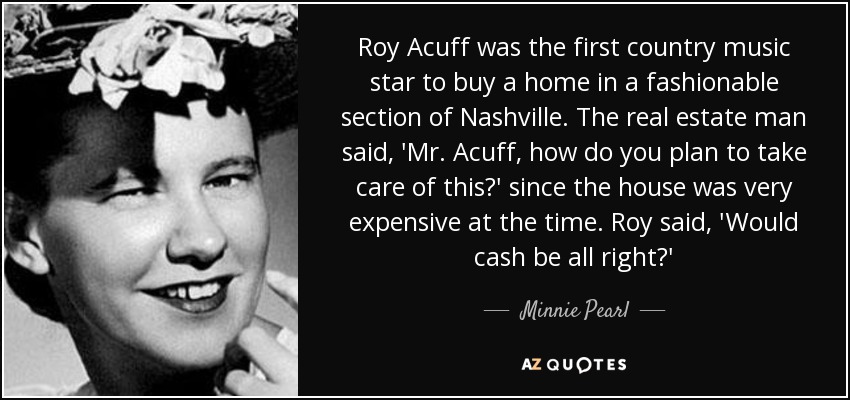
Roy Acuff was the first country music star to buy a home in a fashionable section of Nashville. The real estate man said, 'Mr. Acuff, how do you plan to take care of this?' since the house was very expensive at the time. Roy said, 'Would cash be all right?'
Middle class prosperity is lapidary; the flow of cash rounds and smooths a person like water does riverbed stones.
We can think about how we reduce the pain in paying. So, for example, credit cards are wonderful mechanisms to reduce the pain of paying. If you go to a restaurant and you are paying cash, you would feel much worse than if you were paying with credit card. Why? You know the price, there's no surprise, but if you're paying cash, you feel a bit more guilt.
If you want to spend more money in restaurants, use credit cards more than cash. If you want to spend less, use cash more than credit cards. But in general, we can think about how to use the pain of paying and how much of it do we want. And I think we have like a range. Credit cards have very little pain of paying, debit cards have a little bit more because you feel like today, at least it is coming out of your checking account, and cash has much more.
If you have loans, the first thing you want to do is say, "Okay, look I have a credit card, if I really need to borrow, I have this emergency money that I can get, but for now there is no reason for me to keep cash at zero percent interest rate and at the same time, pay all of this money out. So, I think people need to figure out quickly how to pay loans and how much cash they should really keep.
Well I was a Gerber baby, so probably that was my first money. But in cash, I used to do lemonade stands a lot.
CIA Director George Tenet briefed a Senate panel ... about the current situation in Iraq. He described how cash was being stolen and women were being assaulted with impunity. Senators love to attend these continuing education seminars.
There are only three ways a congressman goes out: They die in office, they cash in as a lobbyist, or they mistakenly tweet a picture of their d*ck.
To most observers, innovation is a solitary process that requires creativity and genius, perhaps even greatness. It can't, in their view, be managed or predicted, just hoped for and, perhaps, facilitated. But for me innovation was and still is more than that. It was a battle in the marketplace between innovators or attackers trying to make money by changing the order of things, and defenders protecting their cash flow.
Those sweetly smiling angels with pensive looks, innocent faces, and cash-boxes for hearts.
I never had a checkbook. It used to be cash in hand, stuff in the pocket, or a manager would keep some accounts and give me money. I started to wonder what it must feel like to actually make a profit, pay taxes, and to have a phone listing, and a manager. And also, I was sick of sleeping around every night.
JPMorgan was already, for the most part. Our businesses at JPMorgan share the same cash-management systems. The commercial bank, the private bank, the retail bank, they all use the branches. The cash-management system moves the money around the world - for global corporations, and for you, the consumer, too.
Wealth is not the standard of worth. Some people put cash before character.
If a man has an apartment stacked to the ceiling with newspapers, we call him crazy. If a woman has a trailer house full of cats, we call her nuts. But when people pathologically hoard so much cash that they impoverish the entire nation, we put them on the cover of Fortune magazine and pretend that they are role models.
The government does not add value to the economy. It removes value from the economy by imposing taxes on one citizen and providing cash to another.
The market performs miracles so routinely that we take it for granted. Supermarkets provide 30,000 choices at rock-bottom prices. We take it for granted that when we stick a piece of plastic in a wall, cash will come out; that when we give the same plastic to a stranger, he will rent us a car, and the next month, Visa will have the accounting correct to the penny. By contrast, "experts" in government can't even count the vote accurately.
The Fed is pushing a variety of workarounds that would inject trillions in new money into the economy while bypassing the banking system altogether. Time will tell whether or not this will succeed. Meanwhile, a serious danger lurks around the corner. Once the recession is over, the lending will start again. With fractional-reserve banking and limitless supplies of cash on hand, we will likely see the overall price trends reversed, from deflation to inflation to possible hyperinflation.
ACORN, you may recall, is the left-wing activist group with longtime ties to community organizer-turned-President Barack Obama. The nonprofit, which now takes in 40 percent of its revenues from American taxpayers after four decades on the public teat, has a history of engaging in voter fraud, corporate shakedowns, partisan bullying and pro-illegal immigration lobbying. The Democrats' stimulus proposals could make the group - and its lesser known but even more radical ideological allies - eligible for upward of $5 billion in new public cash.
A pleasant natural environment is a good - a luxury good, philosophical good, a moral goody-good, a good time for all. Whatever, we want it. If we want something, we should pay for it, with our labor or our cash. We shouldn't beg it, steal it, sit around wishing for it, or euchre the government into taking it by force.
These settlements [Justice Department with lenders] include requirements that banks lend to minorities at below-market rates and, in effect, dish out cash to politically favored 'community groups.' It's a good bet that many of these loans will eventually go bad.
Our attitude toward cash generation and asset management came out of our own thought process. After we acquired a number of businesses we reflected on aspects of business. Our own conclusion was that the key was cash flow.
If you own a wonderful business...the best thing to do is keep it. All you're going to do is trade your wonderful business for a whole bunch of cash, which isn't as good as the business, and you got the problem of investing in other businesses, and you probably paid a tax in between. So my advice to anybody who owns a wonderful business is keep it.
If an asset has cash flow or the likelihood of cash flow in the near term and is not purely dependment on what a future buyer might pay, then it's an investment. If an asset's value is totally dependent on the amount a future buyer might pay, then its purchase is speculation.
Entrepreneurs are perennially short on cash, so they tend to hire less expensive and less experienced team members. Yet most founders are overworked, so they have no time and budget for coaching and training. Team members not confident in their roles lose motivation quickly.
Maybe you'll take the cash out. So a credit card company or a bank that goes into the business of saying we're going to be the broker, we're going to sell you a mortgage that you're going to be able to pay off, we're going to help you reduce your credit card debt, we're going to help you save for retirement, we're going to put you into mutual funds that have low fees rather than high fees.
Follow AzQuotes on Facebook, Twitter and Google+. Every day we present the best quotes! Improve yourself, find your inspiration, share with friends
or simply: