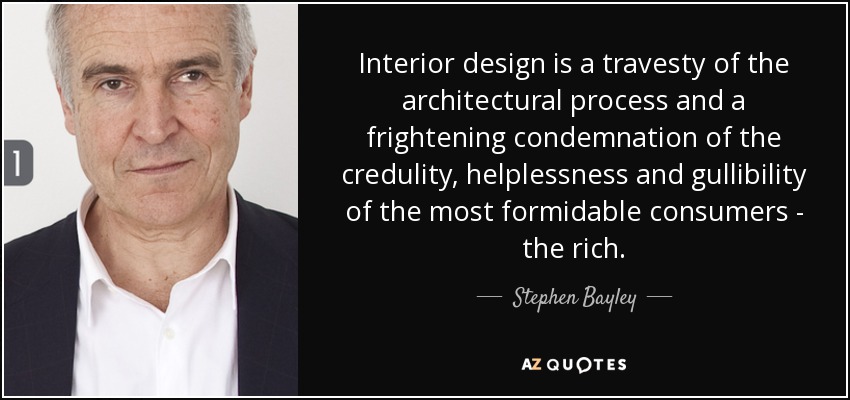
Interior design is a travesty of the architectural process and a frightening condemnation of the credulity, helplessness and gullibility of the most formidable consumers - the rich.
America is a consumer culture, and when we change what we buy - and how we buy it - we'll change who we are.
All production is for the purpose of ultimately satisfying a consumer.
The sexual freedom of today for most people is really only a convention, an obligation, a social duty, a social anxiety, a necessary feature of the consumer's way of life.
Consumers no longer want only a great product - they want to buy products from companies that align with their own character and values.
A consumer is not a moron. She's your wife. Don't insult her intelligence, and don't shock her.
The consumer is getting fed up with shoddy material, poor quality, unsafe products, bad service, weak warranties, lack of adequate information -- the whole gamut of such problems.
Within a capitalist consumer society, the cult of personality has the power to subsume ideas, to make the person, the personality into the product and not the work itself.
Stop competing on price; compete on value. Deliver total consumer solutions, rather than just your piece of the solution.
Homeowners who refinanced their mortgages took out cash and reduced their monthly payments at the same time. Much of the cash obtained by refinancing was spent on consumer durables, home improvements and the like.
In the desktop world, you could build a successful business where a consumer only came back to you once or maybe twice a year. I don't think you can build that kind of business on mobile. You need higher frequency, or otherwise you fall off the home screen and the user never comes back.
I'm part of the consumer culture. I was part of the baby boom generation. I have a car when I shouldn't, a couple of computers; I can't be anti-consumerist in that sense.
I think people often underestimate the power of consumers. But I equally say that consumers are like shock troops: You can't keep them agitated and motivated and committed and active forever. There are pulses where they switch on to a particular issue, and just inevitably they switch off.
I think it's one of the most important battles for consumers to fight: the right to know what's in their food, and how it was grown.
Social media, especially Twitter, has completely changed the fashion and media industries - we now can go direct to consumers in a nanosecond - amazing way of distributing content - right to the point.
I suppose in a way most of my characters are non-consumers, not terribly interested in all the little baubles and artifacts of contemporary life.
Meaningful rules in the consumer credit market can accelerate economic recovery. Rules would increase consumer confidence and, more importantly, weed out all the tricks and traps that sap families of billions of dollars annually.
Cars, toys, aspirin, meat, toasters, water - nearly every product sold has passed basic safety regulations well in advance of being marketed and sold. But consumer credit is a kind of buyer-beware, wild west. That is partly the result of history.
I'm a great admirer, fan and consumer of television. I love serial drama. I have been a major fan of HBO's series for many years.
We live in a consumer culture, and Black Friday is like the July 4th of that culture. It might be good not to live in this culture, but it terms of what we can do to make people safer at big sales, it seems more useful to try to avoid dangerous crowd conditions.
Not only can consumers handle their personal genetic information, but they are getting genomically oriented and anchored about such data.
The biggest weakness of the green-consumer movement, always, is that we tend to pick the easy-to-do things because that's where we can most readily engage people. It doesn't cost them very much to switch products or whatever it happens to be.
Big banks churn out page after page of incomprehensible fine print to obscure the cost and risks of checking accounts, credit cards, mortgages and other financial products. The result is that consumers can't make direct product comparisons, markets aren't competitive, and costs are higher. If the playing field is leveled and the broken market fixed, a lot more money will stay in the pockets of millions of hard-working families. That's real stimulus - money to families, without increasing our national debt.
Personal responsibility matters. There are no excuses for those who spend money on things they cannot afford. But it's a whole lot harder to act responsibly when consumer credit contracts are designed to be incomprehensible, when prices are obscure and risks are hidden.
Companies watch what consumers are doing like a hawk. Just as one letter to a politician can signal an insipient problem, for companies, a trend where people are beginning to switch away from one of their key products to a rival offering on the basis of either claims or real improvements on performance, that's significant.
Follow AzQuotes on Facebook, Twitter and Google+. Every day we present the best quotes! Improve yourself, find your inspiration, share with friends
or simply: