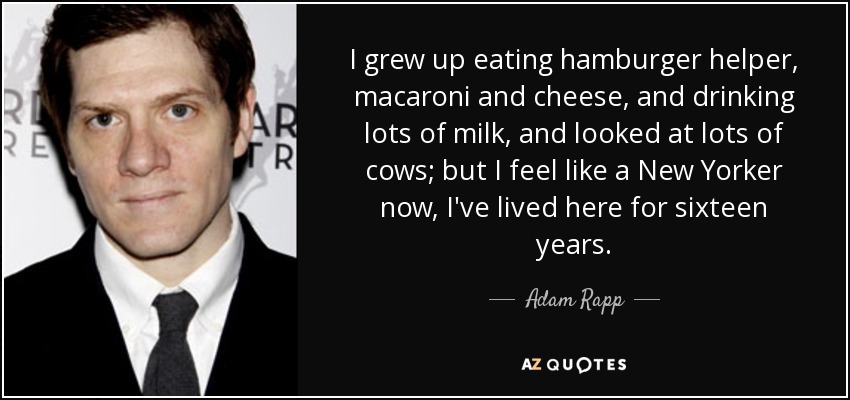
I grew up eating hamburger helper, macaroni and cheese, and drinking lots of milk, and looked at lots of cows; but I feel like a New Yorker now, I've lived here for sixteen years.
I hung out with some crazy desert people. One guy was just walking around with only shorts on - he'd been walking with bare feet for the last two years. He was totally scarred and eating on all fours like a dog.
[In Europe] they're really interested in you drinking their alcohol and eating their food and showing you around.
The idea of somebody being a fan of something I can totally understand. The idea of being followed around by cameras or people taking pictures of you eating a hamburger, I kind of have trouble even imaging it.
The purpose of the media is to make us all spectators, to watch. So that's why we have millions of fat children watching the games, eating and consuming and not playing themselves.
The beginning of mindful eating is the realization that eating meat is not about the meat-eater; it is about the animals who are tormented and killed.
And so in 1975, the grizzly bear was put on, as I said - on the endangered species list as threatened. And new measures were taken, for instance, bear-proofing garbage, creating new regulations to - essentially to try and keep people and people's food away from the bears, let the bears adjust to eating the abundant wild food that's available in Yellowstone and allow them to be more wild, to be independent of humans as sources of foods for the good of both sides. And that has been quite successful.
When virtuous mental attitudes, like mindfulness, respect, and compassion, are invoked to justify nonvirtuous acts like hunting, fishing, and eating animal products, the mental attitudes are insincere. They are self-deceptions that we create to justify habits that in our hearts we know are wrong, but to which we have become attached.
When we hunt or fish, we deliberately kill a defenseless being who wishes us no harm. This is a direct violation of the First Precept. It is absolutely forbidden to Buddhists. As to eating meat, we know that the only way we can obtain it is for an animal to be killed. Therefore, when we eat meat, it is our intent that an innocent animal should die to satisfy our addiction to flesh. And that underlying intention, no matter how well hidden behind a smokescreen of rationalizations will block the growth of compassion and create negative karma.
You deserve the place you have in this world. Do not let the eating disorder take that from you.
People who keep a large snake in their apartment building, which happens quite a bit, all of a sudden, within two summers, have a 14-foot animal that's eating adult rabbits, and needs quite a bit of room and quite a bit of heat. That's the animal that gets put in the back of a pick-up truck and dumped into the Florida Everglades or the city lake, or just left on a doorstep - again, it's quite often the animal that suffers.
When you go into a fast food restaurant, you may just think about how good your meal tastes while you're eating it. But you're not thinking about all the consequences that come from that one purchase - the consequences for your body, the consequences for supporting this company and how it's treating it workers, all the way back to the farm where the potatoes were grown, or the ranch where the cattle were raised.
We can have Americans eating affordably and eating in a way that's sustainable.
The current fast food that we have is inexpensive when you buy it, but the long-term costs of eating it and the long-term costs to society, are much too high. This cheap food, when you add up all the total costs, is much too expensive.
GMOs are found in nearly 80% of processed food in the United States. Currently, up to 92% of U.S. corn is consumed what are you eating GMO with zoe lister-jonesgenetically engineered, as are 94% of soybeans and 94% of cotton. In short, they are everywhere.
If you are what you eat, then I only want to eat the good stuff.
Eating healthy and keeping hydrated does wonders; it centers my mood and helps me keep a sharp mind.
Fur is a contentious issue. Meat is a contentious issue. GMOs are a contentious issue. I think this whole thing going on about whether or not products should be labeled if they have GMOs in them - I, as a consumer, would like to know if I'm eating GMO food. If I choose to buy it then it's my choice.
As humans, we do get to choose what we eat, and when we choose to eat a plant, we are eating (i.e., harming) just that plant, plus indirectly whatever nutrients that plant consumed over its lifetime (and we are also harming whatever beings may have been living on that plant or who were injured or killed in the harvesting process). But when we eat an animal, we are eating not just that animal, but also indirectly all of the plants and other beings that that animal ate over its lifetime - those plants became the flesh that we eat.
I've battled psoriasis; I've had an autoimmune disease since I was two. So I'm very vigilant about taking care of myself and eating right and what I put in my body. It's something that I had to be aware of since a young age. So health is a big deal.
If we want to consider the sanctity of life in deciding what to eat, the choice is clear. Eating a plant based diet causes less harm, to ourselves, to the other animals, to the planet.
We have been conditioned, taught, and coerced by the agents of our culture (parents, grandparents, advertisers, food critic, etc.) to eat the flesh and drink the milk of other animals. Because of this conditioning, which has occurred over a long period of time (thousands of years), we have developed addictive eating habits and blinded ourselves to the facts of our biological system and its true needs.
In fact, we would know ourselves that we are not meant to be meat eaters, and we would not have allowed ourselves to become conditioned to meat eating in the first place, if the effects of meat eating were felt right away. But since heart disease, cancer, diabetes, osteoporosis, etc. usually take many years to develop, we are able to separate them from their cause (or contributing factors) and go on happily eating an animal-based diet.
Human overconsumption is a greater problem than human population growth, and meat eating is a big part of that problem.
Lions and other carnivorous animals do a lot of things besides eat meat. They live outdoors, not in houses; they don't wear clothes or drive around in cars; they usually sleep for many hours after eating a meal. Why cite just one of the many things that they do and argue that we should imitate them? This doesn't make much sense.
Follow AzQuotes on Facebook, Twitter and Google+. Every day we present the best quotes! Improve yourself, find your inspiration, share with friends
or simply: