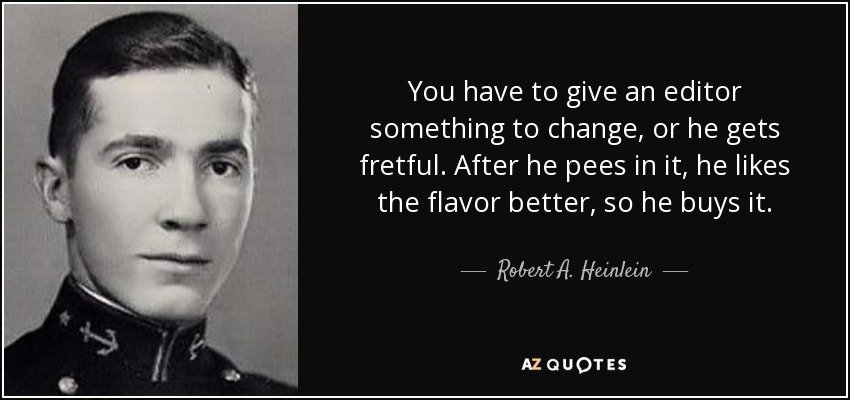
You have to give an editor something to change, or he gets fretful. After he pees in it, he likes the flavor better, so he buys it.
When I started out, people were afraid of parish priests. Now they're afraid of newspaper editors.
I never wanted to be an editor. I never wanted to be a boss. I just wanted to write, and it didn't make any difference whether it was fiction or nonfiction or short stories or whatever. I just - that's what I was destined to do.
There's a way of thinking that comes with being an editor that is incredibly useful on the set. It's not just a vocabulary thing or a right-to-left thing or script supervisor stuff. It's a way of thinking about the film and the shots and the way they fit together, what you need and what you don't need, and what you can get away with if you have to.
I think even if you're on a screen or you're in a play, it's always a group effort. It's not just the actors, it's the editor.
In the mid-2000s, I kind of accidentally became a music editor.
Calling EMACS an editor is like calling the Earth a hunk of dirt.
I depend on good editors and a good director.
I used to sit in the studio with a copy of the (Saturday Evening) Post laid across my knees ... And then I'd conjure up a picture of myself as a famous illustrator and gloat over it, putting myself in various happy situations, surrounded by admiring females, deferred to by office flunkies at the magazines, wined and dined by the editor.
I had published a co-edited book with Oxford a decade ago, my first book actually. Years later I found myself having lunch with Lori Stone, who was an editor at Oxford at that time. We connected at a conference and over the course of lunch she told me about a wonderful new series she had just developed called Understanding Research.
If publishers and editors exert themselves to keep certain topics out of print, it is not because they are frightened of prosecution but because they are frightened of public opinion. In this country intellectual cowardice is the worst enemy a writer or journalist has to face, and that fact does not seem to me to have had the discussion it deserves.
As a cartoonist I do what I find funny. As an editor I have a broader approach realizing that humor is inherently subjective and I don't want my preferences to rule out what others might like.
This impressed me when I was the editor of the Sunday Times [of London] - we had the "Bloody Sunday" killings of 13 unarmed civilians by British paratroopers. We interviewed 500 people for our report, and not one of them could give us a total picture of what was happening. It was like the Rashomon effect multiplied a million times. For a website or even a newspaper to be a collector of information flow is not the highest form of journalism.
It's a fascinating time, I think. I do believe that with all the qualifications I've said - [such as] the uncertain accuracy of the web - nonetheless the access to speeches, documents is unparalleled with the ease of gathering information. If I had had that access when I was an editor or coming up, it would have made my life so much easier. As it was, everything took so much longer.
My first teacher was Steven Spielberg. I worked on Amazing Stories. That was my first job, as a writer and as a story editor. Watching him and his command of the tools of filmmaking, and his admiration for writing and the story itself, was the greatest lesson I ever had.
That's absolutely true, but one problem with the digital revolution, which may tie into what I said earlier, is that there can be a collapse of quality. You may not have liked the decisions made by publishers in the past, you may not have liked the decisions made by magazine editors or newspaper editors in the past. At least there was some quality control
I feel like fashion was much more exclusive. There weren't as many parties. There weren't as many social gatherings. It wasn't required that designers have events to lure customers or editors or any of that - it was about a show. If there was a dinner or a party, people would go out after. New York nightlife was about late nights and dancing.
For example, instead of being asked to write an article, suddenly editors wanted me to make super-short videos. The assumptions of those video gigs was that kids don't read as much news and basically need to be read to, which I found really problematic and kind of insulting. I thought, Isn't it just that you don't have any money and that's why you want me to make some crappy "content" for your website?
I met [my editor] in a bar where alcoholic beverages are served and I bought her one and I told her the idea. And she said that she liked it very much, which embarrassed me because I thought it meant that she was a lightweight and that in the morning, as so many women say to so many men, what seems like a good idea, you know, turns out not to be.
That's what I try to do as a writer and as the editor of HuffPost: cover important stories in an obsessive way that enables them to break through the din of our multimedia universe.
Nothing's harder than writing. There's no comparison. With directing, you can bounce a lot of ideas around. There's tremendous support - you've got editors and sound mixers. With writing, it's all you, and it's just crippling when people tear up your pages.
Procrustes was an editor.
Every newspaper editor says the heart of the paper is the reporter - which is true - except for the pay!
The true Church of England, at this moment, lies in the Editors of the newspapers.
Our editor came to work today in a vibrant pink shirt. Vibrant. Several members of staff have had to go home sick.
Follow AzQuotes on Facebook, Twitter and Google+. Every day we present the best quotes! Improve yourself, find your inspiration, share with friends
or simply: