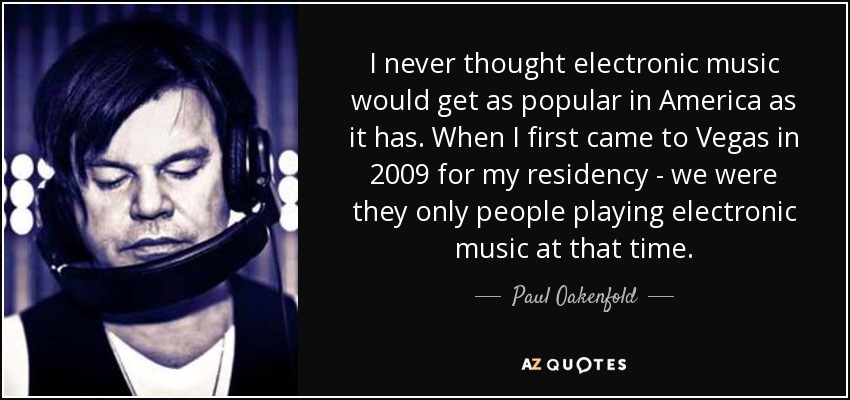
I never thought electronic music would get as popular in America as it has. When I first came to Vegas in 2009 for my residency - we were they only people playing electronic music at that time.
It's good to see that America has a hub for electronic music in Vegas, like Europe has with Ibiza.
In my teenage years I was as addicted to great pop as I was to free jazz, electronic music, and hardcore blues.
If people like electronic music, then great - let that be the next thing. I don't think I ever really will, but there's plenty of records for me to go buy.
I love collecting; my joy is finding private press American or European home studio electronic music from the 60s and 70s.
I had invented my own system, my own way of making electronic music at the San Francisco Tape Music Centre, and I was using what is now referred to as a classical electronic music studio, consisting of tube oscillators and patch bays. There were no mixers or synthesizers. So I managed to figure out how to make the oscillators sing. I used a tape delay system using two tape recorders and stringing the tape between the two tape machines and being able to configure the tracks coming back in different ways.
First of all I had to teach myself how to use the studio because there wasn't any classes in electronic music. So I'd stay there all night and leave in the morning, observe the sun rise and have a lot of different kinds of sounds in my mind. But it was a quest, it was a search. It was research, it was learning.
Composers are influenced by all the important music in their lives - and I suppose that since radio started playing popular music, that's as likely to be The Beatles or Aphex Twin as it is to be Verdi or Ravel. They'd be strange teenagers if they didn't. But cross-pollinating happens too - Aphex Twin did more interesting things with electronic music than most trained composers, who seemed to approach samplers with undue caution and reverence in those early days.
If anything I think we connect to what our parents were listening to when they were our age. I'm listening to a lot of classical and electronic music, like Aphex Twin, non-vocal music.
Electronic music is so weird because trends change so fast.
I do it live on tape with a band. It's not like I'm doing electronic music with a laptop.
Nowadays, especially when you think of electronic music, it's like, the producer is mostly the one who makes the music or the beats and everything. But I am more, since I'm that old, when I started to make music the producer was just sitting in the back shouting and drinking beer.
People call me a bedroom electronic musician, which I suppose I am. But I hate most electronic music; I find it really boring.
We have always been thinking about different ways to perform electronic music, i.e. music made with machines.
I'm a real big electronic music nut; when I was young I listened to musique concrète, German music from Cologne in the early 50s, all kinds of stuff.
My big problem is that I don't promote my electronic music very much because it makes my 'normal' fans angry!
In the '60s my friends were interested and we were hearing electronic music coming in on community radio from Europe, so that's where it started. And I had a tape recorder and started making things with it.
My start came with experimental musicians and live bands. I never played with DJ's because it wasn't really the correct fit. It fit in more with someone using a laptop to create their own electronic music. When you're doing music like that, it's hard to get more than 20 people to come to your show.
I grew up with classical music, and to a lesser extent electronic music, and that's where I belong, so to speak.
I am definitely pro-European, even pro-global, and house music and electronic music has developed a network all over the world, between record shops in Berlin, Tokyo, London, Chicago, Minneapolis and L.A. That's really what I feel part of, rather than being French.
I'm definitely not a laptop/midi/abelton guy. But there is a lot of music I like. I really like Bach organ music. I really like Chopin piano music. I really like Wendy Carlo's electronic music. I really like Miles Davis and John Mclaughlin jazz style. So I'm not only an old-school rocker, but I have to admit that I'm going to be listening to The Doors, Rolling Stones, Iggy Pop, David Bowie and Bob Dylan many times a week.
What I find the challenge is with working with, say, digital machines - performing electronic music - is that when we play instruments there's a physical act that results in a physical vibration. There's a mapping between our exertions and resultant vibrations, or resonance.
With electronic music it's often a little more hidden - the relationship between gesture and sound - which makes it confounding for audiences. But the ingredients of electronic music are the same ingredients of nonelectronic music.
I think for a classical musician the goal is the same as an electronic musician. A very good professional classical musician must not think about technique.
People always focus on people like me who use synthesizers, right, which are explicitly electronic and therefore obvious. "Ah, yes, that's electronic music." But they don't realize that so is the concept of actually taking a piece of extant music and literally re-collaging it, taking chunks out and changing the dynamics radically and creating new rhythmic structures with echo and all that. That's real electronic music, as far as I'm concerned.
Follow AzQuotes on Facebook, Twitter and Google+. Every day we present the best quotes! Improve yourself, find your inspiration, share with friends
or simply: