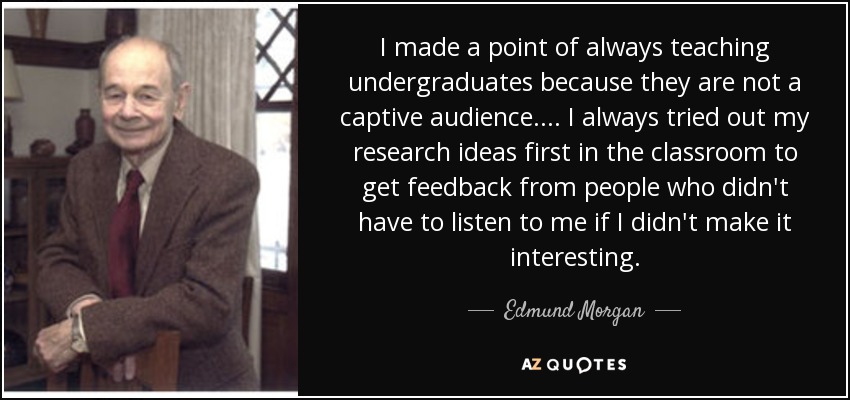
I made a point of always teaching undergraduates because they are not a captive audience. . . . I always tried out my research ideas first in the classroom to get feedback from people who didn't have to listen to me if I didn't make it interesting.
The feedback women are getting at work is amazingly ineffective or vague. You need to signal to your boss or senior colleagues that you want honest feedback, and that you promise not to take it too personally.
When you're playing live, those people who you're trying to please and reach, they're right there giving you feedback. And you don't get that feedback in the studio.
Basically you're doing the best you possibly could do and until it's out there and until people are hearing good feedback, I guess that's how you know you've done something good. We're so close to it that it's hard to look outside because we're inside of it, so it's really nice when you hear good feedback on the outside.
I wasn't able to articulate it until after audience members gave feedback. And then, similarly, when we talked about the bromance being unique, I don't think Mark, Jay, and I really saw how special that aspect of that bromance was until our audience members sort of gave us feedback and let us know, "Hey, we've never seen a bromance like this before on television."
It was dope to the point where I felt like Common almost admired me as much as I admired him. He took us to the hotel, and then he was going through his phone, rapping his raps to me. I was like, Is Common rapping to me right now, trying to get my feedback?
You might want to keep trying to rise, using a path that builds on your natural strengths: sales, analysis, managing people, whatever, and keep asking for honest feedback. When you reach the point at which it feels clear you've topped out, revise your job description or take a step back. Up is not the only way.
We did monologues and scenes, and New York I did a scene from Amadeus and a monologue from Pounding Nails in the Floor With My Forehead by Eric Bogosian, and then in L.A. I switched the scene to This is Our Youth and did the same monologue. I was spiky-haired, super skinny. A lot of people were like, "You should come here and do a sitcom." That was the feedback that I got. Obviously it was quite a different journey than the one I've actually had, but I just listened to people.
Listen carefully to the feedback your readers give you. Dont write unless people want you to write, a lot of people write just because they want to write.
If you get a lot of good feedback from people, thats a sign that you have a strength or gift in writing, if not ... try singing.
I don't think it was much of a forum for positive or negative feedback; it was mainly, "How can I make somebody laugh?" It wasn't a serious thing where I needed people to give me feedback.
I think when I dropped The Eulogy is when it became more [about] feedback because that's when Pitchfork wanted to review it and things like that.
The show [ Too Much Tuna] changed a lot, actually, which is risky when you get positive critical feedback.
You'd think people would realize they're bad at multitasking and would quit. But a cognitive illusion sets in, fueled in part by a dopamine-adrenaline feedback loop, in which multitaskers think they are doing great.
About the only time our gut can truly outperform our reason is if we truly have developed a kind of informed intuition. So that means the chess master or someone who has really thought about it and given themselves feedback on a particular activity for at least 10,000 hours or more.
I could hunker down by myself and listen closely to mixes, but then to be able to have a sounding board of peers to get advice and feedback.
Great performers in all fields seem immune to what outsiders think about them. Their sense of themselves never depends on the feedback-positive or negative-they get from the environment.
The only two people who can give you real feedback about your product are people who just purchased it and people who have just canceled.
I get hundreds of emails daily and a lot of feedback from people that are reading or have read my books. When I'm writing, or in my daily life, I just think of the work. I love to tell a story, but I might work with a story to make it the best I can without thinking of how many people will read it or if it will influence anybody.
During my school visits, I really enjoy the feedback I get from them much more than anything I might tell say to them.
[Hunt for the Wilderpeople] people seem to be just finding it hilarious in Sundance. I would think that judging on the feedback I get; it's a very warming film. It's not sentimental, but people are sort of heart warmed by a message that's pretty rare.
Guitar players get inward and analytical about their playing but when you start to get positive feedback from other players it makes you think that it is coming together.
It's always nice to get good feedback, and a bit of encouragement can go a long way.
Fan feedback going from a box of letters once every few months to literally tweeting while the show is airing. We are able to get a much quicker response to the choices we're making as storytellers.
There are only a few genres, horror and comedy, where you can get that immediate feedback from the audience. It's very gratifying when that's what you're going for, and you can hear the reactions in all the places that you intended.
Follow AzQuotes on Facebook, Twitter and Google+. Every day we present the best quotes! Improve yourself, find your inspiration, share with friends
or simply: