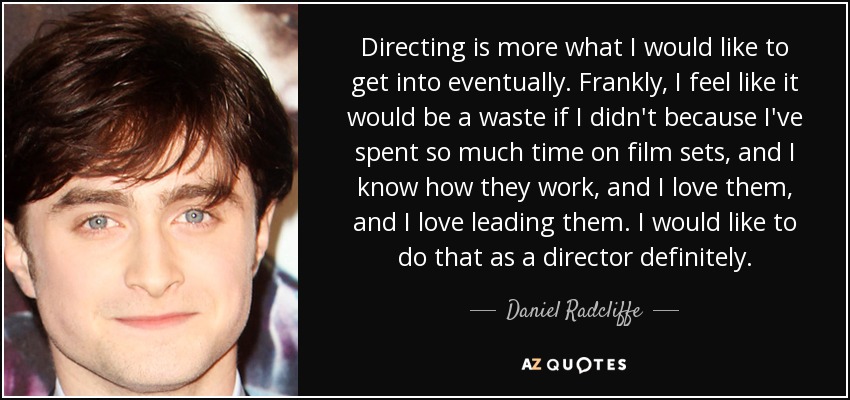
Directing is more what I would like to get into eventually. Frankly, I feel like it would be a waste if I didn't because I've spent so much time on film sets, and I know how they work, and I love them, and I love leading them. I would like to do that as a director definitely.
I've always wanted to act and I grew up a little on film sets when my dad was working as an actor.
I've always been fascinated by Elizabeth Taylor, and I had read that her first kiss happened on a film set, which actually made me a little sad. You need to have normal experiences of your own.
You really just have to love the process. I can't tell you the amount of film sets I've been on where people are talking about Oscars in the middle of the production. It happens all the time.
I am not a master-class director. I am not a teacher. I am a coach. I dont have a methodology. Each actor is different. And on the film set, you have to be next to them all.
A film set is really delicate and people treat you very very well if you're an actor because they want you to be as comfortable as possible for you to do your work, but it really is just one in a team of many and usually 150 people.
A lot of actors on film sets... very often they're not paying attention to the physical world around them. I think through studying art, I've always had that awareness and that's something that I've wanted to bring in to go beyond acting... As a form of expression, they are intrinsically linked.
The movie, like the book before it, is an expertly built machine for the mass production of tears. Directed by Josh Boone 'Stuck in Love', with scrupulous respect for John Green's best-selling young-adult novel, the film sets out to make you weep - not just sniffle or choke up a little, but sob until your nose runs and your face turns blotchy. It succeeds.
Venice never quite seems real, but rather an ornate film set suspended on the water.
I meditated before I hosted the Oscars, I meditate before I go on stage, I meditate in the morning and lunchtime when I'm on a film set.
I think a film set is a quite controlled environment and you feel like you can trust them and it is going to be a safe place to work, but I really don't think about it.
I didn't start out thinking that I could ever make films. I started out being a film lover, loving films, and wanting to have a job that put me close to them and close to filmmakers and close to film sets.
I don't feel isolated on a film set. In a way you do because you don't really mix with the outside world; you're just sort of working non-stop for a few months, but you've got so many people around you.
They're such hierarchical things, film sets, they're sort of mini societies. Often they're incredibly political places.
I realize I have a lot of amazing opportunities, but I don't know how you can play a human being going through real human experiences without being able to walk down the street. If you can't live a real life, how do you play a real person? It always confuses me when actors work back-to-back-to-back with no break. If you live your life on a film set, how the hell can you relate to real people? You don't know what its like to not have people fussing over you all day, and that's not life - that's silly movies. I will always want to take breaks and I wouldn't be OK with losing that.
I've been on lots of film sets. I've produced films and written films and been around, so it wasn't my first rodeo in terms of that stuff. Nothing particularly surprised me, I have to say. I came in and I enjoyed the first day and I enjoyed the last day.
I like stand-up. But I'd also like a family and house and a yard. I want to work with a lot of people, have colleagues; and on good film sets, there's people there that work with the same people for years and years. I love that collaborative spirit in that medium. Comedy is a lot more solitary.
Mike Leigh taught me about making choices - as an actor, you choose between being honest and clever, and with Mike, it's always about being honest. I learned how to behave on a film set from Jim Broadbent. He was a great example of someone with a fantastic career who kept his feet on the ground.
In terms of drama school, what that will give you that you won't necessarily learn on a film set is the technical ability - ie, projecting your voice and stage craft.
When you get to really involve yourself with a piece [script] and the other people and you get to feel like it's a community and you're all building something together, it helps me to produce better work, I think. And there's an exhaustion that happens on a film set - an exhaustion that translates into a relaxation and helps me to live in the moment, in the performance I'm giving and what's happening around me.
If you make a film set in London or in Pakistan or wherever, the thing that interests me is the relationships between individuals - individuals and society, individuals and their family, their girlfriend or boyfriend, it's all the same idea.
I love film sets, but I don't necessarily love being the center of attention.
It was very much about performances, the whole ensemble thing was just great - everybody working together. Sometimes it didn't feel like a film set. It wasn't technically driven, it was very, very enjoyable
The first time I ever thought about doing a film seriously, I was in London. I was about 17 years old. I was just standing in the street, a bit dazzled by an Antonioni bus wipe, which by the way are inherent in London, and I imagined a film set in London starting out with the riff from The Yardbird's "Heart Full of Soul", and now, how ever many years later, I've done it.
I remember being on Atonement and it felt very right to be there. There was so much excitement every day. I remember very vividly how it felt to be a child on a film set, and that is actually really important to hold on to for as long as you continue to make films.
Follow AzQuotes on Facebook, Twitter and Google+. Every day we present the best quotes! Improve yourself, find your inspiration, share with friends
or simply: